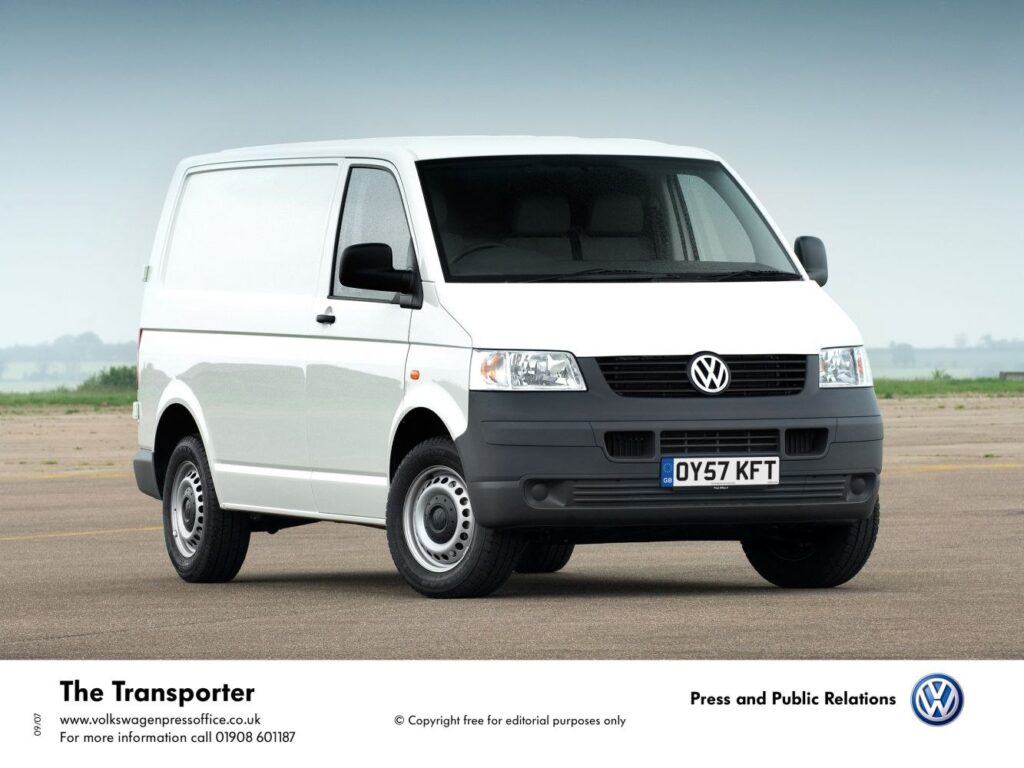
The Volkswagen Transporter (T5) Panel Van represents the fifth generation of Volkswagen’s highly successful and enduring Transporter series, a lineage tracing its roots back to the iconic Type 2 “Bus.” Produced between 2003 and 2006 for this specific powertrain variant, the T5 generation continued the Transporter’s legacy as a versatile, robust, and refined light commercial vehicle. While not directly sold in the United States, where larger, body-on-frame vans historically dominated the commercial sector, the Transporter T5 was a cornerstone of the European, Asian, and other international markets. It was lauded for its car-like driving dynamics, impressive build quality, and a diverse range of configurations, making it an indispensable tool for businesses and tradespeople across the globe. This particular variant, the 2.5 TDI with 174 horsepower and a Tiptronic automatic transmission in the L2H1 (long wheelbase, standard height) configuration, stood out as a premium offering, blending strong performance with enhanced comfort and practicality.
Volkswagen Transporter (T5) Panel Van: A European Workhorse
The Volkswagen Transporter T5, launched in 2003, represented a significant evolution in the Transporter line. It moved away from the more utilitarian focus of earlier generations, incorporating more passenger car-derived features and technologies. This shift aimed to appeal to a broader customer base, including those who required a commercial vehicle but also valued comfort and refinement. The T5 was available in a wide array of body styles, including panel vans, kombis (passenger/cargo), and even specialized conversions for camper vans and mobile workshops. The L2H1 configuration, denoting a long wheelbase and standard roof height, offered a practical balance between cargo capacity and maneuverability, making it a popular choice for businesses needing substantial load space without the bulk of a larger van.
Engine & Performance
Powering the Volkswagen Transporter (T5) Panel Van is a 2.5-liter TDI (Turbocharged Direct Injection) diesel engine, a five-cylinder inline unit engineered for both power and efficiency. This robust powerplant, designated by the engine code EA153 / AXE, generated a substantial 174 horsepower at 3500 revolutions per minute (rpm), making it one of the most potent options in the T5 lineup during its production run. Torque delivery was equally impressive, peaking at a hefty 295.02 lb.-ft. across a broad range from 2000 to 2300 rpm. This low-end torque was crucial for a commercial vehicle, providing excellent pulling power for heavy loads and challenging terrain.
The engine’s architecture featured an inline five-cylinder configuration, a design choice that provided a good balance of smoothness and packaging efficiency. With a displacement of 2460 cubic centimeters (150.12 cu. in.) and two valves per cylinder (SOHC valvetrain), it utilized a sophisticated pump-nozzle (unit injector) fuel injection system, characteristic of Volkswagen’s diesel technology of the era. This system, combined with a turbocharger and intercooler, ensured optimal fuel atomization and air charge density, contributing to both its power output and fuel economy. Power was channeled to the front wheels via a 6-speed Tiptronic automatic transmission. This advanced gearbox for its time offered the convenience of an automatic with the option for manual gear selection, allowing drivers to optimize power delivery for specific driving conditions, such as towing or navigating hilly terrain. The combination of the potent TDI engine and the Tiptronic transmission enabled the Transporter to achieve a 0-60 mph acceleration time of 11.7 seconds, a respectable figure for a panel van, and a top speed of 113.71 mph. Despite its strong performance, the 2.5 TDI engine also demonstrated commendable fuel efficiency for its class, with an extra-urban consumption rating of 36.2 US mpg. This was a significant selling point in markets where fuel costs were a major operational expense for businesses. The vehicle met the Euro 3 emission standard, reflecting its compliance with environmental regulations prevalent at the start of the 21st century. Its weight-to-power ratio of 10.9 kg/Hp (91.3 Hp/tonne) and weight-to-torque ratio of 4.8 kg/Nm (210 Nm/tonne) underscored its well-engineered balance between payload capacity and dynamic capability.
Design & Features
The Volkswagen Transporter (T5) Panel Van was designed first and foremost for utility and durability, yet it incorporated a level of refinement uncommon in its segment. As a panel van, its primary purpose was the transportation of goods, reflected in its spacious cargo area and robust construction. This particular variant, designated L2H1, indicated a long wheelbase (3400 mm or 133.86 inches) and standard roof height (1959 mm or 77.13 inches), providing an optimal balance between maneuverability and significant cargo volume. The exterior design of the T5 was characterized by clean lines and a functional aesthetic, a hallmark of Volkswagen’s design philosophy. Its overall length of 208.27 inches (5290 mm) and width of 74.96 inches (1904 mm, or 88.27 inches including mirrors) ensured a substantial road presence. The body offered 4-5 doors, typically comprising front cabin doors, one or two sliding side doors for cargo access, and rear barn doors or a tailgate. The cabin was designed to accommodate 2-3 occupants, with comfortable seating and an ergonomic layout for long working days.
Cargo capacity was a standout feature, with a maximum trunk space of 6700 liters (236.61 cu. ft.), allowing for the transport of substantial volumes of goods. The van also boasted an impressive maximum payload capacity ranging from 1895.98 to 1973.14 lbs., catering to a wide array of commercial needs. Furthermore, its towing capabilities were robust, with a permitted trailer load of 5511.56 lbs. (with brakes), making it suitable for hauling trailers or equipment. Underneath, the T5 featured an independent suspension system both front and rear, a sophisticated setup for a commercial vehicle of its time. The front utilized McPherson struts with coil springs and an anti-roll bar, while the rear employed independent coil springs, a transverse stabilizer, and trailing arms. This configuration contributed to the Transporter’s renowned car-like ride comfort and handling, reducing driver fatigue on long journeys and enhancing stability with heavy loads. Braking was handled by ventilated discs on all four wheels (308×29.5 mm front, 294×22 mm rear), complemented by an Anti-lock Braking System (ABS) for enhanced safety and control during emergency stops. Hydraulic rack and pinion steering provided precise and responsive handling, further contributing to its ease of driving. The vehicle rode on 215/65 R16 tires mounted on 6.5J x 16 wheel rims.
Technical Specifications
| Category | Specification |
| General Information | |
| Brand | Volkswagen |
| Model | Transporter |
| Generation | Transporter (T5) Panel Van |
| Type (Engine) | 2.5 TDI (174 Hp) Tiptronic L2H1 |
| Production Start | 2003 year |
| Production End | 2006 year |
| Powertrain Architecture | Internal Combustion engine |
| Body type | Van |
| Seats | 2-3 |
| Doors | 4-5 |
| Performance Specs | |
| Fuel consumption (extra urban) | 6.5 l/100 km (36.2 US mpg) |
| Fuel Type | Diesel |
| Acceleration 0 – 60 mph | 11.7 sec |
| Maximum speed | 183 km/h (113.71 mph) |
| Emission standard | Euro 3 |
| Weight-to-power ratio | 10.9 kg/Hp (91.3 Hp/tonne) |
| Weight-to-torque ratio | 4.8 kg/Nm (210 Nm/tonne) |
| Engine Specs | |
| Power | 174 Hp @ 3500 rpm |
| Power per liter | 70.7 Hp/l |
| Torque | 400 Nm @ 2000-2300 rpm (295.02 lb.-ft. @ 2000-2300 rpm) |
| Engine layout | Front, Transverse |
| Engine Model/Code | EA153 / AXE |
| Engine displacement | 2460 cm3 (2.46 liters / 150.12 cu. in.) |
| Number of cylinders | 5 |
| Engine configuration | Inline |
| Cylinder Bore | 81 mm (3.19 in.) |
| Piston Stroke | 95.5 mm (3.76 in.) |
| Compression ratio | 18.5:1 |
| Number of valves per cylinder | 2 |
| Fuel injection system | Pump-nozzle (Unit Injector) |
| Engine aspiration | Turbocharger, Intercooler |
| Valvetrain | SOHC |
| Engine oil capacity | 7.4 l (7.82 US qt) |
| Coolant | 7.1 l (7.5 US qt) |
| Space, Volume and Weights | |
| Kerb Weight | 1905-2140 kg (4199.81 – 4717.89 lbs.) |
| Max. weight | 2800-3000 kg (6172.94 – 6613.87 lbs.) |
| Max load | 860-895 kg (1895.98 – 1973.14 lbs.) |
| Trunk (boot) space – maximum | 6700 l (236.61 cu. ft.) |
| Fuel tank capacity | 80 l (21.13 US gal) |
| Max. roof load | 100 kg (220.46 lbs.) |
| Permitted trailer load with brakes (8%) | 2500 kg (5511.56 lbs.) |
| Permitted trailer load with brakes (12%) | 2500 kg (5511.56 lbs.) |
| Permitted trailer load without brakes | 750 kg (1653.47 lbs.) |
| Permitted towbar download | 100 kg (220.46 lbs.) |
| Dimensions | |
| Length | 5290 mm (208.27 in.) |
| Width | 1904 mm (74.96 in.) |
| Width including mirrors | 2242 mm (88.27 in.) |
| Height | 1959 mm (77.13 in.) |
| Wheelbase | 3400 mm (133.86 in.) |
| Front track | 1628 mm (64.09 in.) |
| Rear (Back) track | 1628 mm (64.09 in.) |
| Front overhang | 894 mm (35.2 in.) |
| Rear overhang | 996 mm (39.21 in.) |
| Ride height (ground clearance) | 165 mm (6.5 in.) |
| Minimum turning circle (turning diameter) | 13.2 m (43.31 ft.) |
| Approach angle | 22° |
| Departure angle | 16° |
| Wading depth | 300 mm (11.81 in.) |
| Drivetrain, Brakes and Suspension Specs | |
| Drivetrain Architecture | The Internal combustion engine (ICE) drives the front wheels of the vehicle. |
| Drive wheel | Front wheel drive |
| Number of gears and type of gearbox | 6 gears, automatic transmission Tiptronic |
| Front suspension | Independent, type McPherson with coil spring and anti-roll bar |
| Rear suspension | Independent coil spring, Transverse stabilizer, Trailing arm |
| Front brakes | Ventilated discs, 308×29.5 mm |
| Rear brakes | Ventilated discs, 294×22 mm |
| Assisting systems | ABS (Anti-lock braking system) |
| Steering type | Steering rack and pinion |
| Power steering | Hydraulic Steering |
| Tires size | 215/65 R16 |
| Wheel rims size | 6.5J x 16 |
Legacy & Market Impact: The Enduring Influence of the Volkswagen Transporter (T5)
The Volkswagen Transporter T5, and particularly its Panel Van variants like the 2.5 TDI (174 Hp) Tiptronic L2H1, carved out a significant legacy as a benchmark in the light commercial vehicle segment. Its production from 2003 to 2006 for this specific powertrain was part of a broader T5 generation that spanned over a decade, cementing its reputation as a reliable, durable, and highly versatile workhorse. In its primary markets, which predominantly included Europe, the UK, Australia, and parts of Asia, the T5 was a dominant force. It competed fiercely against rivals such as the Ford Transit, Mercedes-Benz Vito, Renault Trafic, Opel/Vauxhall Vivaro, and various offerings from Fiat, Citroën, and Peugeot. What set the Transporter apart was its unique blend of passenger car-like refinement and robust commercial capability. While competitors often prioritized sheer ruggedness or low cost, Volkswagen managed to infuse the T5 with a level of driving comfort, interior quality, and sophisticated engineering that resonated with owner-operators and fleet managers alike. The optional Tiptronic automatic transmission and the powerful 2.5 TDI engine further enhanced its appeal, offering a premium driving experience not always associated with commercial vans.
The T5’s impact was multifaceted. For small businesses, it provided a dependable and efficient means of transport, capable of handling diverse tasks from package delivery to specialized trade work. Its various body configurations, including the L2H1 long wheelbase panel van, allowed for extensive customization and adaptation to specific industry needs. The strong diesel powertrains, like the 174 HP 2.5 TDI, offered impressive fuel economy for their performance, a critical factor in a commercial vehicle’s total cost of ownership. Historically, the Transporter series has been a cornerstone of Volkswagen’s commercial vehicle division, evolving from the iconic Type 2 “Bus” into increasingly sophisticated and capable generations. The T5 continued this evolution, introducing more advanced safety features for its time (like ABS as standard), improved ergonomics, and a more aerodynamic design than its T4 predecessor. Its independent suspension setup, a rarity among many traditional vans, contributed significantly to its superior ride and handling characteristics, making it less fatiguing for drivers on long routes. Despite its significant success globally, the Volkswagen Transporter T5 was never officially imported into the United States market. The US commercial van segment during this period was largely dominated by larger, truck-based full-size vans such as the Ford E-Series and Chevrolet Express, alongside smaller minivans that served a different purpose. Volkswagen’s previous attempts with smaller commercial vehicles in the US had limited success, and the brand opted to focus its US lineup on passenger cars and SUVs. However, its influence on global automotive design and commercial vehicle standards is undeniable. The T5 remains a highly sought-after used vehicle in its primary markets, a testament to its enduring quality, versatility, and the strong brand reputation of the Volkswagen Transporter line. Its legacy continues to shape the expectations for modern light commercial vehicles, proving that a work vehicle can also be refined, comfortable, and a pleasure to drive.