
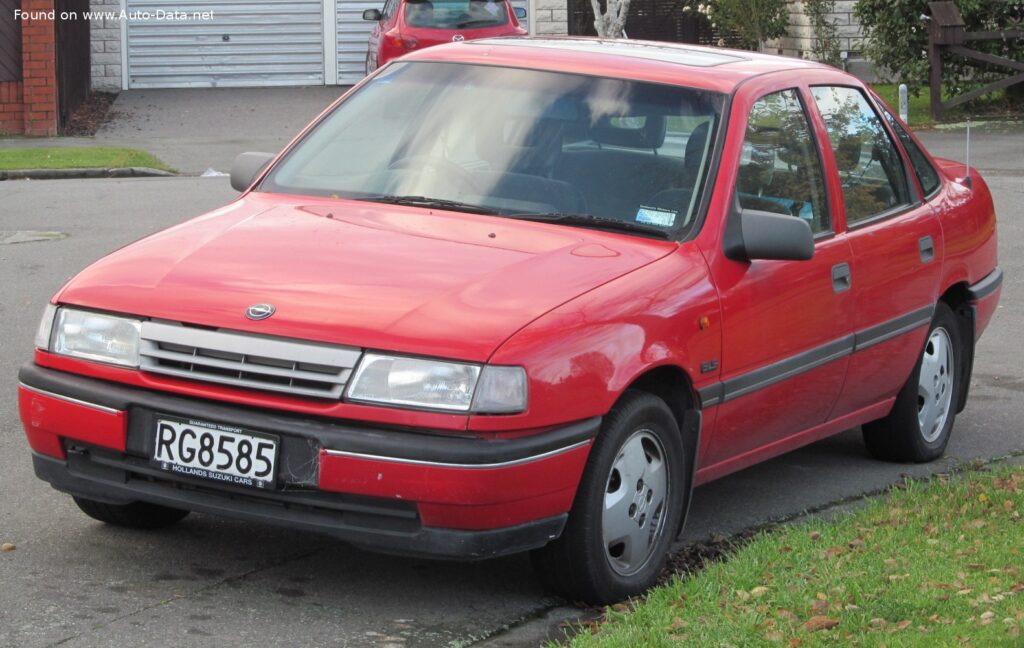
The Opel Vectra A 1.4 (75 Hp) represents a significant chapter in the history of European family cars. Launched in 1988, the first-generation Opel Vectra, known internally as the Vectra A, was a pivotal model for the German automaker, replacing the long-running Ascona. Positioned in the highly competitive D-segment (mid-size family car segment) in Europe, the Vectra A introduced a more modern, aerodynamic design and a front-wheel-drive platform that set new standards for its class. The 1.4-liter variant, with its 75 horsepower engine, served as an economical entry point into the Vectra lineup, offering practicality and efficiency for families and fleet buyers across the continent. While never officially sold in the United States under the Opel brand, the Vectra A, and its British counterpart, the Vauxhall Cavalier, were ubiquitous sights on European roads, embodying the pragmatic and robust engineering characteristic of Opel during this era. Its development focused on improved aerodynamics, enhanced safety features for its time, and a more refined driving experience compared to its predecessor.
Engine & Performance of the Opel Vectra A 1.4 (75 Hp)
Powering the entry-level Opel Vectra A was the 14NV engine, a naturally aspirated 1.4-liter (1389 cm³) inline-four cylinder unit. This powertrain was designed with reliability and fuel efficiency in mind, rather than outright performance. It featured a single overhead camshaft (OHC) valvetrain with two valves per cylinder, a common and robust configuration for the late 1980s. Fuel delivery was managed by a carburetor system, which was standard for many mainstream vehicles of this period, prior to the widespread adoption of electronic fuel injection.
The engine produced a modest but adequate 75 horsepower at 5600 revolutions per minute (rpm) and generated 79.66 pound-feet (108 Nm) of torque at a relatively low 3000 rpm. This torque delivery profile ensured decent responsiveness for urban driving and everyday commutes, making the car feel less strained in typical traffic conditions. The engine was mounted transversely at the front, driving the front wheels through a five-speed manual transmission, a setup that maximized interior space and offered predictable handling characteristics.
In terms of performance, the Vectra A 1.4 was not built for speed. It accelerated from 0 to 60 miles per hour in 13.8 seconds, with a top speed of approximately 109.36 mph (176 km/h). These figures were competitive for an economy-focused family sedan of its time. Fuel economy was a strong point for this variant, with a combined rating of 37.3 US miles per gallon (6.3 liters per 100 km). Urban driving yielded around 25.6 US mpg (9.2 l/100 km), while extra-urban conditions saw a remarkable 47 US mpg (5 l/100 km), highlighting its efficiency on longer journeys. The 1.4-liter engine, while basic, was a workhorse that proved to be a durable and cost-effective choice for millions of European motorists.
Design & Features of the Opel Vectra A
The Opel Vectra A marked a significant styling departure from its predecessor, the Ascona. Its design language was characterized by smooth, rounded lines and an aerodynamic profile, which contributed to both its modern appearance and improved fuel efficiency. The specific variant discussed here is a 4-door sedan, a popular body style for family cars in Europe. It offered seating for five occupants, with a focus on interior comfort and practicality.
Measuring 174.49 inches (4432 mm) in length, 67.17 inches (1706 mm) in width, and 55.12 inches (1400 mm) in height, the Vectra A provided a substantial footprint for its class. Its 102.36-inch (2600 mm) wheelbase contributed to a stable ride and generous interior room. A key highlight of the Vectra A’s design was its impressive trunk capacity, ranging from 18.72 cubic feet (530 liters) to a cavernous 29.66 cubic feet (840 liters) with the rear seats folded down (or loaded to the roofline in a sedan, though the higher figure usually refers to hatchback variants or a very generous interpretation of sedan capacity). This made it an exceptionally practical vehicle for family vacations and hauling cargo.
In terms of features for its era, the Vectra A was relatively well-equipped. For a car launched in 1988, the availability of an Anti-lock Braking System (ABS) as an assisting system was a notable safety feature, often optional but indicative of Opel’s commitment to modern automotive technology. The suspension system comprised coil springs at both the front and rear, providing a comfortable and compliant ride. Braking was handled by disc brakes at the front and drum brakes at the rear, a common and effective setup for vehicles of its class and performance level. The car rode on 175/70 R14 tires, fitted to 14-inch wheel rims, providing a good balance between ride comfort and handling. The interior, while not luxurious in the 1.4-liter variant, was ergonomically designed, featuring durable materials and straightforward controls, reflecting its role as a dependable everyday vehicle.
Technical Specifications: Opel Vectra A 1.4 (75 Hp)
| General Information | |
| Brand | Opel |
| Model | Vectra |
| Generation | Vectra A |
| Type (Engine) | 1.4 (75 Hp) |
| Production Start | 1988 year |
| Production End | 1992 year |
| Powertrain Architecture | Internal Combustion engine |
| Body type | Sedan |
| Seats | 5 |
| Doors | 4 |
| Performance Specs | |
| Fuel consumption (urban) | 9.2 l/100 km (25.6 US mpg) |
| Fuel consumption (extra urban) | 5 l/100 km (47 US mpg) |
| Fuel consumption (combined) | 6.3 l/100 km (37.3 US mpg) |
| Fuel Type | Petrol (Gasoline) |
| Acceleration 0 – 60 mph | 13.8 sec |
| Acceleration 0 – 100 km/h | 14.5 sec |
| Maximum speed | 109.36 mph (176 km/h) |
| Weight-to-power ratio | 13.2 kg/Hp (75.8 Hp/tonne) |
| Weight-to-torque ratio | 9.2 kg/Nm (109.1 Nm/tonne) |
| Engine Specs | |
| Power | 75 Hp @ 5600 rpm |
| Power per liter | 54 Hp/l |
| Torque | 79.66 lb.-ft. (108 Nm) @ 3000 rpm |
| Engine layout | Front, Transverse |
| Engine Model/Code | 14NV |
| Engine displacement | 1.4 liters (1389 cm³ / 84.76 cu. in.) |
| Number of cylinders | 4 |
| Engine configuration | Inline |
| Cylinder Bore | 3.06 in. (77.6 mm) |
| Piston Stroke | 2.89 in. (73.4 mm) |
| Compression ratio | 9.4:1 |
| Number of valves per cylinder | 2 |
| Fuel injection system | Carburetor |
| Engine aspiration | Naturally aspirated engine |
| Valvetrain | OHC |
| Engine oil capacity | 3.17 US quarts (3 liters) |
| Coolant capacity | 5.92 US quarts (5.6 liters) |
| Space, Volume and Weights | |
| Kerb Weight | 2182.58 lbs. (990 kg) |
| Max. weight | 3373.07 lbs. (1530 kg) |
| Max load | 1190.5 lbs. (540 kg) |
| Trunk (boot) space – minimum | 18.72 cu. ft. (530 l) |
| Trunk (boot) space – maximum | 29.66 cu. ft. (840 l) |
| Fuel tank capacity | 16.11 US gallons (61 liters) |
| Dimensions | |
| Length | 174.49 in. (4432 mm) |
| Width | 67.17 in. (1706 mm) |
| Height | 55.12 in. (1400 mm) |
| Wheelbase | 102.36 in. (2600 mm) |
| Front track | 56.57 in. (1437 mm) |
| Rear (Back) track | 56.38 in. (1432 mm) |
| Drivetrain, Brakes and Suspension Specs | |
| Drivetrain Architecture | The Internal combustion engine (ICE) drives the front wheels of the vehicle. |
| Drive wheel | Front wheel drive |
| Number of gears and type of gearbox | 5 gears, manual transmission |
| Front suspension | Coil spring |
| Rear suspension | Coil spring |
| Front brakes | Disc |
| Rear brakes | Drum |
| Assisting systems | ABS (Anti-lock braking system) |
| Tires size | 175/70 R14 |
| Wheel rims size | 14 |
Legacy and Market Impact of the Opel Vectra A
The Opel Vectra A, particularly in its 1.4-liter guise, carved out a significant legacy as a reliable, practical, and economical family car in Europe. It was a formidable competitor in its segment, challenging rivals such as the Ford Sierra (later Mondeo), Volkswagen Passat, Renault 21, and Peugeot 405. Its robust German engineering, combined with its modern design and competitive pricing, made it a popular choice for both private buyers and large corporate fleets throughout its production run from 1988 to 1995 (though this specific engine variant concluded in 1992).
The Vectra A’s impact was profound. It symbolized Opel’s commitment to contemporary automotive design and technology, moving away from the more angular aesthetics of the 1970s and early 1980s. Its aerodynamic efficiency was a key selling point, contributing to better fuel economy and reduced wind noise. The car’s solid build quality and straightforward mechanics, particularly in the entry-level models like the 1.4-liter, earned it a reputation for dependability and low running costs. This made it an ideal vehicle for families seeking a no-nonsense daily driver and for businesses requiring a cost-effective vehicle for their representatives.
Beyond Europe, the Vectra A was also sold in various global markets, often under different badges. In the United Kingdom, it was famously known as the Vauxhall Cavalier Mk3, where it achieved immense popularity and became one of the best-selling cars of its time. It was also exported to Latin America as the Chevrolet Vectra and even had a short stint in Australia as the Holden Apollo, showcasing GM’s strategy of platform sharing across its global brands.
The Opel Vectra A’s widespread adoption and enduring presence on European roads for decades after its initial launch attest to its success. It was a vehicle that excelled at its primary purpose: providing reliable, spacious, and efficient transportation for the masses. While the 1.4-liter model may not have been the most glamorous variant, its role as an accessible and economical option cemented the Vectra A’s position as a true automotive icon of the late 20th century European car market. Its influence can still be seen in the design and engineering philosophies of subsequent Opel (and Vauxhall) models, underscoring its historical significance in the evolution of the modern family car.
