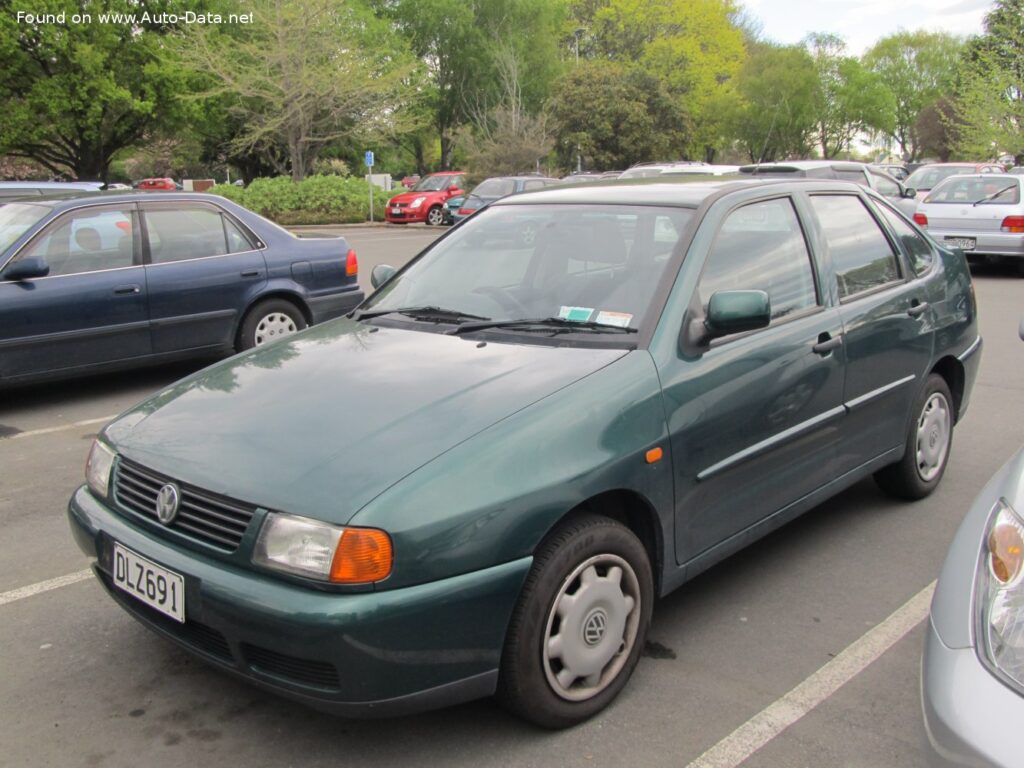
The Volkswagen Polo, a name synonymous with compact efficiency and reliability across global markets, entered its third generation (Type 6N) in 1994. While primarily known for its hatchback variants, Volkswagen also offered a sedan version, often designated as the “Classic” or “Sedan” in various markets. The Volkswagen Polo III Classic 1.9 TDI (110 Hp), produced between 1998 and 2000, represented a particularly compelling package within this lineup, especially for buyers prioritizing fuel economy, robust performance, and practicality in the European and Asian markets where it predominantly sold. This specific iteration, equipped with Volkswagen’s highly regarded Turbocharged Direct Injection (TDI) diesel engine, solidified the Polo Classic’s reputation as a workhorse capable of long-distance cruising with impressive efficiency, a trait highly valued outside the North American continent where the Polo was never officially imported.
Unlike its hatchback sibling which was a direct competitor to vehicles like the Ford Fiesta and Opel Corsa, the Polo III Classic sedan carved out its niche against slightly larger compact sedans, offering a more traditional three-box design that appealed to families and professionals seeking greater cargo capacity and a more formal aesthetic. The 1.9 TDI engine, a hallmark of Volkswagen engineering during this period, provided a blend of torque-rich performance and remarkable fuel efficiency, making it a popular choice for its operational economy.
Engine & Performance: The Power of the Volkswagen Polo III Classic 1.9 TDI
At the heart of the Volkswagen Polo III Classic 1.9 TDI (110 Hp) lies a venerable powerplant that became legendary for its efficiency and durability: the 1.9-liter (1896 cm³) inline-four cylinder Turbocharged Direct Injection (TDI) diesel engine, identified by its AFN engine code. This unit, a staple across numerous Volkswagen Group models of the era, delivered a robust 110 horsepower at 4150 rpm. While 110 horsepower might seem modest by today’s standards, its true strength lay in its torque output.
The engine produced a substantial 235 Nm (173.33 lb.-ft.) of torque, available at a remarkably low 1900 rpm. This characteristic low-end torque was instrumental in providing excellent drivability and effortless acceleration, particularly in urban environments or when carrying a full load. This translated into a respectable 0-60 mph acceleration time of just 10.1 seconds (0-100 km/h in 10.6 seconds), making the Polo Classic 1.9 TDI feel surprisingly sprightly for its class and purpose. The top speed was rated at 193 km/h (119.92 mph), more than adequate for autobahn cruising.
Fuel economy was undoubtedly one of the strongest selling points for this model. The 1.9 TDI engine showcased its prowess with an urban fuel consumption of 6.5 l/100 km (approximately 36.2 US mpg) and an astonishing extra-urban figure of just 4 l/100 km (approximately 58.8 US mpg). These figures were outstanding for the late 1990s and contributed significantly to the car’s low running costs. The engine’s architecture featured a front, longitudinal layout, with two valves per cylinder and an OHC (Overhead Camshaft) valvetrain, all fed by a direct injection fuel system complemented by a turbocharger and intercooler for optimal performance and efficiency. A 5-speed manual transmission channeled power to the front wheels, offering a direct and engaging driving experience.
Design & Features: Practicality and European Sensibility
The Volkswagen Polo III Classic distinguished itself from its hatchback counterpart with a traditional sedan body type, featuring four doors and seating for five occupants. Its design language was understated and functional, characteristic of Volkswagen’s approach during the late 1990s. With a length of 4164 mm (163.94 inches), a width of 1640 mm (64.57 inches), and a height of 1414 mm (55.67 inches), the Polo Classic offered a compact footprint that was easy to maneuver in crowded European cities, yet provided surprising interior space.
The wheelbase measured 2441 mm (96.1 inches), contributing to a stable ride quality. Despite its compact exterior, the sedan body style provided a generous trunk (boot) space, ranging from 455 liters (16.07 cu. ft.) with the rear seats up, expandable to 760 liters (26.84 cu. ft.) when the rear seats were folded. This flexibility made it a practical choice for families and individuals requiring substantial cargo capacity.
In terms of features, the Polo III Classic 1.9 TDI included essentials for its time. Safety was addressed with an Anti-lock Braking System (ABS) as a standard or optional feature, enhancing stopping power and control. The braking system comprised ventilated discs at the front and drum brakes at the rear. Steering was a hydraulic rack and pinion setup, providing a direct and communicative feel that drivers appreciated. The suspension system featured a wishbone setup for the front and a suspension with traction connecting levers at the rear, designed to offer a comfortable ride while maintaining predictable handling. The vehicle rode on 185/60 R14 tires mounted on 6J x 14 wheel rims, a common and cost-effective size for easy replacement.
Technical Specifications
| Category | Specification |
| Brand | Volkswagen |
| Model | Polo |
| Generation | Polo III Classic |
| Type (Engine) | 1.9 TDI (110 Hp) |
| Start of Production | 1998 year |
| End of Production | 2000 year |
| Powertrain Architecture | Internal Combustion engine |
| Body Type | Sedan |
| Seats | 5 |
| Doors | 4 |
| Performance Specs | |
| Fuel Consumption (Urban) | 6.5 l/100 km (36.2 US mpg) |
| Fuel Consumption (Extra Urban) | 4 l/100 km (58.8 US mpg) |
| Fuel Type | Diesel |
| Acceleration 0-60 mph | 10.1 sec |
| Acceleration 0-100 km/h | 10.6 sec |
| Maximum Speed | 193 km/h (119.92 mph) |
| Weight-to-Power Ratio | 10.1 kg/Hp (98.7 Hp/tonne) |
| Weight-to-Torque Ratio | 4.7 kg/Nm (210.8 Nm/tonne) |
| Engine Specs | |
| Power | 110 Hp @ 4150 rpm |
| Power per Liter | 58 Hp/l |
| Torque | 235 Nm @ 1900 rpm (173.33 lb.-ft.) |
| Engine Layout | Front, Longitudinal |
| Engine Model/Code | AFN |
| Engine Displacement | 1896 cm³ (1.9 liters, 115.7 cu. in.) |
| Number of Cylinders | 4 |
| Engine Configuration | Inline |
| Cylinder Bore | 79.5 mm (3.13 in.) |
| Piston Stroke | 95.5 mm (3.76 in.) |
| Compression Ratio | 19.5:1 |
| Number of Valves per Cylinder | 2 |
| Fuel Injection System | Direct injection |
| Engine Aspiration | Turbocharger, Intercooler |
| Valvetrain | OHC |
| Engine Oil Capacity | 4.3 l (4.54 US qt) |
| Coolant Capacity | 6 l (6.34 US qt) |
| Space, Volume and Weights | |
| Kerb Weight | 1115 kg (2458.15 lbs.) |
| Max. Weight | 1575 kg (3472.28 lbs.) |
| Max Load | 460 kg (1014.13 lbs.) |
| Trunk (boot) Space (Min) | 455 l (16.07 cu. ft.) |
| Trunk (boot) Space (Max) | 760 l (26.84 cu. ft.) |
| Fuel Tank Capacity | 45 l (11.89 US gal) |
| Dimensions | |
| Length | 4164 mm (163.94 in.) |
| Width | 1640 mm (64.57 in.) |
| Height | 1414 mm (55.67 in.) |
| Wheelbase | 2441 mm (96.1 in.) |
| Front Track | 1429 mm (56.26 in.) |
| Rear (Back) Track | 1410 mm (55.51 in.) |
| Drivetrain, Brakes and Suspension Specs | |
| Drivetrain Architecture | Front wheel drive, Internal Combustion engine |
| Drive Wheel | Front wheel drive |
| Number of Gears & Type of Gearbox | 5 gears, manual transmission |
| Front Suspension | Wishbone |
| Rear Suspension | Suspension with traction connecting levers |
| Front Brakes | Ventilated discs |
| Rear Brakes | Drum |
| Assisting Systems | ABS (Anti-lock braking system) |
| Steering Type | Steering rack and pinion |
| Power Steering | Hydraulic Steering |
| Tires Size | 185/60 R14 |
| Wheel Rims Size | 6J x 14 |
Legacy & Market Impact of the Volkswagen Polo III Classic
The Volkswagen Polo III Classic 1.9 TDI (110 Hp), despite its absence from the North American market, carved out a significant legacy in its primary sales regions, particularly across Europe, parts of Asia, and South America. Its impact was primarily felt in its ability to offer Volkswagen’s renowned build quality and engineering in a more affordable and practical sedan package than its Golf-based Jetta/Vento siblings. The “Classic” designation often highlighted its more conventional and arguably more mature styling compared to the sportier hatchback.
In Europe, where diesel engines held a strong market share, especially in the late 1990s and early 2000s, the 1.9 TDI variant was particularly well-received. Its outstanding fuel economy, coupled with the engine’s reputation for longevity and robust performance, made it a favorite among fleet operators, taxi companies, and private buyers who covered significant mileage. It was a practical, no-nonsense car that delivered on its promises of reliability and cost-effectiveness. Competitors in its segment included compact sedans like the Opel Astra Classic sedan, Ford Escort sedan, and various Japanese and Korean offerings that were also gaining traction in European markets. However, the Polo Classic often held an edge due to the strong brand perception of Volkswagen and the proven track record of its TDI engines.
The Polo III Classic, particularly with the 1.9 TDI engine, represented a sweet spot for many consumers: it was small enough to be agile in urban settings, yet offered sufficient space and comfort for longer journeys. Its conservative styling meant it aged gracefully, and its mechanical simplicity (compared to later, more electronically complex vehicles) contributed to its long-term durability and ease of maintenance. This combination of attributes cemented its reputation as a highly dependable and economical vehicle, contributing to the Polo’s overall success as a global compact car. Today, these models are often sought after in their respective markets for their enduring reliability and low operational costs, a testament to Volkswagen’s engineering prowess during that era.