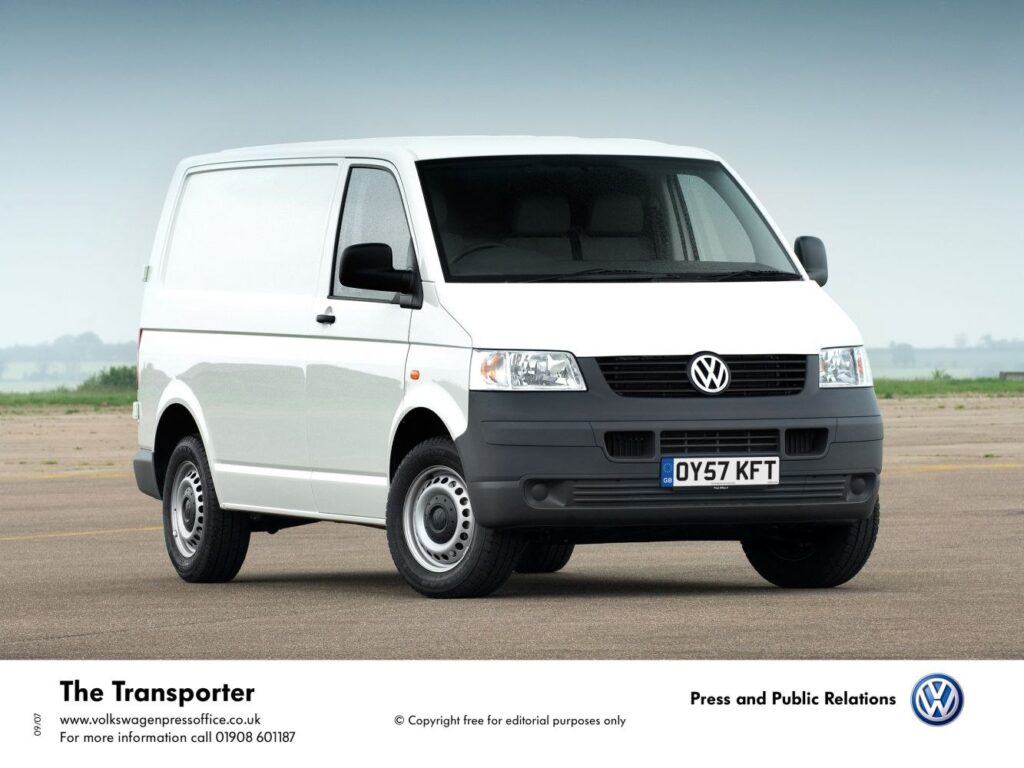
The Volkswagen Transporter, a name synonymous with versatility and reliability in the light commercial vehicle segment, saw its fifth generation (T5) introduced in 2003. Produced until 2009, the Volkswagen Transporter (T5) Panel Van represented a significant evolution in design, engineering, and performance for Volkswagen’s iconic “bus” lineage. While the Transporter series has a long and storied history, particularly in Europe and other international markets where it serves as everything from a cargo van to a family hauler, the T5 generation brought a new level of sophistication and car-like driving dynamics to the segment. This particular variant, the 3.2 V6 (235 Hp) Tiptronic L1H2, stood out as a remarkably powerful and well-equipped option, blending robust utility with surprisingly refined performance for a panel van.
Primarily targeted at businesses and individuals requiring substantial cargo capacity combined with a comfortable and capable driving experience, the T5 Panel Van was a common sight across European roadways. The L1H2 designation indicates a standard wheelbase (L1) combined with a high roof (H2), maximizing interior volume. The presence of a 3.2-liter V6 engine, typically found in Volkswagen’s passenger car lineup, paired with a sophisticated Tiptronic automatic transmission, positioned this Transporter as a premium offering, capable of effortlessly hauling heavy loads or covering long distances with ease, a stark contrast to the more utilitarian diesel engines often found in its stablemates.
Engine & Performance: The Potent 3.2 V6 in the Volkswagen Transporter (T5) Panel Van
At the heart of this formidable panel van was Volkswagen’s 3.2-liter VR6 engine, a distinctive and compact narrow-angle V6 known for its smooth operation and impressive power delivery. Codenamed EA390 / BKK, this naturally aspirated gasoline engine produced a robust 235 horsepower at 6200 rpm and a healthy 232.33 lb.-ft. of torque at a relatively low 2950 rpm. This output was exceptional for a commercial van of its time, giving the Transporter a performance edge typically reserved for passenger vehicles.
The VR6 engine’s unique configuration, with its cylinders arranged in a very narrow ‘V’ angle, allowed for a single cylinder head, making it compact enough to be mounted transversely in the front-wheel-drive architecture of the T5. With a bore of 3.31 inches and a stroke of 3.78 inches, and a compression ratio of 10.85:1, the engine was designed for efficiency and responsiveness. It featured a DOHC valvetrain with four valves per cylinder and a multi-port manifold injection system, ensuring optimal fuel delivery and combustion.
Power was channeled to the front wheels via a sophisticated 6-speed Tiptronic automatic transmission. This gearbox offered the convenience of an automatic with the option for manual gear selection, providing drivers with greater control, especially when navigating hilly terrain or towing. The combination of the powerful V6 and the smooth Tiptronic transmission resulted in impressive acceleration for a vehicle of its class, reaching 0-60 mph in a swift 10.1 seconds and achieving a top speed of 123.65 mph. Despite its performance, the T5 3.2 V6 was rated to meet Euro 4 emission standards, reflecting its contemporary environmental considerations. Fuel economy, while not its primary focus, was rated at 24.2 US mpg in extra-urban driving conditions, respectable for a large van with a powerful gasoline engine.
Design & Features: Utility and Ergonomics of the T5 Panel Van
The Volkswagen Transporter (T5) Panel Van was designed from the ground up to be a highly functional and durable commercial vehicle. The L1H2 configuration meant a standard length of 192.52 inches and a significant height of 85.43 inches, allowing for an impressive maximum cargo volume of 236.61 cubic feet (6700 liters). This generous space, coupled with a maximum payload capacity of 1918.02 lbs., made it an ideal choice for a wide range of commercial applications, from delivery services to mobile workshops.
The exterior design of the T5 was robust yet modern, characterized by clean lines and functional aesthetics. It typically featured 4-5 doors for easy access to the cabin and cargo area, with seating for 2-3 occupants. The interior was designed with ergonomics and durability in mind, prioritizing driver comfort during long hours on the road. Despite its commercial nature, the T5 benefited from Volkswagen’s passenger car expertise, offering a more refined cabin environment than many of its competitors.
Underneath its practical exterior, the T5 featured an advanced chassis for its class. It boasted an independent suspension system both front and rear, with McPherson struts and an anti-roll bar at the front, and an independent coil spring setup with a transverse stabilizer and trailing arms at the rear. This sophisticated suspension contributed to the Transporter’s renowned car-like handling and ride comfort, even when fully loaded. Safety features included ventilated disc brakes on all four wheels (13.11 x 1.28 inches front, 11.57 x 0.87 inches rear) and an Anti-lock Braking System (ABS), crucial for managing the vehicle’s considerable weight. Hydraulic rack and pinion steering provided precise control, while the 235/55 R17 tires on 7J x 17 wheels ensured ample grip and stability.
Volkswagen Transporter (T5) Technical Specifications
| Category | Specification |
|---|---|
| General Information | |
| Brand | Volkswagen |
| Model | Transporter |
| Generation | Transporter (T5) Panel Van |
| Type (Engine) | 3.2 V6 (235 Hp) Tiptronic L1H2 |
| Start of Production | 2003 year |
| End of Production | 2009 year |
| Powertrain Architecture | Internal Combustion engine |
| Body type | Van |
| Seats | 2-3 |
| Doors | 4-5 |
| Performance Specifications | |
| Fuel consumption (extra urban) | 9.7 l/100 km |
| Fuel Type | Petrol (Gasoline) |
| Acceleration 0 – 60 mph | 10.1 sec |
| Maximum speed | 199 km/h |
| Emission standard | Euro 4 |
| Weight-to-power ratio | 8.2 kg/Hp |
| Weight-to-torque ratio | 6.1 kg/Nm |
| Engine Specifications | |
| Power | 235 Hp @ 6200 rpm |
| Power per liter | 73.7 Hp/l |
| Torque | 315 Nm @ 2950 rpm |
| Engine layout | Front, Transverse |
| Engine Model/Code | EA390 / BKK |
| Engine displacement | 3189 cm3 |
| Number of cylinders | 6 |
| Engine configuration | VR-engine |
| Cylinder Bore | 84 mm |
| Piston Stroke | 95.9 mm |
| Compression ratio | 10.85:1 |
| Number of valves per cylinder | 4 |
| Fuel injection system | Multi-port manifold injection |
| Engine aspiration | Naturally aspirated engine |
| Valvetrain | DOHC |
| Space, Volume and Weights | |
| Kerb Weight | 1930-2130 kg |
| Max. weight | 2800-3000 kg |
| Max load | 870 kg |
| Trunk (boot) space – maximum | 6700 l |
| Fuel tank capacity | 80 l |
| Dimensions | |
| Length | 4890 mm |
| Width | 1904 mm |
| Height | 2170 mm |
| Wheelbase | 3000 mm |
Legacy & Market Impact: The Enduring Appeal of the Transporter T5
The Volkswagen Transporter (T5) continued the celebrated legacy of its predecessors, cementing its status as a benchmark in the light commercial vehicle sector. In markets outside the United States, where it was not officially sold in this configuration, the T5 was a dominant force, competing fiercely with rivals such as the Mercedes-Benz Vito, Ford Transit Custom, Renault Trafic, and Fiat Scudo. What set the T5 apart, especially in its higher-spec variants like the 3.2 V6 Panel Van, was its blend of robust utility with a driving experience that often felt more akin to a passenger car than a traditional commercial vehicle.
The decision to offer a powerful 3.2-liter V6 engine, typically reserved for performance-oriented sedans and SUVs, underscored Volkswagen’s commitment to providing a versatile range of options for the Transporter. While the diesel engines were the volume sellers due to their fuel efficiency for commercial operations, the V6 provided a compelling alternative for those requiring higher performance, smoother operation, and greater towing capacity. Its ability to tow up to 5511.56 lbs. (2500 kg) with brakes made it a highly capable hauler for trailers and equipment.
The T5’s success was not limited to its panel van form. Its highly adaptable platform served as the foundation for a diverse range of variants, including the Kombi (passenger/cargo mix), Caravelle (passenger shuttle), Multivan (luxury MPV), and the iconic California camper van. The T5, particularly with its advanced independent suspension and car-like ergonomics, significantly influenced the expectations for comfort and driving dynamics in the commercial van segment. It helped to blur the lines between dedicated work vehicles and more refined, multi-purpose transporters.
Today, the Volkswagen Transporter (T5) remains a highly sought-after vehicle in the used market, renowned for its build quality, durability, and the sheer breadth of its capabilities. The 3.2 V6 Tiptronic L1H2 variant, while rarer, is particularly prized by enthusiasts and those who appreciate its unique combination of power, refinement, and practicality. Its impact on the global automotive landscape, especially in Europe, is undeniable, representing a period when commercial vehicles began to offer unprecedented levels of comfort, technology, and performance, all while upholding the Transporter’s long-standing reputation as a reliable workhorse.