
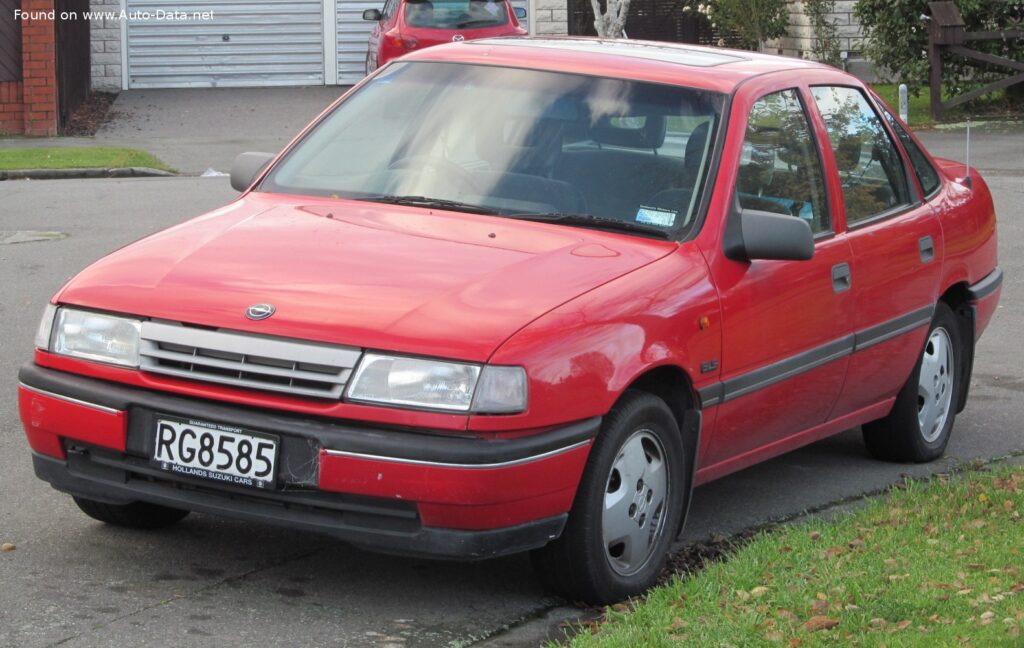
The Opel Vectra A, launched in 1988, was a pivotal model for General Motors’ European subsidiary, Opel. Positioned in the highly competitive D-segment, it succeeded the Opel Ascona and aimed to capture a larger share of the family car market across Europe. This article provides a detailed analysis of the Opel Vectra A 1.7 D (57 Hp), a specific variant produced between October 1988 and March 1989, delving into its technical specifications, design philosophy, and market impact.
The Opel Vectra A: A European Mainstay
The Vectra A represented a significant step forward for Opel, offering a modern and practical alternative to established competitors. While never officially sold in the United States, the Vectra A was a common sight on European roads, known for its reliability, robust engineering, and accessible pricing. It was designed as a dependable sedan, appealing to families and fleet buyers seeking a practical vehicle for everyday use. The 1.7 D variant, in particular, focused on fuel efficiency and affordability, making it a popular choice for drivers covering long distances.
Engine & Performance
The Opel Vectra A 1.7 D (57 Hp) was powered by a naturally aspirated 1.7-liter (103.74 cubic inches) diesel engine, designated the 17D. This inline four-cylinder unit featured an Overhead Camshaft (OHC) valvetrain and two valves per cylinder, prioritizing fuel economy and durability over high performance. It produced 57 horsepower at 4600 rpm and 77.44 lb.-ft. of torque at 2400 rpm. While modest by modern standards, this output was considered adequate for a diesel sedan in the late 1980s, given the car’s curb weight of 2380.99 lbs.
The engine employed a precombustion chamber injection system, a common diesel technology of the era. This system offered smoother operation and quieter running compared to direct injection, although with a slight efficiency trade-off. Power was delivered to the front wheels through a 5-speed manual transmission, providing drivers with control over fuel consumption. Performance figures reflected the car’s utilitarian nature: 0 to 60 mph acceleration took approximately 19 seconds, and the top speed was 94.45 mph. Fuel economy was a key strength, with combined cycle consumption reaching 39.2 US mpg and up to 53.5 US mpg on the open road. This efficiency made the Vectra 1.7 D an attractive option for drivers prioritizing economical commuting and long-distance travel.
Design & Features
The Opel Vectra A was offered as a traditional four-door sedan, characterized by a clean, aerodynamic design. Its smooth lines and relatively low drag coefficient contributed to both its aesthetic appeal and its fuel efficiency. The vehicle measured 174.49 inches in length, 67.17 inches in width, and 55.12 inches in height, providing a spacious interior for five occupants.
The interior of the Vectra A focused on practicality and durability, with comfortable seating and straightforward controls. Trunk space was generous for the segment, offering 18.72 cubic feet with all seats in place and expanding to 29.66 cubic feet with the rear seats folded (utilizing a pass-through system). The suspension utilized coil springs at both the front and rear, providing a comfortable ride. Braking was handled by disc brakes at the front and drum brakes at the rear, a cost-effective configuration for the time. Rack and pinion steering offered direct and responsive handling, and the car rode on 175/70 R14 tires mounted on 14-inch wheels.
Technical Specifications: Opel Vectra A 1.7 D (57 Hp)
| Category | Specification |
|---|---|
| Brand | Opel |
| Model | Vectra |
| Generation | Vectra A |
| Type (Engine) | 1.7 D (57 Hp) |
| Start of Production | October, 1988 |
| End of Production | March, 1989 |
| Powertrain Architecture | Internal Combustion Engine |
| Body Type | Sedan |
| Seats | 5 |
| Doors | 4 |
| Fuel Consumption (Urban) | 35.1 US mpg |
| Fuel Consumption (Extra Urban) | 53.5 US mpg |
| Fuel Consumption (Combined) | 39.2 US mpg |
| Fuel Type | Diesel |
| Acceleration 0 – 60 mph | 19 seconds |
| Maximum Speed | 94.45 mph |
| Weight-to-Power Ratio | 18.9 kg/Hp (52.8 Hp/tonne) |
| Weight-to-Torque Ratio | 10.3 kg/Nm (97.2 Nm/tonne) |
| Power | 57 Hp @ 4600 rpm |
| Power per Liter | 33.5 Hp/l |
| Torque | 77.44 lb.-ft. @ 2400 rpm |
| Engine Layout | Front, Transverse |
| Engine Model/Code | 17D |
| Engine Displacement | 1.7 liters (103.74 cu. in.) |
| Number of Cylinders | 4 |
| Engine Configuration | Inline |
| Cylinder Bore | 3.25 inches |
| Piston Stroke | 3.13 inches |
| Compression Ratio | 23:1 |
| Number of Valves per Cylinder | 2 |
| Fuel Injection System | Precombustion Chamber Injection |
| Engine Aspiration | Naturally Aspirated |
| Valvetrain | OHC |
| Engine Oil Capacity | 5.02 US qt |
| Coolant Capacity | 9.62 US qt |
| Kerb Weight | 2380.99 lbs. |
| Max. Weight (GVWR) | 3549.44 lbs. |
| Max Load | 1168.45 lbs. |
| Trunk (Boot) Space – Minimum | 18.72 cu. ft. |
| Trunk (Boot) Space – Maximum | 29.66 cu. ft. |
| Fuel Tank Capacity | 16.11 US gal |
| Length | 174.49 inches |
| Width | 67.17 inches |
| Height | 55.12 inches |
| Wheelbase | 102.36 inches |
| Front Track | 56.57 inches |
| Rear Track | 56.38 inches |
| Drivetrain Architecture | Internal Combustion Engine (ICE) drives front wheels |
| Drive Wheel | Front Wheel Drive |
| Number of Gears and Gearbox Type | 5 gears, Manual Transmission |
| Front Suspension | Coil Spring |
| Rear Suspension | Coil Spring |
| Front Brakes | Disc |
| Rear Brakes | Drum |
| Steering Type | Steering Rack and Pinion |
| Tires Size | 175/70 R14 |
| Wheel Rims Size | 14 inches |
The Opel Vectra A, including the 1.7 D variant, played a crucial role in the European automotive market. As the successor to the popular Ascona, it successfully competed with rivals like the Ford Sierra, Volkswagen Passat, and Peugeot 405. The 1.7 D, while not the most powerful version, offered an economical and reliable option for families and fleet buyers. Its enduring design, robust engineering, and practical features cemented its place as a mainstay of European roads for years to come, and the Vectra A platform’s versatility ensured its continued success with various body styles and drivetrain configurations.
