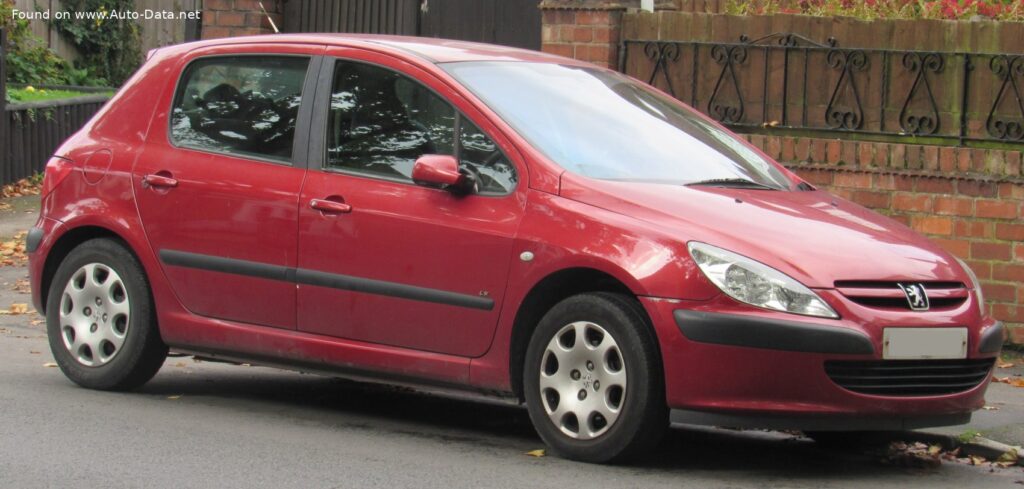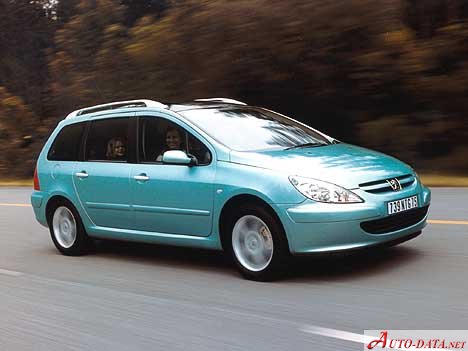
The Peugeot 307 Station Wagon 1.6 16V (109 Hp) Automatic was a key model in Peugeot’s lineup during the early 2000s, designed to cater to the European market’s demand for practical and versatile family vehicles. Introduced as the successor to the popular Peugeot 306 in 2001, the 307 quickly gained recognition, earning the prestigious European Car of the Year award in 2002. This article details the first-generation Peugeot 307 Station Wagon 1.6 16V (109 Hp) Automatic, produced between 2002 and 2005, focusing on its technical specifications, design features, and market role.
Engine & Performance of the Peugeot 307 Station Wagon
The Peugeot 307 Station Wagon 1.6 16V (109 Hp) Automatic was powered by Peugeot’s 1.6-liter (1587 cm3) “TU5JP4” inline-four engine. This naturally aspirated engine utilized a Double Overhead Camshaft (DOHC) valvetrain and multi-port fuel injection, a common and reliable configuration for the era. The engine produced 109 horsepower at 5800 revolutions per minute (rpm), providing sufficient power for everyday driving and typical family transport needs. Torque output was rated at 108.42 lb-ft (147 Nm) at 4000 rpm, offering adequate pulling power for a station wagon frequently carrying passengers and cargo.
Power was delivered to the front wheels through a 4-speed automatic transmission. While not as sophisticated as modern multi-gear automatics, this transmission prioritized smooth shifting and ease of use, aligning with the vehicle’s focus on comfort and practicality. The 307 Station Wagon 1.6 16V Automatic could accelerate from 0 to 60 mph in approximately 13.1 seconds, reaching a top speed of 111.85 mph (180 km/h). These performance figures positioned the vehicle as a practical family car rather than a performance-oriented model.
Fuel economy was a significant consideration for European buyers, and the 307 delivered competitive figures. Combined fuel consumption was rated at 28.3 US mpg (8.3 l/100 km), with urban driving yielding around 21 US mpg (11.2 l/100 km) and extra-urban driving achieving approximately 36.8 US mpg (6.4 l/100 km). Its 15.85 US gallon (60-liter) fuel tank provided a reasonable driving range. The engine met Euro 3 emission standards, demonstrating compliance with environmental regulations of the time, with CO2 emissions of 194 g/km.
Design & Features
The Peugeot 307 Station Wagon featured a practical and aesthetically pleasing design, characterized by its elongated roofline and spacious rear cargo area. As a traditional 5-door station wagon (estate), it prioritized interior space and versatility. The vehicle measured 173.98 inches (4419 mm) in length, 69.17 inches (1757 mm) in width, and between 60.39 and 60.79 inches (1534-1544 mm) in height. A 106.61-inch (2708 mm) wheelbase contributed to a comfortable ride and generous interior space.
The interior offered seating for five passengers. A key feature was its cargo capacity, providing a minimum of 12.01 cubic feet (340 liters) with all seats in use, expanding to an impressive 54.38 cubic feet (1540 liters) with the rear seats folded down. This flexibility made it ideal for families needing to transport luggage, groceries, or sports equipment. The higher roofline, compared to the hatchback version, enhanced cabin headroom and provided a more spacious feel.
The chassis and suspension were designed for comfort and stability. The front suspension utilized a MacPherson strut system, while the rear employed a torsion beam, a cost-effective and space-efficient solution common in front-wheel-drive vehicles. Braking was provided by ventilated discs at the front and solid discs at the rear, equipped with an Anti-lock Braking System (ABS) for enhanced safety during emergency stops. Hydraulic power steering, a rack and pinion system, offered responsive and assisted steering. The vehicle rode on 195/65 R15 tires mounted on 15-inch wheels, balancing ride comfort and grip.
Technical Specifications
| Category | Specification |
| General Information | |
| Brand | Peugeot |
| Model | 307 |
| Generation | 307 Station Wagon |
| Type (Engine) | 1.6 16V (109 Hp) Automatic |
| Start of production | 2002 |
| End of production | 2005 |
| Powertrain Architecture | Internal Combustion engine |
| Body type | Station wagon (estate) |
| Seats | 5 |
| Doors | 5 |
| Performance Specs | |
| Fuel consumption (economy) – urban | 21 US mpg (11.2 l/100 km) |
| Fuel consumption (economy) – extra urban | 36.8 US mpg (6.4 l/100 km) |
| Fuel consumption (economy) – combined | 28.3 US mpg (8.3 l/100 km) |
| CO2 emissions | 194 g/km |
| Fuel Type | Petrol (Gasoline) |
| Acceleration 0 – 60 mph | 13.1 sec |
| Maximum speed | 111.85 mph (180 km/h) |
| Emission standard | Euro 3 |
| Weight-to-power ratio | 12.5 kg/Hp, 80.1 Hp/tonne |
| Weight-to-torque ratio | 9.3 kg/Nm, 108.1 Nm/tonne |
| Engine Specs | |
| Power | 109 Hp @ 5800 rpm |
| Power per liter | 68.7 Hp/l |
| Torque | 108.42 lb.-ft. (147 Nm) @ 4000 rpm |
| Engine layout | Front, Transverse |
| Engine Model/Code | NFU TU5JP4 |
| Engine displacement | 1.6 liters (1587 cm3 / 96.84 cu. in.) |
| Number of cylinders | 4 |
| Engine configuration | Inline |
| Cylinder Bore | 3.09 in. (78.5 mm) |
| Piston Stroke | 3.23 in. (82 mm) |
| Compression ratio | 11:1 |
| Number of valves per cylinder | 4 |
| Fuel injection system | Multi-port manifold injection |
| Engine aspiration | Naturally aspirated engine |
| Valvetrain | DOHC |
| Engine oil capacity | 3.43 US qt (3.25 l) |
| Coolant | 7.08 US qt (6.7 l) |
| Space, Volume and Weights | |
| Kerb Weight | 2998.29 lbs. (1360 kg) |
| Max. weight (GVWR) | 4318.86 lbs. (1959 kg) |
| Max load | 1320.57 lbs. (599 kg) |
| Trunk (boot) space – minimum | 12.01 cu. ft. (340 l) |
| Trunk (boot) space – maximum | 54.38 cu. ft. (1540 l) |
| Fuel tank capacity | 15.85 US gal (60 l) |
| Permitted trailer load with brakes (12%) | 2425.08 lbs. (1100 kg) |
| Permitted trailer load without brakes | 1576.31 lbs. (715 kg) |
| Dimensions | |
| Length | 173.98 in. (4419 mm) |
| Width | 69.17 in. (1757 mm) |
| Height | 60.39 – 60.79 in. (1534-1544 mm) |
| Wheelbase | 106.61 in. (2708 mm) |
| Front track | 59.25 in. (1505 mm) |
| Rear (Back) track | 59.45 in. (1510 mm) |
| Front overhang | 34.57 in. (878 mm) |
| Rear overhang | 32.8 in. (833 mm) |
| Drivetrain, Brakes and Suspension Specs | |
| Drivetrain Architecture | The Internal combustion engine (ICE) drives the front wheels of the vehicle. |
| Drive wheel | Front wheel drive |
| Number of gears and type of gearbox | 4 gears, automatic transmission |
| Front suspension | Spring Strut |
| Rear suspension | Torsion |
| Front brakes | Ventilated discs |
| Rear brakes | Disc |
| Assisting systems | ABS (Anti-lock braking system) |
| Steering type | Steering rack and pinion |
| Power steering | Hydraulic Steering |
| Tires size | 195/65 R15 |
| Wheel rims size | 15 inches |
Legacy and Market Impact
The Peugeot 307 Station Wagon, particularly the 1.6 16V Automatic variant, was a significant model for Peugeot in the European compact car market during the early 2000s. It successfully built upon the reputation of the 306, offering increased space, improved safety, and a more modern design. In Europe, where station wagons remained popular, the 307 Wagon competed with models like the Volkswagen Golf Variant, Ford Focus Wagon, Opel Astra Caravan, and Renault Mégane Estate.
Its strengths included practicality, ride comfort, and robustness. The higher roofline gave it a semi-MPV feel, enhancing cabin space and ease of access, appealing to families. The generous cargo volume, expandable by folding the rear seats, made it a versatile option. While not a performance car, the 1.6-liter engine and automatic transmission provided a smooth and easy driving experience, suitable for urban and highway use. Its fuel efficiency and standard ABS contributed to lower running costs and enhanced safety.
Although not sold in the US market, the Peugeot 307 Station Wagon 1.6 16V (109 Hp) Automatic represented a quintessential European family car, embodying Peugeot’s blend of distinctive design, practicality, and comfort. It remains a testament to a period when European manufacturers excelled in creating well-engineered cars tailored to the needs of their home continent.