
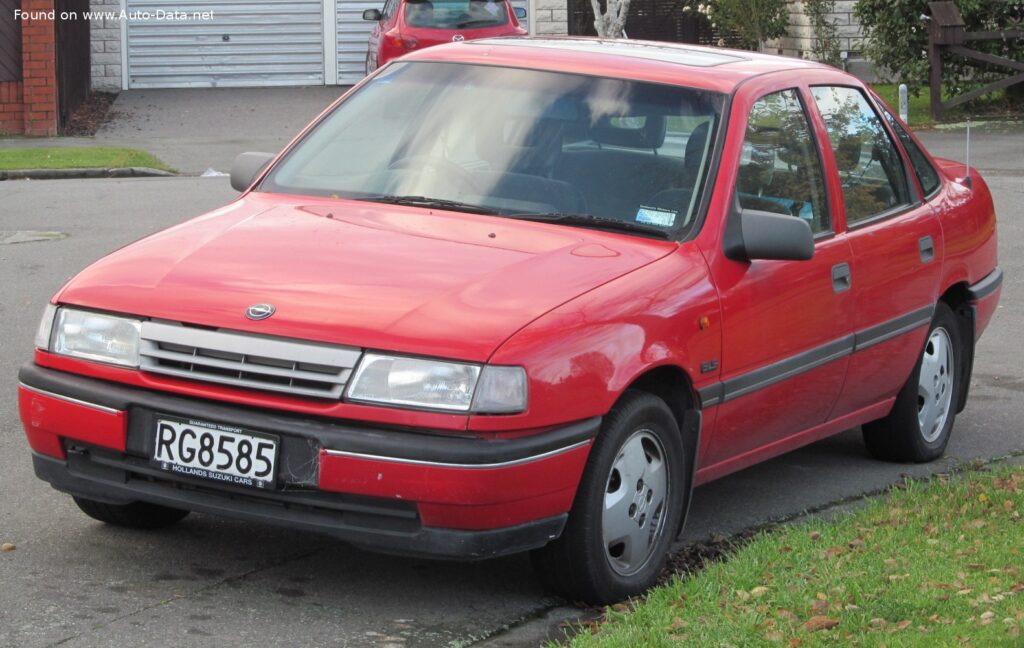
The Opel Vectra A 1.8 S (90 Hp) represents a pivotal model in Opel’s history, launched in September 1988 as the successor to the long-running Ascona. This first-generation Vectra, known internally as the Vectra A, was a critical entry in the highly competitive European mid-size family car segment. Positioned as a modern, aerodynamically efficient, and practical sedan, the Vectra A was designed to appeal to a broad range of buyers, from families to business users, across the continent. While never officially sold in the United States under the Opel badge, its underlying platform and design principles would influence various General Motors products globally. The 1.8 S variant, produced for a brief period from 1988 to July 1989, offered a balanced blend of everyday performance and fuel economy, making it a popular choice in its initial market.
Engineering and Performance of the Opel Vectra A
At the heart of the Opel Vectra A 1.8 S (90 Hp) was Opel’s 1.8-liter (1796 cm3 or 109.6 cu. in.) naturally aspirated inline-four engine, designated by the code 18SV. This powerplant, featuring an Overhead Camshaft (OHC) valvetrain and a carburetor fuel injection system, was typical of automotive technology during the late 1980s. It delivered 90 horsepower at 5400 rpm, providing adequate motivation for a family sedan of its era. Torque output stood at 109.16 lb-ft (148 Nm) at 2800 rpm, ensuring accessible pulling power for daily driving and highway cruising.
Power was channeled to the front wheels via a standard 5-speed manual transmission, a common and efficient setup that contributed to the car’s overall practicality. This Front-Wheel Drive (FWD) drivetrain architecture was a hallmark of modern European sedans, offering improved traction in adverse conditions and more efficient packaging for interior space. The Vectra A 1.8 S was capable of accelerating from 0 to 60 mph in an estimated 11.9 seconds (0-100 km/h in 12.5 seconds), with a top speed of 113.71 mph (183 km/h). While not a performance leader, these figures were competitive for its segment and purpose.
Fuel efficiency was a key consideration for European buyers, and the Vectra A 1.8 S delivered reasonable figures for its time. The combined fuel economy was rated at 33.1 US mpg (7.1 l/100 km), with urban consumption at 23.1 US mpg (10.2 l/100 km) and an impressive extra-urban figure of 42.8 US mpg (5.5 l/100 km). These numbers highlighted Opel’s focus on creating an economical and cost-effective vehicle for the mass market, especially given the carburetor-based fuel delivery system.
Design and Features
The Opel Vectra A introduced a sleek, modern design that significantly departed from its predecessor. Its four-door sedan body type exuded a contemporary aesthetic, characterized by smooth lines and a remarkably low drag coefficient (Cd) of just 0.29. This aerodynamic efficiency was a significant achievement for a production car in 1988 and contributed directly to its improved fuel economy and reduced wind noise at higher speeds. The car’s dimensions were practical for European roads, measuring 174.49 inches (4432 mm) in length, 67.17 inches (1706 mm) in width, and 55.12 inches (1400 mm) in height, with a wheelbase of 102.36 inches (2600 mm).
Inside, the Vectra A offered a spacious cabin designed to comfortably accommodate five occupants. The interior was functional and ergonomic, prioritizing ease of use and practicality. A notable feature was the generous trunk space, ranging from 18.72 cu. ft. (530 liters) to a maximum of 29.66 cu. ft. (840 liters) with the rear seats folded, making it highly versatile for families and their luggage. Standard features for the 1.8 S included hydraulic power steering, enhancing maneuverability and driving comfort. While common today, the availability of an Anti-lock Braking System (ABS) as an assisting system was a significant safety feature for a mainstream car in the late 1980s, underscoring Opel’s commitment to advancing vehicle safety. The car rode on 175/70 R14 tires paired with 14-inch wheel rims, providing a comfortable and stable ride.
Suspension duties were handled by coil springs at both the front and rear, a conventional but effective setup for balancing ride comfort and handling dynamics. Braking performance was managed by ventilated discs at the front for effective stopping power, complemented by drum brakes at the rear, a common configuration for cars in this class and era.
Opel Vectra A 1.8 S: Technical Specifications
| Category | Specification |
| Brand | Opel |
| Model | Vectra A |
| Type (Engine) | 1.8 S (90 Hp) |
| Production Start | September, 1988 |
| Production End | July, 1989 |
| Powertrain Architecture | Internal Combustion Engine (ICE) |
| Body Type | Sedan |
| Seats | 5 |
| Doors | 4 |
| Performance Specs | |
| Fuel Consumption (Urban) | 10.2 l/100 km (23.1 US mpg) |
| Fuel Consumption (Extra Urban) | 5.5 l/100 km (42.8 US mpg) |
| Fuel Consumption (Combined) | 7.1 l/100 km (33.1 US mpg) |
| Fuel Type | Petrol (Gasoline) |
| Acceleration 0-60 mph | 11.9 sec |
| Acceleration 0-100 km/h | 12.5 sec |
| Maximum Speed | 113.71 mph (183 km/h) |
| Weight-to-Power Ratio | 11.8 kg/Hp (84.9 Hp/tonne) |
| Weight-to-Torque Ratio | 7.2 kg/Nm (139.6 Nm/tonne) |
| Engine Specs | |
| Power | 90 Hp @ 5400 rpm |
| Power per Liter | 50.1 Hp/l |
| Torque | 109.16 lb-ft (148 Nm) @ 2800 rpm |
| Engine Layout | Front, Transverse |
| Engine Model/Code | 18SV |
| Engine Displacement | 1.8 Liters (1796 cm3 / 109.6 cu. in.) |
| Number of Cylinders | 4 |
| Engine Configuration | Inline |
| Cylinder Bore | 3.34 in. (84.8 mm) |
| Piston Stroke | 3.13 in. (79.5 mm) |
| Compression Ratio | 9.2:1 |
| Valves per Cylinder | 2 |
| Fuel Injection System | Carburetor |
| Engine Aspiration | Naturally Aspirated |
| Valvetrain | OHC |
| Engine Oil Capacity | 4.23 US qt (4 l) |
| Coolant Capacity | 7.4 US qt (7 l) |
| Space, Volume, and Weights | |
| Kerb Weight | 2336.9 lbs (1060 kg) |
| Max. Weight | 3549.44 lbs (1610 kg) |
| Max Load | 1212.54 lbs (550 kg) |
| Trunk (Boot) Space (Min) | 18.72 cu. ft. (530 l) |
| Trunk (Boot) Space (Max) | 29.66 cu. ft. (840 l) |
| Fuel Tank Capacity | 16.11 US gal (61 l) |
| Dimensions | |
| Length | 174.49 in. (4432 mm) |
| Width | 67.17 in. (1706 mm) |
| Height | 55.12 in. (1400 mm) |
| Wheelbase | 102.36 in. (2600 mm) |
| Front Track | 56.57 in. (1437 mm) |
| Rear Track | 56.38 in. (1432 mm) |
| Drag Coefficient (Cd) | 0.29 |
| Drivetrain, Brakes, and Suspension | |
| Drivetrain Architecture | Front-Wheel Drive (ICE drives front wheels) |
| Drive Wheel | Front Wheel Drive |
| Number of Gears | 5, Manual Transmission |
| Front Suspension | Coil Spring |
| Rear Suspension | Coil Spring |
| Front Brakes | Ventilated Discs |
| Rear Brakes | Drum |
| Assisting Systems | ABS (Anti-lock Braking System) |
| Power Steering | Hydraulic Steering |
| Tire Size | 175/70 R14 |
| Wheel Rims Size | 14 inches |
Legacy and Market Impact of the Opel Vectra A
The Opel Vectra A, particularly in its early 1.8 S iteration, quickly established itself as a formidable competitor in the European mid-size segment. It went head-to-head with established rivals such as the Ford Sierra, Volkswagen Passat, and Renault 21, often surpassing them in terms of aerodynamic efficiency and interior packaging. Its introduction marked a significant step forward for Opel, demonstrating a commitment to modern design, advanced engineering for its time, and practical utility.
The Vectra A garnered a reputation for its solid build quality, reliable mechanicals, and comfortable ride, traits that resonated well with European consumers. Its spacious interior and large trunk made it an ideal choice for families, while its economical engines and competitive pricing ensured its popularity across various income brackets. The car’s success contributed significantly to Opel’s market share throughout the late 1980s and early 1990s, cementing its position as a major player in the European automotive landscape.
While the Vectra A itself was not imported to the United States, its underlying GM V-platform was a global architecture. Elements of its design and engineering philosophy could be seen in other GM products around the world, including some sold under the Chevrolet, Pontiac, or Saturn brands in North America. This cross-pollination of platforms and technology was a common strategy for General Motors during this period, allowing for economies of scale across its diverse brand portfolio.
The Opel Vectra A 1.8 S (90 Hp), though a modest variant, played a crucial role in the model’s initial success. It showcased Opel’s ability to produce a well-rounded, efficient, and practical family car that met the demands of the European market. Its legacy is one of reliability, sensible engineering, and a significant contribution to Opel’s brand image as a producer of dependable, mainstream vehicles that offered good value and modern features for their time. It laid the groundwork for subsequent Vectra generations and remains a classic example of late 20th-century European automotive engineering.
