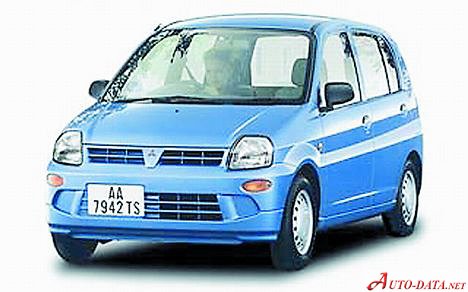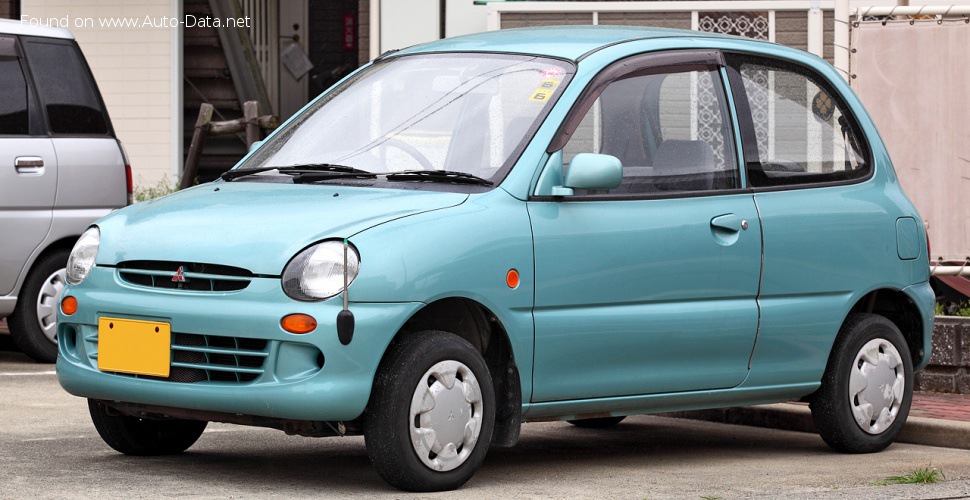
The Mitsubishi Minica V 0.66 16V PG (50 Hp) Automatic represents a crucial iteration of Mitsubishi’s long-running Minica series, a staple in Japan’s unique Kei car segment. Launched in 1993, the fifth generation Minica (Minica V) continued the tradition of offering compact, efficient, and tax-advantageous transportation perfectly suited for the dense urban environments of Japan. This particular variant, equipped with a 0.66-liter, 16-valve engine producing 50 horsepower and paired with an automatic transmission, was designed to provide accessible and user-friendly mobility within the stringent Kei car regulations. While never officially imported to the United States, the Minica V embodies the ingenuity and pragmatism of Japanese automotive engineering, showcasing how manufacturers adapted to specific market demands with highly specialized vehicles. It served as a testament to Mitsubishi’s commitment to small car development, offering a blend of economy, practicality, and surprisingly advanced features for its class during its production run from 1993 to 1999.
Engineering for the Kei Segment: The Mitsubishi Minica V
The Mitsubishi Minica V, like its predecessors, was meticulously engineered to comply with Japan’s “Kei jidosha” (light automobile) regulations. These rules dictate maximum vehicle dimensions, engine displacement, and power output, offering significant tax and insurance benefits to owners. For the 1993 model year, the Minica V entered a highly competitive segment, facing rivals from Suzuki, Daihatsu, and Honda. Mitsubishi’s approach was to blend reliability with a focus on interior space and ease of driving, particularly for urban commuters. The 0.66-liter engine was the heart of this strategy, providing just enough power for city driving while staying within the regulatory limits. The automatic transmission further enhanced its appeal, making it a convenient choice for drivers navigating stop-and-go traffic.
Engine & Performance
At the core of the Mitsubishi Minica V 0.66 16V PG (50 Hp) Automatic was a transversely mounted, front-engine, front-wheel-drive powertrain. The engine itself was a compact 659 cubic centimeter (0.66-liter) inline-four cylinder unit, a marvel of miniaturization that still managed to incorporate a 16-valve cylinder head, an advanced feature for a Kei car of its era. This naturally aspirated engine, designated PG, produced a respectable 50 horsepower at a high 7500 rpm and 41.3 lb.-ft. of torque at 5500 rpm. The high-revving nature was typical for small-displacement Japanese engines, allowing them to extract maximum power from their limited volume.
Fuel delivery was managed by a carburetion system, a common and cost-effective solution for Kei cars in the early 1990s, although fuel injection was becoming more prevalent in larger vehicles. The overhead camshaft (OHC) valvetrain contributed to the engine’s efficiency and responsiveness. Despite its modest output, the engine’s power-to-liter ratio of 75.9 horsepower per liter was quite impressive for a non-turbocharged engine of its size. Mated to a 3-speed automatic transmission, the powertrain was optimized for smooth, undemanding urban driving, prioritizing convenience over outright performance. With a curb weight of just 1477.1 pounds, the Minica V offered a weight-to-power ratio of 13.4 kg/Hp (74.6 Hp/tonne), making it surprisingly nimble within city limits. Its small fuel tank capacity of 8.45 US gallons was perfectly adequate for its intended short-distance urban use, contributing to its overall lightweight design.
Design & Features
The Mitsubishi Minica V adopted a practical and unpretentious design, characteristic of the Kei car segment. It was conceived as a 3-door hatchback, offering seating for four occupants. The exterior dimensions were strictly dictated by Kei regulations: a length of 129.72 inches, a width of 54.92 inches, and a height of 57.68 inches. These compact figures ensured excellent maneuverability and ease of parking in congested Japanese cities. The design prioritized maximizing interior volume within this tiny footprint, featuring a relatively tall roofline and a boxy profile to enhance headroom and cargo space.
Despite its economy car status, the Minica V incorporated several features that enhanced its usability and safety. Power steering, specifically a hydraulic rack and pinion system, significantly reduced the effort required to maneuver the vehicle, a welcome attribute for urban driving. Furthermore, the inclusion of an Anti-lock Braking System (ABS) was a notable safety enhancement for a Kei car in the early to mid-1990s, providing improved control during emergency braking situations. The braking system utilized disc brakes at the front and drum brakes at the rear, a common configuration for vehicles of this size and weight. Suspension duties were handled by spring struts at the front and coil springs at the rear, providing a comfortable ride for its class. The vehicle rode on small 12-inch wheels fitted with 135/80 R12 S tires, emphasizing economy and low rolling resistance. The tight minimum turning circle of 27.56 feet further underscored its urban agility.
Technical Specifications: Mitsubishi Minica V 0.66 16V PG (50 Hp) Automatic
| General Information | |
| Brand | Mitsubishi |
| Model | Minica |
| Generation | Minica V |
| Type (Engine) | 0.66 16V PG (50 Hp) Automatic |
| Start of Production | 1993 year |
| End of Production | 1999 year |
| Powertrain Architecture | Internal Combustion engine |
| Body type | Hatchback |
| Seats | 4 |
| Doors | 3 |
| Performance Specs | |
| Fuel Type | Petrol (Gasoline) |
| Weight-to-power ratio | 13.4 kg/Hp, 74.6 Hp/tonne |
| Weight-to-torque ratio | 12 kg/Nm, 83.6 Nm/tonne |
| Engine Specs | |
| Power | 50 Hp @ 7500 rpm |
| Power per liter | 75.9 Hp/l |
| Torque | 56 Nm (41.3 lb.-ft.) @ 5500 rpm |
| Engine layout | Front, Transverse |
| Engine displacement | 659 cm3 (40.21 cu. in.) |
| Number of cylinders | 4 |
| Engine configuration | Inline |
| Cylinder Bore | 60 mm (2.36 in.) |
| Piston Stroke | 58.3 mm (2.3 in.) |
| Compression ratio | 10:1 |
| Number of valves per cylinder | 4 |
| Fuel injection system | Carburetor |
| Engine aspiration | Naturally aspirated engine |
| Valvetrain | OHC |
| Space, Volume and Weights | |
| Kerb Weight | 670 kg (1477.1 lbs.) |
| Fuel tank capacity | 32 l (8.45 US gal) |
| Dimensions | |
| Length | 3295 mm (129.72 in.) |
| Width | 1395 mm (54.92 in.) |
| Height | 1465 mm (57.68 in.) |
| Wheelbase | 2280 mm (89.76 in.) |
| Front track | 1215 mm (47.83 in.) |
| Rear (Back) track | 1215 mm (47.83 in.) |
| Minimum turning circle (turning diameter) | 8.4 m (27.56 ft) |