
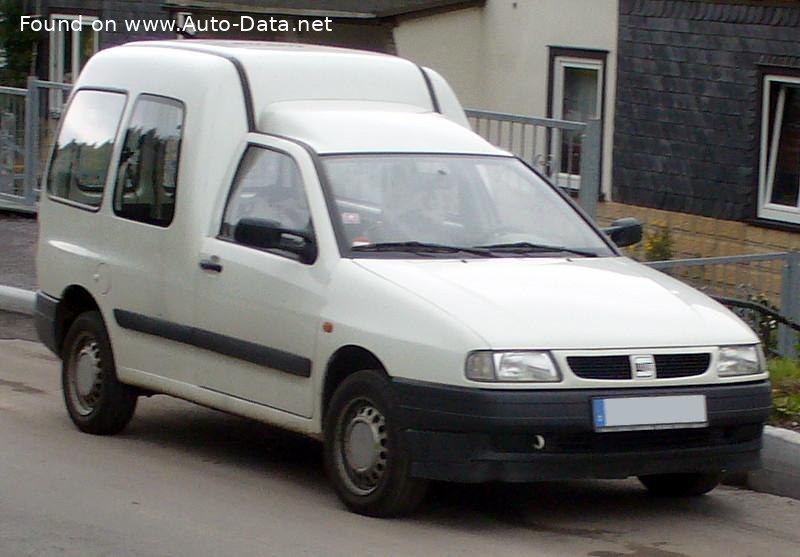
The Seat Inca (9K) 1.6 i (75 Hp) represents a crucial period for the Spanish automaker, Seat, under the stewardship of the Volkswagen Group. Introduced in January 1996, the Inca (9K) was a light commercial vehicle, or LCV, that also offered a passenger-oriented minivan variant. This model was a rebadged version of the Volkswagen Caddy (Typ 9K), sharing its platform and many mechanical components with the contemporary Volkswagen Polo Mk3 (Typ 6N) and Seat Ibiza Mk2. While never officially sold in the United States, the Inca played a significant role in the European market, particularly in Spain and other parts of Southern Europe, as a versatile and economical solution for both businesses and families seeking practical transportation. Its production spanned from early 1996 until November 2000, establishing its presence as a robust and no-frills option in the compact utility segment.
Seat Inca (9K) 1.6 i (75 Hp): A European Utility Vehicle
The Seat Inca (9K) occupied a unique space in the European automotive landscape. It wasn’t designed for high performance or luxury, but rather for practicality and affordability. Positioned as a compact panel van and minivan, it catered to a broad audience, from small business owners needing a reliable delivery vehicle to families seeking an economical and spacious people carrier. Its close relationship with the Volkswagen Caddy meant it benefited from the established engineering and parts availability of the Volkswagen Group, enhancing its appeal to cost-conscious buyers.
Engine & Performance
The Seat Inca (9K) 1.6 i (75 Hp) was powered by a 1.6-liter naturally aspirated inline-four gasoline engine. This engine, transversely mounted at the front of the vehicle, prioritized reliability and fuel efficiency over outright power. It produced 75 horsepower at 4600 rpm and 135 Nm (99.57 lb.-ft.) of torque at 2800 rpm. This torque delivery provided adequate low-end grunt for urban driving and carrying moderate loads. The engine featured a SOHC (Single Overhead Camshaft) valvetrain with two valves per cylinder and utilized a multi-port fuel injection system.
Power was transmitted to the front wheels through a five-speed manual transmission, offering drivers a direct and engaging driving experience. The Inca (9K) 1.6 i could achieve a maximum speed of 96.31 mph (155 km/h). Fuel economy was respectable for its class and era, averaging 28 US mpg (8.4 l/100 km) combined, with 21.6 US mpg (10.9 l/100 km) in urban conditions and 33.6 US mpg (7 l/100 km) on the open road. These figures contributed to its appeal as an economical vehicle for both commercial and personal use.
Design & Features
The design of the Seat Inca (9K) was fundamentally dictated by its utilitarian purpose. Classified as a compact panel van with windows and rear seating, it featured a three-door configuration – two front doors and a large rear access, typically a single upward-swinging or barn-door style. The passenger variant comfortably seated five occupants. Exterior styling was deliberately understated, prioritizing functionality over aesthetic embellishments, mirroring the design philosophy of its Volkswagen Caddy counterpart.
The Inca’s dimensions were compact yet practical. Measuring 165.63 inches (4207 mm) in length, 66.77 inches (1696 mm) in width, and 72.28 inches (1836 mm) in height, it offered a generous interior volume and a relatively high roofline. The 102.4-inch (2601 mm) wheelbase contributed to a stable ride. The suspension system comprised an independent McPherson strut setup with coil springs and an anti-roll bar at the front, and a robust rigid axle suspension with leaf springs at the rear, designed to handle varying loads. Braking was handled by disc brakes at the front and drum brakes at the rear. Hydraulic power steering with a rack and pinion system provided ease of maneuverability, even when the vehicle was fully loaded.
Technical Specifications: Seat Inca (9K) 1.6 i (75 Hp)
| General Information | |
| Brand | Seat |
| Model | Inca |
| Generation | Inca (9K) |
| Type (Engine) | 1.6 i (75 Hp) |
| Start of production | January, 1996 |
| End of production | November, 2000 |
| Powertrain Architecture | Internal Combustion engine |
| Body type | Minivan |
| Seats | 5 |
| Doors | 3 |
| Performance Specs | |
| Fuel consumption (economy) – urban | 10.9 l/100 km (21.6 US mpg) |
| Fuel consumption (economy) – extra urban | 7 l/100 km (33.6 US mpg) |
| Fuel consumption (economy) – combined | 8.4 l/100 km (28 US mpg) |
| Fuel Type | Petrol (Gasoline) |
| Maximum speed | 155 km/h (96.31 mph) |
| Weight-to-power ratio | 14.8 kg/Hp (67.6 Hp/tonne) |
| Weight-to-torque ratio | 8.2 kg/Nm (121.6 Nm/tonne) |
| Engine Specs | |
| Power | 75 Hp @ 4600 rpm |
| Power per liter | 46.9 Hp/l |
| Torque | 135 Nm @ 2800 rpm (99.57 lb.-ft. @ 2800 rpm) |
| Engine layout | Front, Transverse |
| Engine displacement | 1598 cm3 (97.52 cu. in.) |
| Number of cylinders | 4 |
| Engine configuration | Inline |
| Number of valves per cylinder | 2 |
| Fuel injection system | Multi-port manifold injection |
| Engine aspiration | Naturally aspirated engine |
| Valvetrain | SOHC |
| Engine oil capacity | 3.4 l (3.59 US qt) |
| Coolant | 5.5 l (5.81 US qt) |
| Space, Volume and Weights | |
| Kerb Weight | 1110 kg (2447.13 lbs) |
| Max. weight | 1735 kg (3825.02 lbs) |
| Max load | 625 kg (1377.89 lbs) |
| Fuel tank capacity | 54 l (14.27 US gal) |
| Dimensions | |
| Length | 4207 mm (165.63 in.) |
| Width | 1696 mm (66.77 in.) |
| Height | 1836 mm (72.28 in.) |
| Wheelbase | 2601 mm (102.4 in.) |
| Front track | 1436 mm (56.54 in.) |
| Rear track | 1452 mm (57.17 in.) |
| Drivetrain, Brakes and Suspension Specs | |
| Drivetrain Architecture | The Internal combustion engine (ICE) drives the front wheels of the vehicle. |
| Drive wheel | Front wheel drive |
| Number of gears and type of gearbox | 5 gears, manual transmission |
| Front suspension | Independent, type McPherson with coil spring and anti-roll bar |
| Rear suspension | Rigid axle suspension, Leaf spring |
| Front brakes | Disc |
| Rear brakes | Drum |
| Steering type | Steering rack and pinion |
| Power steering | Hydraulic Steering |
Legacy and Market Impact
The Seat Inca (9K) successfully established itself within the European compact utility vehicle segment, competing with models like the Citroën Berlingo, Peugeot Partner, and Renault Kangoo. Its strength lay in its Volkswagen Group engineering, offering a dependable and cost-effective alternative to the Volkswagen Caddy. The panel van variant proved popular with small businesses, while the passenger version provided an affordable and practical minivan option.
Despite its utilitarian design and basic features, the Inca’s simplicity was a key asset. Its ease of maintenance, readily available parts, and straightforward mechanics made it a popular choice in markets prioritizing durability and low ownership costs. The Inca’s role in Seat’s lineup was to expand the brand’s appeal beyond traditional passenger cars, demonstrating its ability to produce workhorse vehicles tailored to specific market needs. The Seat Inca (9K) remains a testament to the enduring appeal of practical, no-nonsense vehicles in the European automotive landscape.
