
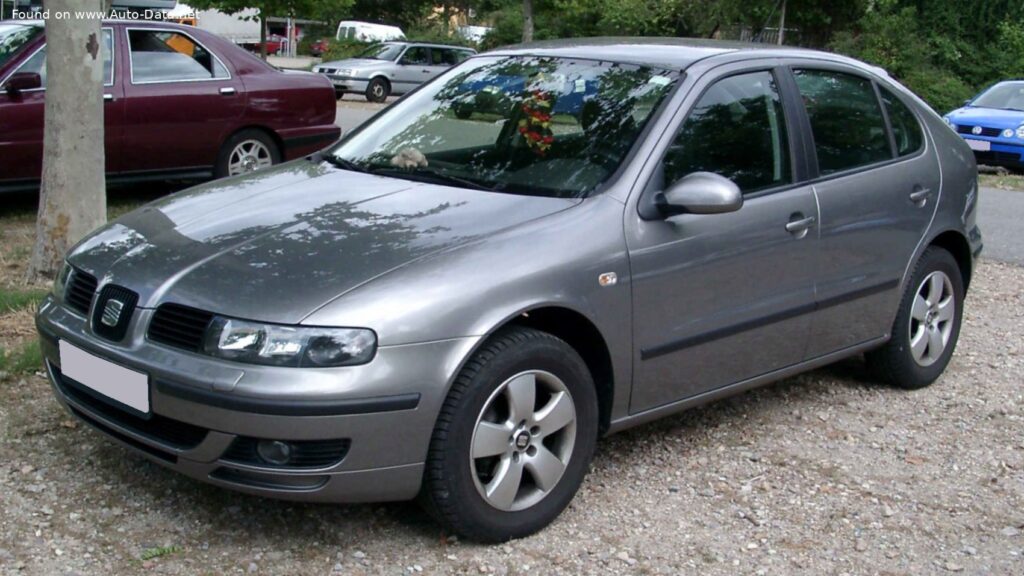
The Seat Leon I (1M) represents a pivotal model for the Spanish automaker SEAT, a subsidiary of the Volkswagen Group. Launched in November 1999, this first-generation Leon was SEAT’s ambitious entry into the highly competitive European C-segment, a class dominated by popular hatchbacks like the Volkswagen Golf, Ford Focus, and Opel Astra. Based on the robust and widely acclaimed Volkswagen Group A4 (PQ34) platform, shared with the Audi A3, Skoda Octavia, and the Volkswagen Golf IV, the Leon I (1M) aimed to combine German engineering prowess with a distinctive Spanish design flair and a sportier driving character. The 1.4 16V variant, with its 75 horsepower engine, served as an entry-level option, providing an economical and practical solution for a broad spectrum of European buyers seeking a reliable and stylish compact hatchback. Production of this generation continued until May 2005, cementing its place in SEAT’s modern history.
Seat Leon I (1M): A Detailed Overview
The Seat Leon I (1M) was designed to appeal to a younger demographic seeking a more dynamic alternative to the traditionally conservative offerings in the compact hatchback segment. While sharing mechanical components with other Volkswagen Group vehicles, the Leon distinguished itself through its styling and focus on driving engagement. It was never officially sold in the United States, but it played a crucial role in establishing SEAT as a recognizable brand within Europe, known for its blend of practicality, style, and affordability.
Engine & Performance: The 1.4 16V Powertrain
At the heart of the entry-level Seat Leon I (1M) was a 1.4-liter (1390 cm3 or 84.82 cu. in.) naturally aspirated inline four-cylinder engine. This 16-valve unit, designated by codes such as AHW, APE, AXP, or BCA, was a common and well-proven powertrain within the Volkswagen Group’s compact offerings. Delivering 75 horsepower at 5000 revolutions per minute (rpm) and a peak torque of 94.41 lb-ft (128 Nm) at 3300 rpm, the engine was designed with efficiency and urban usability in mind rather than outright speed.
Power was delivered to the front wheels via a standard 5-speed manual transmission, a setup typical for compact cars of its era. This configuration, coupled with the engine’s characteristics, resulted in a modest but adequate performance profile. The Leon 1.4 16V could accelerate from 0 to 60 mph in a calculated 13.6 seconds (0-100 km/h in 14.3 seconds) and reach a top speed of 105.63 mph (170 km/h). While these figures might not impress performance enthusiasts, they were entirely suitable for daily commuting and general European road conditions.
Fuel economy was a strong suit for this particular variant, with a combined consumption rating of 36.2 US mpg (6.5 liters per 100 km). This efficiency, combined with a 14.53 US gallon (55-liter) fuel tank, offered a respectable cruising range, making it an attractive option for budget-conscious drivers. The engine featured a multi-port manifold injection system and an OHC (Overhead Camshaft) valvetrain, contributing to its reliability and relatively low maintenance requirements. The compression ratio stood at 10.5:1, typical for a naturally aspirated petrol engine of its time.
Design & Features of the Seat Leon I (1M)
The Seat Leon I (1M) distinguished itself with a design penned by the renowned Italian designer Giorgetto Giugiaro. While sharing its underpinnings with more conservative stablemates, the Leon embraced a more dynamic and aggressive aesthetic. Its five-door hatchback body type, measuring 164.72 inches (4184 mm) in length, 68.58 inches (1742 mm) in width, and 56.65 inches (1439 mm) in height, offered a practical yet sporty silhouette. The prominent “dynamic line” running along the side, the distinctive headlamps, and the integrated rear spoiler gave it a youthful and energetic appearance, appealing to a demographic looking for something more exciting than the standard compact fare.
Inside, the Leon offered seating for five passengers, with a cabin that blended functional ergonomics with a hint of sportiness. While the 1.4 16V was an entry-level model, it still benefited from the solid build quality associated with the Volkswagen Group platform. Trunk space was practical for its class, offering 12.01 cubic feet (340 liters) with the rear seats up, expandable to 23.17 cubic feet (656 liters) when folded down.
In terms of features and safety, the Leon I (1M) came equipped with essential technologies for its era. Standard safety features included an Anti-lock Braking System (ABS), which was becoming increasingly common and crucial for vehicle control. The braking system utilized ventilated discs at the front and solid discs at the rear, providing adequate stopping power for a vehicle of its weight and performance. A hydraulic power steering system with a rack and pinion setup ensured responsive and communicative steering, contributing to the Leon’s reputation for engaging driving dynamics. The vehicle rode on 175/80 R14 tires, balancing comfort and grip for everyday use. Suspension consisted of a wishbone setup at the front and coil springs at the rear, a conventional yet effective arrangement for comfort and handling.
Technical Specifications
| Category | Specification |
| Brand | Seat |
| Model | Leon I (1M) |
| Type (Engine) | 1.4 16V (75 Hp) |
| Production Start | November, 1999 |
| Production End | May, 2005 |
| Powertrain Architecture | Internal Combustion engine |
| Body type | Hatchback |
| Seats | 5 |
| Doors | 5 |
| Fuel consumption (combined) | 6.5 l/100 km (36.2 US mpg / 43.5 UK mpg) |
| Fuel Type | Petrol (Gasoline) |
| Acceleration 0 – 60 mph | 13.6 sec |
| Acceleration 0 – 100 km/h | 14.3 sec |
| Maximum speed | 170 km/h (105.63 mph) |
| Weight-to-power ratio | 16.1 kg/Hp (62 Hp/tonne) |
| Weight-to-torque ratio | 9.5 kg/Nm (105.8 Nm/tonne) |
| Power | 75 Hp @ 5000 rpm |
| Power per liter | 54 Hp/l |
| Torque | 128 Nm @ 3300 rpm (94.41 lb.-ft. @ 3300 rpm) |
| Engine layout | Front, Transverse |
| Engine Model/Code | AHW, APE, AXP, BCA |
| Engine displacement | 1390 cm3 (84.82 cu. in.) |
| Number of cylinders | 4 |
| Engine configuration | Inline |
| Cylinder Bore | 76.5 mm (3.01 in.) |
| Piston Stroke | 75.6 mm (2.98 in.) |
| Compression ratio | 10.5:1 |
| Valves per cylinder | 4 |
| Fuel injection system | Multi-port manifold injection |
| Engine aspiration | Naturally aspirated engine |
| Valvetrain | OHC |
| Engine oil capacity | 3.2 l (3.38 US qt) |
| Coolant capacity | 6 l (6.34 US qt) |
| Kerb Weight | 1210 kg (2667.59 lbs) |
| Max. weight | 1680 kg (3703.77 lbs) |
| Max load | 470 kg (1036.17 lbs) |
| Trunk (boot) space – minimum | 340 l (12.01 cu. ft.) |
| Trunk (boot) space – maximum | 656 l (23.17 cu. ft.) |
| Fuel tank capacity | 55 l (14.53 US gal) |
| Length | 4184 mm (164.72 in.) |
| Width | 1742 mm (68.58 in.) |
| Height | 1439 mm (56.65 in.) |
| Wheelbase | 2513 mm (98.94 in.) |
| Front track | 1513 mm (59.57 in.) |
| Rear (Back) track | 1492 mm (58.74 in.) |
| Drivetrain Architecture | Front-wheel drive, Internal Combustion engine |
| Drive wheel | Front wheel drive |
| Gearbox type | 5 gears, manual transmission |
| Front suspension | Wishbone |
| Rear suspension | Coil spring |
| Front brakes | Ventilated discs |
| Rear brakes | Disc |
| Assisting systems | ABS (Anti-lock braking system) |
| Steering type | Steering rack and pinion |
| Power steering | Hydraulic Steering |
| Tires size | 175/80 R14 |
Legacy and Market Impact in Europe
The Seat Leon I (1M) carved out a significant niche for SEAT, particularly in its primary European market. Positioned as the “sporty” alternative to the more conservative Volkswagen Golf IV, the Leon offered a compelling package of sharp styling, reliable mechanics, and competitive pricing. It successfully leveraged the Volkswagen Group’s engineering excellence while injecting a distinct personality, which was crucial for SEAT’s brand identity. While not sold in the United States, its influence was keenly felt across the Atlantic as it helped solidify SEAT’s reputation as a dynamic and youthful brand within the broader European automotive landscape.
The 1.4 16V variant, in particular, played a vital role in the Leon’s success by providing an accessible entry point into the model range. It appealed to first-time car buyers, urban dwellers, and families seeking economical transportation without sacrificing modern features or stylish aesthetics. Its primary competitors in the European C-segment included the Volkswagen Golf IV, Ford Focus (Mk1), Opel/Vauxhall Astra G, Peugeot 307, and Renault Mégane (Mk1/Mk2). Against these formidable rivals, the Leon I (1M) stood out with its blend of Spanish passion and German precision.
The Leon I (1M) helped shape SEAT’s future product strategy, proving that there was a strong market for cars that combined practicality with a sporty edge. Its success paved the way for subsequent generations of the Leon, which continued to build on this foundation, further establishing SEAT as a key player in the European compact car segment. Today, the first-generation Leon is remembered as a well-rounded and influential model that successfully elevated SEAT’s brand image and market presence. Its enduring design and mechanical reliability mean that many examples can still be seen on European roads, a testament to its lasting impact.
