
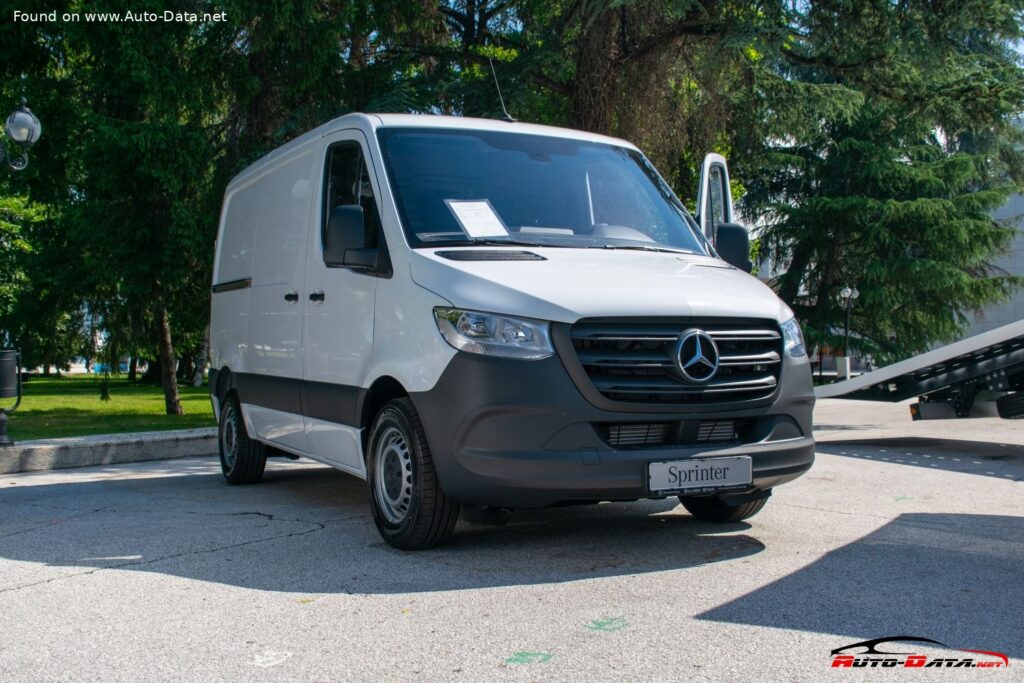
The Mercedes-Benz Sprinter has long been a benchmark in the light commercial vehicle (LCV) segment, renowned for its versatility, durability, and advanced engineering. The specific variant under review, the Mercedes-Benz Sprinter Panel Van Compact (W907/W910) 215 CDI (150 Hp) W910 9G-TRONIC, represents a modern iteration of this iconic van, with production commencing in 2021. Part of the third-generation Sprinter family, internally designated W907 for rear-wheel-drive and W910 for front-wheel-drive variants, this model specifically focuses on the compact panel van configuration with a front-wheel-drive powertrain, offering a compelling blend of maneuverability, efficiency, and cargo capacity for urban and regional logistics. While the Sprinter is a global product, widely popular in North America, Europe, and other key markets, this particular configuration highlights its adaptability to diverse operational demands, leveraging Mercedes-Benz’s commitment to cutting-edge technology and commercial utility.
Powertrain and Performance of the Sprinter 215 CDI
At the heart of the Mercedes-Benz Sprinter 215 CDI (150 Hp) W910 9G-TRONIC lies a sophisticated internal combustion engine designed for efficiency and robust performance. This model is equipped with Mercedes-Benz’s OM 654 engine, a 1950 cm³ (approximately 2.0-liter) inline-four diesel unit. This powerplant delivers a respectable 150 horsepower (Hp) at 3800 revolutions per minute (rpm), making it well-suited for a variety of commercial tasks. More critically for a commercial vehicle, the engine produces a substantial 340 Newton-meters (Nm) of torque, which translates to approximately 250.77 pound-feet (lb-ft), available across a broad and usable range from 1500 to 2400 rpm. This low-end torque is crucial for effortless acceleration, carrying heavy loads, and navigating challenging terrains, ensuring that the van performs optimally even when fully laden.
The OM 654 engine features a modern diesel common rail fuel injection system, combined with a turbocharger and intercooler, which not only enhances power output but also contributes significantly to fuel efficiency and reduced emissions. Adhering to the stringent Euro 6d emission standard, this Sprinter variant underscores Mercedes-Benz’s commitment to environmental responsibility, a key factor for modern fleet operators. The engine’s power per liter stands at 76.9 Hp/l, reflecting its efficient design. The powertrain architecture is front-wheel drive, a configuration often favored for its lighter weight, improved traction in certain conditions, and a lower load floor, which can simplify cargo loading and unloading.
Mated to this potent diesel engine is the advanced 9G-TRONIC automatic transmission, featuring nine forward gears. This sophisticated gearbox is engineered to provide seamless gear changes, optimizing both fuel economy and driving comfort. The wider spread of ratios allows the engine to operate within its most efficient range more frequently, reducing fuel consumption on highways while ensuring ample pulling power at lower speeds. The inclusion of a particulate filter as part of the engine systems further highlights its compliance with modern emission regulations and its commitment to cleaner operation. With a fuel tank capacity of 65 liters (17.17 US gallons) and an AdBlue tank of 22 liters (5.81 US gallons), the Sprinter 215 CDI is designed for extended operational periods between refueling, minimizing downtime for commercial users.
Design and Utility of the Sprinter Panel Van
The Mercedes-Benz Sprinter Panel Van Compact (W907/W910) is designed first and foremost for utility and practicality. As a panel van, it features a robust body type with five doors – typically two front doors, a sliding side door, and rear barn doors – providing excellent access to the cargo area. With seating for three occupants, it caters to small crews or driver-plus-passenger needs, while dedicating the majority of its interior volume to cargo. The “Compact” designation implies a shorter wheelbase and overall length compared to other Sprinter variants, making it particularly agile for urban deliveries and navigating confined spaces.
Measuring 5267 mm (207.36 inches) in length, 2020 mm (79.53 inches) in width (2345 mm or 92.32 inches including mirrors), and 2356 mm (92.76 inches) in height, this Sprinter variant offers a substantial cargo volume despite its compact classification. The maximum trunk space is an impressive 7800 liters (275.45 cubic feet), allowing for a wide range of goods to be transported. The vehicle’s kerb weight is 2075 kg (4574.59 lbs), with a maximum permissible weight of 3000 kg (6613.87 lbs), translating to a maximum payload capacity of 925 kg (2039.28 lbs). This robust payload capability, combined with its 2000 kg (4409.25 lbs) permitted trailer load with brakes and 750 kg (1653.47 lbs) without brakes, underscores its capability as a serious work vehicle.
The Sprinter’s chassis and suspension are engineered to handle heavy loads and ensure stability. It features a leaf spring front suspension and a combination of hydraulic elements and leaf springs at the rear, a configuration optimized for load-bearing and durability. Braking performance is handled by disc brakes on both the front and rear axles, complemented by an Anti-lock Braking System (ABS) for enhanced safety and control during emergency braking maneuvers, particularly important when the vehicle is heavily loaded. The tires are sized 225/65 R16, mounted on 6.5J x 16 wheel rims, providing a good balance of load capacity and ride comfort. The minimum turning circle of 13 meters (42.65 feet) is commendable for a vehicle of its size, further aiding maneuverability in tight urban environments.
Safety and Driver Assistance
While specific driver-assistance features beyond ABS aren’t detailed in the provided data, modern Sprinters generally include a suite of safety technologies. These commonly include features like Crosswind Assist, which helps stabilize the van in strong side winds, and optional systems like Lane Keeping Assist and Blind Spot Monitoring. These features contribute to a safer driving experience, particularly on long journeys or in challenging conditions.
Technical Specifications
| Category | Specification |
|---|---|
| General Information | Mercedes-Benz |
| Model | Sprinter |
| Generation | Sprinter Panel Van Compact (W907/W910) |
| Type (Engine) | 215 CDI (150 Hp) W910 9G-TRONIC |
| Start of production | 2021 year |
| Powertrain Architecture | Internal Combustion engine |
| Body type | Van |
| Seats | 3 |
| Doors | 5 |
| Performance Specs | Diesel |
| Fuel Type | Euro 6d |
| Emission standard | 13.8 kg/Hp, 72.3 Hp/tonne |
| Weight-to-power ratio | 6.1 kg/Nm, 163.9 Nm/tonne |
| Weight-to-torque ratio | 150 Hp @ 3800 rpm. |
| Engine Specs | 76.9 Hp/l |
| Power | 340 Nm @ 1500-2400 rpm. (250.77 lb.-ft.) |
| Power per liter | 1950 cm³ (119 cu. in.) |
| Torque | 4 |
| Engine layout | Inline |
| Engine Model/Code | OM 654 |
| Engine displacement | 4 |
| Number of cylinders | Diesel Commonrail |
| Engine configuration | Turbocharger, Intercooler |
| Number of valves per cylinder | 10 l (10.57 US qt | 8.8 UK qt) |
| Fuel injection system | Particulate filter |
| Engine aspiration | 2075 kg (4574.59 lbs.) |
| Engine oil capacity | 3000 kg (6613.87 lbs.) |
| Engine systems | 925 kg (2039.28 lbs.) |
| Space, Volume and Weights | 7800 l (275.45 cu. ft.) |
| Kerb Weight | 65 l (17.17 US gal | 14.3 UK gal) |
| Max. weight | 22 l (5.81 US gal | 4.84 UK gal) |
| Max load | 300 kg (661.39 lbs.) |
| Trunk (boot) space – maximum | 2000 kg (4409.25 lbs.) |
| Fuel tank capacity | 750 kg (1653.47 lbs.) |
| AdBlue tank | 5267 mm (207.36 in.) |
| Max. roof load | 2020 mm (79.53 in.) |
| Permitted trailer load with brakes (12%) | 2345 mm (92.32 in.) |
| Permitted trailer load without brakes | 2356 mm (92.76 in.) |
| Dimensions | 3259 mm (128.31 in.) |
| Length | 1759 mm (69.25 in.) |
| Width | 1770 mm (69.69 in.) |
| Width including mirrors | 1012 mm (39.84 in.) |
| Height | 996 mm (39.21 in.) |
| Wheelbase | 143 mm (5.63 in.) |
| Front track | 13 m (42.65 ft.) |
| Rear (Back) track | Front wheel drive |
| Front overhang | 9 gears, automatic transmission G-TRONIC |
| Rear overhang | Leaf spring |
| Ride height (ground clearance) | Hydraulic elements, Leaf spring |
| Minimum turning circle (turning diameter) | Disc |
| Drivetrain, Brakes and Suspension Specs | Disc |
| Drivetrain Architecture | ABS (Anti-lock braking system) |
| Drive wheel | 225/65 R16 |
| Number of gears and type of gearbox | 6.5J x 16 |
| Front suspension | |
| Rear suspension | |
| Front brakes | |
| Rear brakes | |
| Assisting systems | |
| Tires size | |
| Wheel rims size |
Market Presence and Enduring Legacy of the Mercedes-Benz Sprinter
The Mercedes-Benz Sprinter has carved out a formidable reputation as a leader in the global light commercial vehicle market. Its legacy is built upon a foundation of reliability, versatility, and advanced engineering, making it a preferred choice for a vast array of businesses, from last-mile delivery services to mobile workshops, passenger transport, and recreational vehicle conversions. The W907/W910 generation, introduced to global markets including the United States, continues this tradition, adapting to the evolving demands of modern commerce.
In the highly competitive commercial van segment, the Sprinter faces rivals such as the Ford Transit, Ram ProMaster (based on the Fiat Ducato platform), and in certain international markets, the Volkswagen Crafter. What often distinguishes the Sprinter is its premium positioning, offering a more refined driving experience, superior build quality, and a greater emphasis on advanced technology and safety features. While the 215 CDI (150 Hp) W910 9G-TRONIC variant, with its front-wheel-drive and compact dimensions, targets a specific niche requiring efficiency and maneuverability, the broader Sprinter lineup caters to virtually every commercial need, from heavy-duty cargo hauling to specialized upfits. The 215 CDI variant, with its efficient diesel engine and sophisticated 9G-TRONIC transmission, exemplifies Mercedes-Benz’s strategy to offer economical yet powerful solutions for businesses seeking to optimize their operational costs without compromising on performance or brand prestige. Its role in supporting the backbone of logistics and service industries worldwide ensures the Mercedes-Benz Sprinter’s enduring legacy as a true workhorse of the modern era.
