
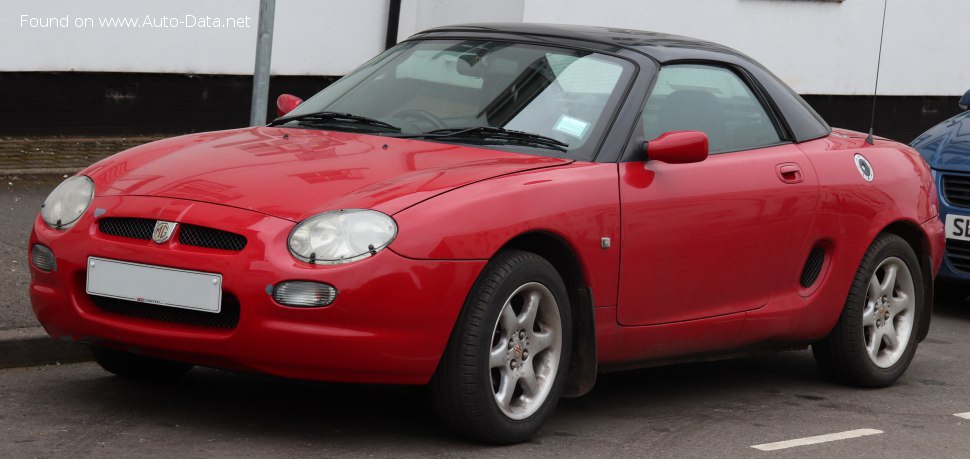
The Rover MGF (RD) marked a significant return for the British automotive marque Rover Group to the mainstream sports car market after a hiatus of two decades, following the cessation of MG B production in 1980. Launched in 1995, the Rover MGF (RD) 1.8 i (120 Hp) was a contemporary interpretation of the classic British two-seater roadster, designed to compete with popular models like the Mazda MX-5 Miata in Europe. While never officially sold in the United States, the MGF garnered considerable attention in its primary European and Asian markets for its innovative engineering, striking design, and accessible performance. It represented a crucial effort by Rover to revitalize its sporting heritage under the MG badge, offering a blend of modern technology and traditional open-top motoring excitement. This particular variant, the 1.8 i (120 Hp), served as the entry-level model, providing a compelling balance of performance and efficiency for a broad audience.
Produced from 1995 until 2000 before its facelifted successor, the MG TF, took over, the MGF was a pivotal model in Rover’s lineup. It was an internal combustion engine (ICE) powered cabriolet, engineered with a mid-mounted engine layout, a characteristic more commonly associated with higher-end sports cars. This configuration contributed to its balanced handling and dynamic capabilities, setting it apart from many front-engine, rear-wheel-drive competitors. The MGF was a two-door, two-seat vehicle, embodying the pure essence of a roadster designed for driving enjoyment. Its introduction was met with enthusiasm, signaling a potential resurgence for the British sports car industry and solidifying its place as a modern classic in the automotive landscape.
Engine & Performance of the Rover MGF (RD)
At the heart of the Rover MGF (RD) 1.8 i (120 Hp) was Rover’s acclaimed K-Series engine, specifically the 18K4F variant. This naturally aspirated, 1.8-liter (1796 cm³ or 109.6 cu. in.) inline-four cylinder engine was renowned for its light weight and efficient design. Featuring a Double Overhead Camshaft (DOHC) valvetrain with four valves per cylinder, it was a technically advanced unit for its time, ensuring optimal airflow and combustion. The engine utilized a multi-port manifold injection system for precise fuel delivery, contributing to its respectable power output and fuel economy.
The 1.8 i (120 Hp) model produced a healthy 120 horsepower at 5500 rpm, translating to a power-per-liter ratio of 66.8 HP/l. Torque figures stood at 160 Nm, or approximately 118.01 lb.-ft., peaking at 4000 rpm. This robust torque delivery, combined with the vehicle’s relatively light curb weight of 2336.9 lbs (1060 kg), resulted in a spirited performance. The MGF 1.8 i could accelerate from 0 to 60 mph in a swift 8.7 seconds, with a 0-100 km/h sprint time of 9.2 seconds. Its top speed was rated at 193 km/h, or nearly 120 mph (119.92 mph), making it a capable performer on both winding roads and open highways.
The powertrain architecture featured a mid-transverse engine layout, driving the rear wheels through a crisp-shifting 5-speed manual transmission. This rear-wheel-drive configuration, coupled with the mid-engine placement, provided excellent weight distribution and handling characteristics, distinguishing the MGF from many of its front-wheel-drive competitors. The car boasted an impressive weight-to-power ratio of 8.8 kg/Hp (113.2 Hp/tonne) and a weight-to-torque ratio of 6.6 kg/Nm (150.9 Nm/tonne), underscoring its performance credentials. Fuel efficiency was also commendable for a sports car of its era, with a combined consumption rating of 6.7 l/100 km, equivalent to approximately 35.1 US mpg. This blend of performance, efficiency, and dynamic handling made the MGF a highly attractive proposition in the European sports car market.
Design & Features of the Rover MGF (RD)
The Rover MGF (RD) was instantly recognizable for its distinct styling, blending traditional British roadster aesthetics with modern design cues. Its body type was a classic two-door cabriolet, emphasizing open-top driving pleasure. The car’s compact dimensions – with a length of 154.06 inches (3913 mm), a width of 64.09 inches (1628 mm), and a height of 50 inches (1270 mm) – contributed to its agile appearance and nimble handling. A wheelbase of 93.5 inches (2375 mm) further aided in its dynamic stability.
Beyond its visual appeal, the MGF incorporated several advanced engineering features for its class. The suspension system, a crucial aspect of any sports car, utilized a double wishbone setup at both the front and rear. This sophisticated arrangement, often found in more expensive performance vehicles, provided excellent wheel control, precise steering response, and a comfortable ride quality, balancing sportiness with everyday usability. The steering system was a responsive rack and pinion unit, complemented by hydraulic power steering, offering direct feedback to the driver.
Braking performance was handled by ventilated discs at the front and solid discs at the rear, ensuring ample stopping power. An Anti-lock Braking System (ABS) was included as a standard assisting system, enhancing safety and control during emergency braking maneuvers. The MGF was fitted with staggered tire sizes: 185/55 VR15 for the front and 205/50 VR15 for the rear, optimizing grip and handling balance. Despite its compact nature, the MGF offered a minimum trunk space of 7.38 cu. ft. (209 liters), sufficient for weekend getaways, and a 13.21 US gallon (50 liter) fuel tank capacity, providing a reasonable cruising range. The overall design and feature set underscored Rover’s commitment to delivering a modern, engaging, and well-equipped sports car.
Technical Specifications
| Category | Specification |
| General Information | |
| Brand | Rover |
| Model | MGF |
| Generation | MGF (RD) |
| Type (Engine) | 1.8 i (120 Hp) |
| Start of Production | 1995 |
| End of Production | 2000 |
| Powertrain Architecture | Internal Combustion engine |
| Body Type | Cabriolet |
| Seats | 2 |
| Doors | 2 |
| Performance Specs | |
| Fuel Consumption (Combined) | 6.7 l/100 km (35.1 US mpg) |
| Fuel Type | Petrol (Gasoline) |
| Acceleration 0 – 60 mph | 8.7 sec |
| Acceleration 0 – 100 km/h | 9.2 sec |
| Maximum Speed | 193 km/h (119.92 mph) |
| Weight-to-Power Ratio | 8.8 kg/Hp (113.2 Hp/tonne) |
| Weight-to-Torque Ratio | 6.6 kg/Nm (150.9 Nm/tonne) |
| Engine Specs | |
| Power | 120 Hp @ 5500 rpm |
| Power per Liter | 66.8 Hp/l |
| Torque | 160 Nm @ 4000 rpm (118.01 lb.-ft. @ 4000 rpm) |
| Engine Layout | Middle, Transverse |
| Engine Model/Code | 18K4F |
| Engine Displacement | 1796 cm³ (1.8 liters / 109.6 cu. in.) |
| Number of Cylinders | 4 |
| Engine Configuration | Inline |
| Cylinder Bore | 80 mm (3.15 in.) |
| Piston Stroke | 89.3 mm (3.52 in.) |
| Compression Ratio | 10.5:1 |
| Valves per Cylinder | 4 |
| Fuel Injection System | Multi-port manifold injection |
| Engine Aspiration | Naturally aspirated engine |
| Valvetrain | DOHC |
| Space, Volume and Weights | |
| Kerb Weight | 1060 kg (2336.9 lbs) |
| Max. Weight | 1320 kg (2910.1 lbs) |
| Max Load | 260 kg (573.2 lbs) |
| Trunk (Boot) Space – Minimum | 209 l (7.38 cu. ft.) |
| Fuel Tank Capacity | 50 l (13.21 US gal) |
| Dimensions | |
| Length | 3913 mm (154.06 in.) |
| Width | 1628 mm (64.09 in.) |
| Height | 1270 mm (50 in.) |
| Wheelbase | 2375 mm (93.5 in.) |
| Front Track | 1400 mm (55.12 in.) |
| Rear Track | 1406 mm (55.35 in.) |
| Drivetrain, Brakes and Suspension Specs | |
| Drivetrain Architecture | Internal combustion engine drives the rear wheels. |
| Drive Wheel | Rear wheel drive |
| Number of Gears and Type | 5 gears, manual transmission |
| Front Suspension | Double wishbone |
| Rear Suspension | Double wishbone |
| Front Brakes | Ventilated discs |
| Rear Brakes | Disc |
| Assisting Systems | ABS (Anti-lock braking system) |
| Steering Type | Steering rack and pinion |
| Power Steering | Hydraulic Steering |
| Tires Size | 185/55 VR15 (Front); 205/50 VR15 (Rear) |
Legacy and Market Impact of the Rover MGF (RD)
The introduction of the Rover MGF in 1995 was a bold statement from a brand that had struggled to redefine itself in the modern automotive landscape. It represented a strategic move to re-enter the lucrative and image-boosting sports car segment, leveraging the venerable MG badge that held deep emotional resonance, particularly in the United Kingdom and across Europe. The Rover MGF (RD) 1.8 i (120 Hp), with its mid-engine layout and rear-wheel drive, was a significant departure from previous MG sports cars, signaling a commitment to modern engineering and dynamic performance.
In its primary markets, the MGF was a direct competitor to the highly successful Mazda MX-5 Miata, which had almost single-handedly revived the affordable roadster segment. Other rivals included European offerings like the Fiat Barchetta and, to a lesser extent, more premium options such as the BMW Z3. The MGF carved out its niche by offering a distinctively British character, combined with a sophisticated suspension system. The double wishbone setup detailed for this specific model provided excellent handling dynamics, arguably offering a more refined ride than some of its competitors.
The MGF’s impact was substantial. It proved that Rover could still produce an exciting and desirable sports car, injecting much-needed vitality into the MG brand. Its fresh design, strong performance for its class, and competitive pricing helped it achieve significant sales volumes in Europe, becoming the best-selling sports car in the UK for a period. It successfully captured the spirit of a classic British roadster while integrating contemporary safety features like ABS and modern engine technology.
However, the MGF’s legacy is also intertwined with the broader challenges faced by the Rover Group, which ultimately led to its demise. Despite its individual success, the MGF could not single-handedly save the company. Production of the MGF (RD) ceased in 2000, making way for the facelifted and re-engineered MG TF, which continued the lineage until the collapse of MG Rover in 2005. Today, the MGF is regarded as a modern classic, appreciated by enthusiasts for its engaging driving experience, distinctive styling, and its pivotal role in the history of the British sports car. It stands as a testament to Rover’s ambition and engineering capability in the late 20th century, a car that brought joy to many and reminded the world of Britain’s enduring sports car heritage.
