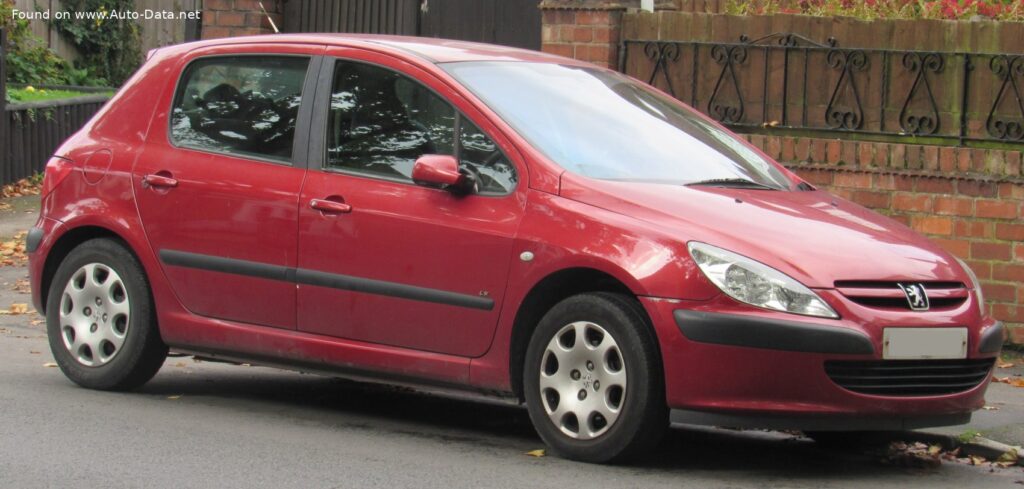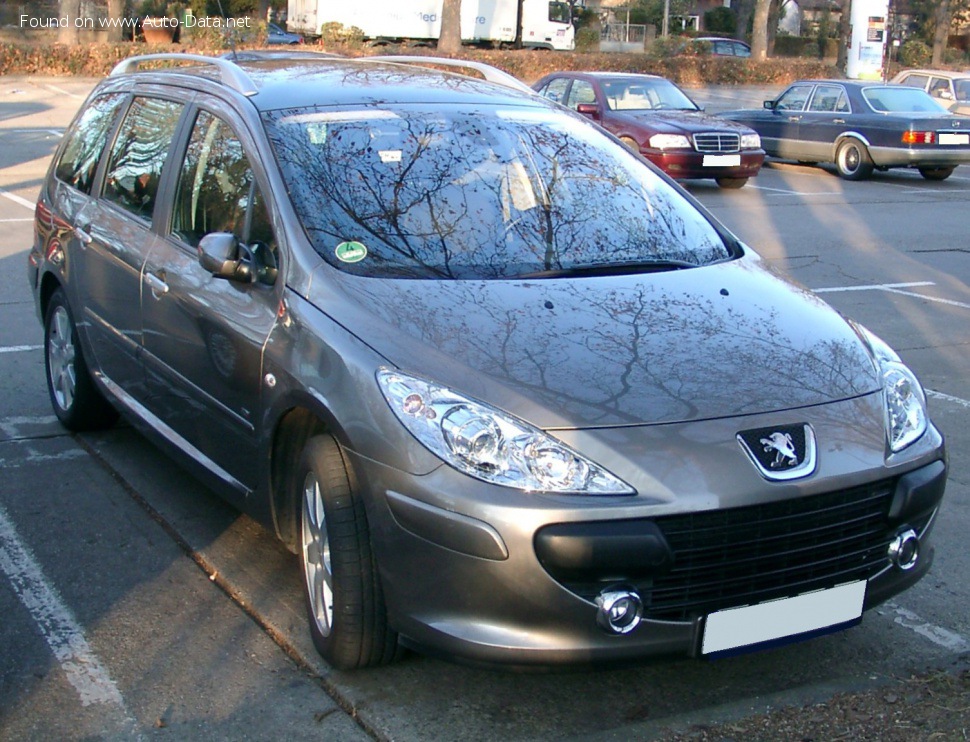
The Peugeot 307 Station Wagon (facelift 2005) 1.6 (109 Hp) Automatic represents a significant vehicle in the European C-segment, offering a practical and versatile solution for families during its production run. Introduced as the successor to the popular 306 in 2001, the station wagon variant received a facelift in 2005, modernizing its aesthetics and refining its overall package to remain competitive in a fiercely contested market. While never officially sold in the United States, the 307 Station Wagon played a crucial role in Europe, providing a spacious and economical alternative to larger vehicles and the burgeoning SUV segment.
Engine & Performance
The Peugeot 307 Station Wagon (facelift 2005) 1.6 is powered by a naturally aspirated 1.6-liter (1587 cm3 or 96.84 cu. in.) inline-four petrol engine, designated NFU TU5JP4 by Peugeot. This engine was a common choice in Peugeot’s smaller and mid-sized models, known for its balance of performance and fuel efficiency. It produces 109 horsepower (Hp) at 5800 revolutions per minute (rpm) and 147 Newton meters (Nm) of torque, equivalent to 108.42 pound-feet (lb.-ft.) at 4000 rpm. The engine employs a multi-port manifold injection system, a reliable fuel delivery method for its time, ensuring consistent power and fuel atomization.
Power is transferred to the front wheels via a 4-speed automatic transmission. While modern vehicles often utilize more gears, this 4-speed unit was typical for compact cars of the era, prioritizing smooth, unhurried shifts suitable for both urban driving and highway cruising. The drivetrain configuration – a transversely mounted front engine driving the front wheels – is a standard setup for compact vehicles, maximizing interior space and minimizing manufacturing costs.
Fuel economy figures for the 307 Station Wagon 1.6 Automatic were competitive for its segment. It achieved 11.4 liters per 100 kilometers (20.6 US mpg) in urban conditions, and a more efficient 6.3 liters per 100 kilometers (37.3 US mpg) on the extra-urban cycle. The combined fuel economy was 8.3 liters per 100 kilometers (28.3 US mpg). These figures, while not exceptional by today’s standards, represented a practical compromise for a family-oriented vehicle. The vehicle also met the Euro 4 emission standard, with CO2 emissions of 194 grams per kilometer, reflecting the environmental regulations of the time.
Design & Features
The Peugeot 307 Station Wagon (facelift 2005) is a five-door station wagon (estate) designed to accommodate five passengers. The 2005 facelift brought subtle but effective changes to the front fascia, including redesigned headlights, a larger grille – often referred to as the “lion’s mouth” – and revised bumper styling, aligning its appearance with other contemporary Peugeot models like the 407. These updates provided a more modern and assertive aesthetic.
The vehicle’s dimensions – a length of 174.33 inches, a width of 69.37 inches, and a height ranging from 61.42 to 62.2 inches – provided a substantial footprint for its class, contributing to a spacious interior. A wheelbase of 106.61 inches further enhanced passenger comfort and stability. The primary advantage of the 307 Station Wagon was its cargo capacity. With all seats in place, the trunk offered 18.36 cubic feet (520 liters) of space. Folding the rear seats expanded this to an impressive 78.08 cubic feet (2211 liters), enabling the transport of substantial amounts of luggage, groceries, or larger items. This flexibility was a key selling point in the European market, where station wagons are highly valued for their practicality.
Safety features included an Anti-lock Braking System (ABS) as standard, along with ventilated disc brakes at the front and solid disc brakes at the rear, providing reliable stopping power. The steering system utilized a rack and pinion setup, offering a direct and predictable feel. The vehicle’s kerb weight was 3238.59 lbs (1469 kg), with a maximum permissible weight of 4365.15 lbs (1980 kg), allowing for a maximum load of 1126.56 lbs (511 kg). A fuel tank capacity of 15.85 US gallons (60 liters) provided a reasonable range between refueling stops.
Technical Specifications
| Category | Specification |
| Brand | Peugeot |
| Model | 307 Station Wagon (facelift 2005) |
| Type (Engine) | 1.6 (109 Hp) Automatic |
| Production Start | 2005 |
| Production End | 2008 |
| Powertrain Architecture | Internal Combustion Engine |
| Body Type | Station wagon (estate) |
| Seats | 5 |
| Doors | 5 |
| Fuel Consumption (Urban) | 11.4 l/100 km (20.6 US mpg) |
| Fuel Consumption (Extra Urban) | 6.3 l/100 km (37.3 US mpg) |
| Fuel Consumption (Combined) | 8.3 l/100 km (28.3 US mpg) |
| CO2 Emissions | 194 g/km |
| Fuel Type | Petrol (Gasoline) |
| Emission Standard | Euro 4 |
| Weight-to-Power Ratio | 13.5 kg/Hp (74.2 Hp/tonne) |
| Weight-to-Torque Ratio | 10 kg/Nm (100.1 Nm/tonne) |
| Power | 109 Hp @ 5800 rpm |
| Power per Liter | 68.7 Hp/l |
| Torque | 147 Nm @ 4000 rpm (108.42 lb.-ft. @ 4000 rpm) |
| Engine Layout | Front, Transverse |
| Engine Model/Code | NFU TU5JP4 |
| Engine Displacement | 1587 cm3 (96.84 cu. in.) |
| Number of Cylinders | 4 |
| Engine Configuration | Inline |
| Cylinder Bore | 78.5 mm (3.09 in.) |
| Piston Stroke | 82 mm (3.23 in.) |
| Number of Valves per Cylinder | 4 |
| Fuel Injection System | Multi-port manifold injection |
| Engine Aspiration | Naturally aspirated engine |
| Kerb Weight | 1469 kg (3238.59 lbs) |
| Max. Weight | 1980 kg (4365.15 lbs) |
| Max Load | 511 kg (1126.56 lbs) |
| Trunk (boot) Space – Minimum | 520 l (18.36 cu. ft.) |
| Trunk (boot) Space – Maximum | 2211 l (78.08 cu. ft.) |
| Fuel Tank Capacity | 60 l (15.85 US gal) |
| Length | 4428 mm (174.33 in.) |
| Width | 1762 mm (69.37 in.) |
| Height | 1560-1580 mm (61.42 – 62.2 in.) |
| Wheelbase | 2708 mm (106.61 in.) |
Legacy and Market Impact
The Peugeot 307 Station Wagon (facelift 2005), and the 307 range as a whole, established a strong presence in the European compact car market. It competed with models like the Volkswagen Golf Variant, Ford Focus Estate, Renault Mégane Estate, and Opel Astra Caravan. Peugeot positioned the 307 as a stylish, comfortable, and practical family vehicle, praised for its “tall body” design, offering excellent headroom and a commanding driving position. The 1.6-liter engine proved reliable and economical for many families, while the station wagon’s spacious interior and cargo capacity were key differentiators.
Despite some early concerns regarding build quality and electronics, the facelifted models benefited from refinements. The 307 Station Wagon contributed to Peugeot’s reputation for producing practical, well-designed vehicles, particularly in segments prioritizing practicality and fuel efficiency. Its success paved the way for the Peugeot 308, which continued the brand’s tradition in the compact segment. The 307 Station Wagon’s absence from the US market underscores the differing automotive preferences and market dynamics between Europe and North America during that period.