
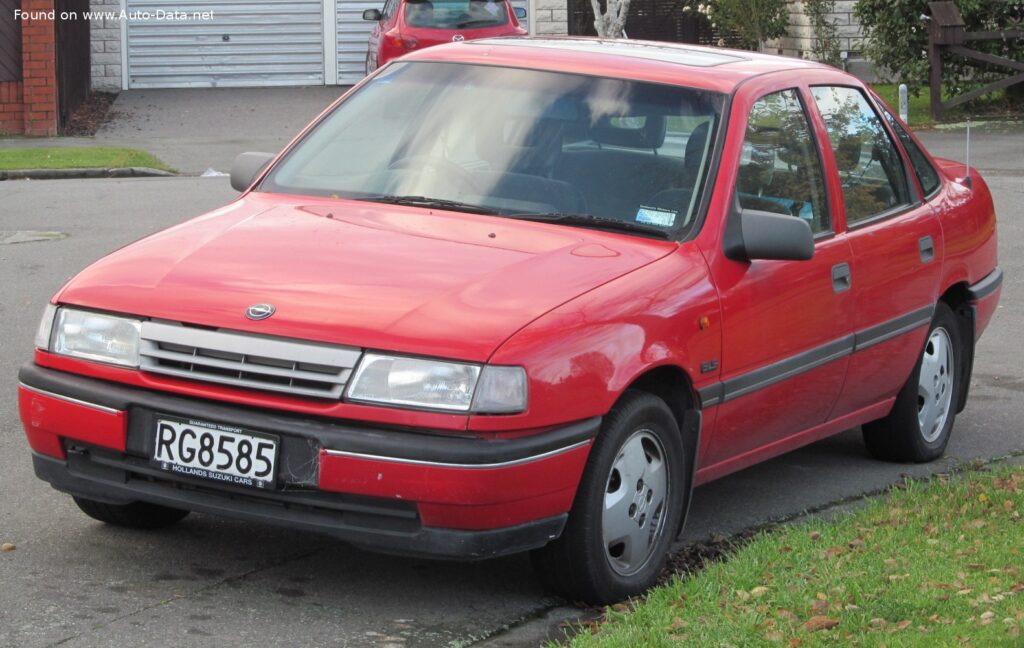
The Opel Vectra A, launched in 1988, represented a significant step forward for Opel (and its British counterpart, Vauxhall, where it was known as the Cavalier Mk3) in the competitive European mid-size family car segment. As a direct successor to the long-running Ascona/Cavalier Mk2, the Vectra A introduced a more modern, aerodynamically efficient design and a range of technological advancements for its time. It aimed to compete with established rivals like the Ford Sierra and Volkswagen Passat by offering a compelling combination of practicality, comfort, and engineering prowess.
This specific variant, the Opel Vectra A 2.0i (115 Hp) 4×4, distinguished itself from its front-wheel-drive siblings with a sophisticated all-wheel-drive system. Produced for a limited period between 1988 and 1989, this model signified Opel’s exploration of enhanced traction and stability, particularly appealing in regions experiencing challenging weather conditions. The 2.0-liter gasoline engine, coupled with the all-wheel-drive architecture, promised a more secure and engaging driving experience compared to many two-wheel-drive vehicles of the period. While the Opel Vectra A was never officially sold in the United States, its engineering and market position in Europe offer valuable insights into the global automotive landscape of the late 1980s.
Engine & Performance of the Opel Vectra A
The Opel Vectra A 2.0i (115 Hp) 4×4 was powered by a robust and reliable 2.0-liter (1998 cm3 or 121.93 cu. in.) naturally aspirated inline-four engine, designated the 20NE. This engine was a mainstay for Opel during this era, known for its dependability and respectable performance. Fuel delivery was managed by a single-point injection system, a common technology at the time that improved efficiency and reduced emissions compared to carbureted engines.
The engine produced 115 horsepower at 5200 rpm, resulting in a power output of 57.6 horsepower per liter. Torque figures were also competitive for the segment, peaking at 170 Newton-meters (approximately 125.39 lb.-ft.) at 2600 rpm. This broad torque band contributed to the car’s tractable nature, making it suitable for both urban driving and highway cruising. Power was transmitted to all four wheels through a 5-speed manual transmission, a setup that was both engaging and efficient for the period.
In terms of performance, the Vectra A 2.0i (115 Hp) 4×4 could accelerate from 0 to 60 mph in approximately 10.5 seconds, a commendable figure for a family sedan with all-wheel drive in 1988. Its top speed reached 119.3 mph (192 km/h), allowing it to maintain pace with traffic on European autobahns. Fuel economy, while not a primary selling point for a 4×4 variant, was reasonable for the time, averaging 27.4 US mpg (8.6 liters per 100 km) in combined driving conditions. The all-wheel-drive system, while adding weight and complexity, provided a significant advantage in terms of grip and stability, particularly on slippery surfaces or in adverse weather, making it a safer and more confident choice for many European drivers.
Design & Features of the Opel Vectra A
The Opel Vectra A, as a sedan, reflected the design trends of the late 1980s, emphasizing aerodynamics and passenger comfort. Its sleek, rounded lines were a departure from the boxier designs of previous decades, contributing to an impressive drag coefficient (Cd) of just 0.29. This not only improved fuel efficiency but also reduced wind noise at higher speeds, enhancing the overall driving experience. The four-door, five-seat configuration made it a practical choice for families, offering ample space for passengers and luggage.
Measuring 174.49 inches (4432 mm) in length, 67.17 inches (1706 mm) in width, and 55.12 inches (1400 mm) in height, the Vectra A had a substantial yet manageable footprint. The 102.36-inch (2600 mm) wheelbase ensured a comfortable ride and stable handling. Inside, the Vectra A prioritized functionality. While not luxurious, the interior was well-appointed for its class, featuring durable materials and an ergonomic layout. The trunk space was particularly generous, offering a minimum of 18.72 cu. ft. (530 liters) and expanding to 29.66 cu. ft. (840 liters) with the rear seats folded down, providing excellent versatility for carrying cargo.
Standard features for the 1988 model year included power steering, a capable heating and ventilation system, and a basic audio system. Safety features, while not as advanced as those found in modern vehicles, included three-point seatbelts for front and outer rear passengers and a robust passenger safety cell. The integration of the 4×4 drivetrain was a key feature of this variant, providing superior traction and handling dynamics compared to front-wheel-drive counterparts, especially in challenging driving conditions like snow or rain, common in many parts of Europe.
Opel Vectra A 2.0i (115 Hp) 4×4: Technical Specifications
| Category | Specification |
| Brand | Opel |
| Model | Vectra |
| Generation | Vectra A |
| Type (Engine) | 2.0i (115 Hp) 4×4 |
| Start of Production | 1988 |
| End of Production | 1989 |
| Powertrain Architecture | Internal Combustion engine |
| Body type | Sedan |
| Seats | 5 |
| Doors | 4 |
| Fuel consumption (economy) – combined | 8.6 l/100 km |
| Fuel Type | Petrol (Gasoline) |
| Acceleration 0 – 62 mph | 11 sec |
| Acceleration 0 – 60 mph (Calculated) | 10.5 sec |
| Maximum speed | 192 km/h |
| Power | 115 Hp @ 5200 rpm. |
| Power per liter | 57.6 Hp/l |
| Torque | 170 Nm @ 2600 rpm. |
| Engine layout | Front, Transverse |
| Engine Model/Code | 20NE |
| Engine displacement | 1998 cm3 |
| Number of cylinders | 4 |
| Engine configuration | Inline |
| Cylinder Bore | 86 mm |
| Piston Stroke | 86 mm |
| Compression ratio | 9.2:1 |
| Number of valves per cylinder | 2 |
| Fuel injection system | Single-point injection |
| Engine aspiration | Naturally aspirated engine |
| Valvetrain | OHC |
| Engine oil capacity | 4 l |
| Coolant | 7.2 l |
| Trunk (boot) space – minimum | 530 l |
| Trunk (boot) space – maximum | 840 l |
| Fuel tank capacity | 61 l |
| Length | 4432 mm |
| Width | 1706 mm |
| Height | 1400 mm |
| Wheelbase | 2600 mm |
| Front track | 1420 mm |
| Rear (Back) track | 1423 mm |
| Drag coefficient (Cd) | 0.29 |
| Drive wheel | All wheel drive (4×4) |
| Number of gears and type of gearbox | 5 gears, manual transmission |
The Opel Vectra A, and particularly the 2.0i (115 Hp) 4×4 variant, played a crucial role in establishing Opel as a major player in the European mid-size car market. It arrived at a time when family sedans were evolving, and the Vectra A’s blend of modern design, efficient engineering, and available all-wheel-drive technology made it a compelling choice for consumers. While never sold in the United States, the Vectra A remains a significant example of European automotive design and engineering from the late 1980s, and the rare 4×4 models are sought after by enthusiasts today.
