
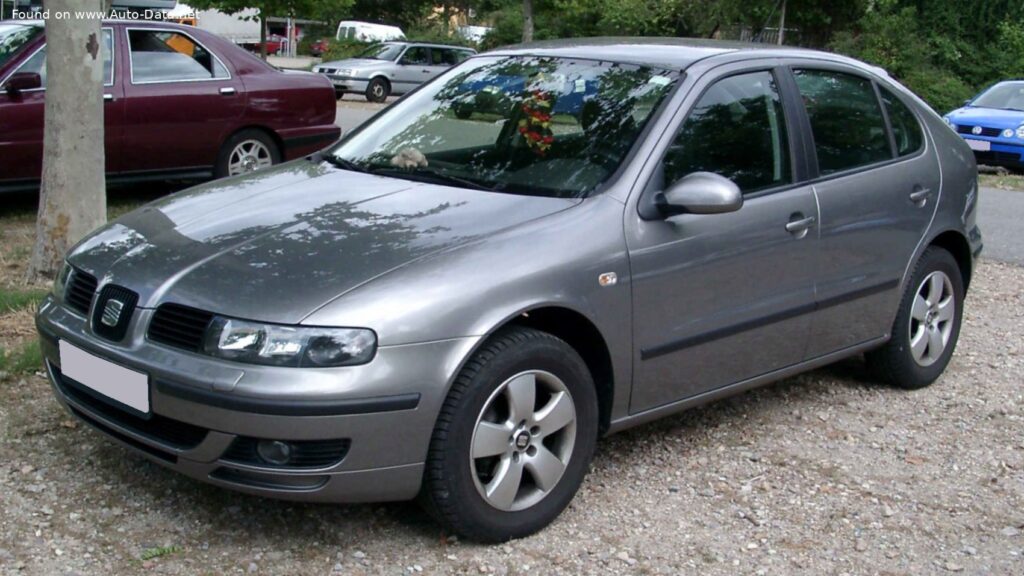
The Seat Leon I (1M) 1.9 SDI (68 Hp) represents a significant entry for the Spanish automaker into the competitive European C-segment. Launched in 1999, the Leon I (1M) aimed to establish SEAT as a distinct brand within the Volkswagen Group, offering a blend of style, practicality, and affordability. This particular variant, the 1.9 SDI (68 Hp), produced from June 2000 to October 2003, prioritized fuel economy and reliability, appealing to drivers seeking a dependable and economical daily driver. While never officially sold in the United States, the Leon I (1M) found success in Europe and select international markets as a well-built and stylish five-door hatchback, utilizing the proven PQ34 platform shared with other Volkswagen Group vehicles.
The Seat Leon I (1M): A European Compact
The first-generation Seat Leon, internally designated 1M, was SEAT’s response to the demand for a modern, compact hatchback. It competed directly with established models like the Volkswagen Golf, Opel Astra, and Ford Focus. The 1.9 SDI model specifically targeted budget-conscious buyers who valued low running costs and a no-nonsense approach to transportation. Its design, penned by Giorgetto Giugiaro and refined by SEAT’s design team, offered a more dynamic aesthetic than some of its platform siblings, contributing to SEAT’s evolving brand image as a sporty and passionate automaker. For European consumers, the 1.9 SDI provided a pragmatic solution for urban commuting and everyday transportation needs.
Engine & Performance: The 1.9 SDI Powerplant
The Seat Leon I (1M) 1.9 SDI is powered by the robust 1.9-liter SDI (Suction Diesel Injection) engine, identified by the code AQM. This naturally aspirated diesel engine, unlike its turbocharged TDI counterparts, relies solely on atmospheric pressure for air intake. This results in a power output of 68 horsepower at 4200 rpm and a peak torque of 98.1 lb.-ft. at 2200 rpm. While these figures are modest by contemporary standards, the engine is renowned for its longevity, simplicity, and exceptional fuel efficiency.
The naturally aspirated design delivers a linear and predictable power delivery, though acceleration is not its forte. The 0 to 60 mph sprint takes approximately 16.8 seconds, with a maximum speed of around 99.42 mph. The engine’s strength lies in its fuel economy, achieving a combined consumption of 45.2 US mpg. Coupled with a 14.53 US gallon fuel tank, this provides a substantial driving range, a key benefit for European drivers. The direct injection system, a hallmark of Volkswagen Group diesels, ensures efficient combustion and reduced emissions for its time. A smooth-shifting 5-speed manual transmission and front-wheel drive complete the powertrain, offering a direct and engaging driving experience.
Design & Features: Practicality and European Style
The Seat Leon I (1M) features a five-door hatchback body style, a popular choice in the European compact segment. Its exterior design is characterized by a more aggressive front fascia, distinctive character lines, and a subtly sculpted profile, giving it a sportier appearance. The vehicle’s dimensions – 164.72 inches in length, 68.58 inches in width, and 56.65 inches in height – place it squarely within the compact class, ensuring maneuverability in urban environments while providing adequate interior space.
The interior comfortably accommodates five occupants, with a focus on ergonomics and functionality. Standard features typically included power steering (hydraulic, providing good road feel) and essential safety systems like ABS (Anti-lock Braking System). The trunk offers 12.01 cubic feet of space with the rear seats up, expanding to 23.17 cubic feet when folded, providing versatility for carrying luggage or larger items. The suspension, featuring wishbones at the front and coil springs at the rear, delivers a comfortable yet controlled ride. Ventilated discs at the front and disc brakes at the rear provide adequate stopping power for the vehicle’s performance capabilities.
Technical Specifications: Seat Leon I (1M) 1.9 SDI (68 Hp)
| Category | Specification |
| General Information | Brand |
| Seat | |
| Model | |
| Leon | |
| Generation | |
| Leon I (1M) | |
| Engine Type | |
| 1.9 SDI (68 Hp) | |
| Production Start | |
| June, 2000 | |
| Production End | |
| October, 2003 | |
| Powertrain Architecture | |
| Internal Combustion Engine | |
| Body Type | |
| Hatchback | |
| Seats | |
| 5 | |
| Doors | |
| 5 | |
| Performance Specs | Fuel Consumption (Combined) |
| 45.2 US mpg (5.2 l/100 km) | |
| Fuel Type | |
| Diesel | |
| Acceleration 0 – 60 mph | |
| 16.8 sec | |
| Maximum Speed | |
| 99.42 mph (160 km/h) | |
| Weight-to-Power Ratio | |
| 18.7 kg/Hp (53.5 Hp/tonne) | |
| Weight-to-Torque Ratio | |
| 9.5 kg/Nm (104.7 Nm/tonne) | |
| Engine Specs | Power |
| 68 Hp @ 4200 rpm | |
| Power per Liter | |
| 35.9 Hp/l | |
| Torque | |
| 98.1 lb.-ft. @ 2200 rpm (133 Nm) | |
| Engine Layout | |
| Front, Transverse | |
| Engine Model/Code | |
| AQM | |
| Engine Displacement | |
| 1.9 Liters (1896 cm3 / 115.7 cu. in.) | |
| Number of Cylinders | |
| 4 | |
| Engine Configuration | |
| Inline | |
| Cylinder Bore | |
| 3.13 in. (79.5 mm) | |
| Piston Stroke | |
| 3.76 in. (95.5 mm) | |
| Compression Ratio | |
| 19.5:1 | |
| Valves per Cylinder | |
| 2 | |
| Fuel Injection System | |
| Direct injection | |
| Engine Aspiration | |
| Naturally aspirated engine | |
| Valvetrain | |
| OHC | |
| Engine Oil Capacity | |
| 4.76 US qt (4.5 l) | |
| Coolant Capacity | |
| 6.34 US qt (6 l) | |
| Space, Volume & Weights | Kerb Weight |
| 2799.87 lbs. (1270 kg) | |
| Maximum Weight | |
| 3836.04 lbs. (1740 kg) | |
| Maximum Load | |
| 1036.17 lbs. (470 kg) | |
| Trunk (Boot) Space – Minimum | |
| 12.01 cu. ft. (340 l) | |
| Trunk (Boot) Space – Maximum | |
| 23.17 cu. ft. (656 l) | |
| Fuel Tank Capacity | |
| 14.53 US gal (55 l) | |
| Dimensions | Length |
| 164.72 in. (4184 mm) | |
| Width | |
| 68.58 in. (1742 mm) | |
| Height | |
| 56.65 in. (1439 mm) | |
| Wheelbase | |
| 98.94 in. (2513 mm) | |
| Front Track | |
| 59.57 in. (1513 mm) | |
| Rear Track | |
| 58.74 in. (1492 mm) | |
| Drivetrain, Brakes & Suspension | Drivetrain Architecture |
| Front-wheel drive (ICE drives front wheels) | |
| Drive Wheel | |
| Front wheel drive | |
| Gearbox Type | |
| 5 gears, manual transmission | |
| Front Suspension | |
| Wishbone | |
| Rear Suspension | |
| Coil spring | |
| Front Brakes | |
| Ventilated discs | |
| Rear Brakes | |
| Disc | |
| Assisting Systems | |
| ABS (Anti-lock braking system) | |
| Steering Type | |
| Steering rack and pinion | |
| Power Steering | |
| Hydraulic Steering | |
| Tires Size | |
| 175/80 R14 |
Legacy and Market Impact of the Seat Leon I (1M)
The Seat Leon I (1M), particularly the 1.9 SDI variant, played a vital role in establishing SEAT’s identity and market position in Europe during the early 2000s. While not a performance-oriented model, the 1.9 SDI was a reliable and economical workhorse, embodying the practicality and cost-effectiveness sought by many European buyers. Its competitors included diesel versions of the Volkswagen Golf IV, Skoda Octavia, Ford Focus, Opel Astra, and Peugeot 307. The Leon distinguished itself with its distinctive styling and a perceived sportier character, even in its base configuration.
The SDI engine’s simplicity and robustness earned it a reputation for durability and low maintenance costs. The absence of a turbocharger meant fewer potential failure points, making it a popular choice for fleet operators and individuals prioritizing long-term reliability. Excellent fuel economy, a consistent strength of the 1.9 SDI, was a significant advantage in markets with higher diesel fuel prices. The first-generation Leon’s success helped solidify SEAT’s image as a youthful and dynamic brand, distinct from Volkswagen’s more conservative approach and Skoda’s value focus. The Seat Leon I (1M) laid the foundation for subsequent generations, continuing the themes of attractive design, strong performance (in other variants), and everyday usability. Even today, these models can be found in service across Europe, a testament to their enduring build quality and the reliability of their powertrain.
