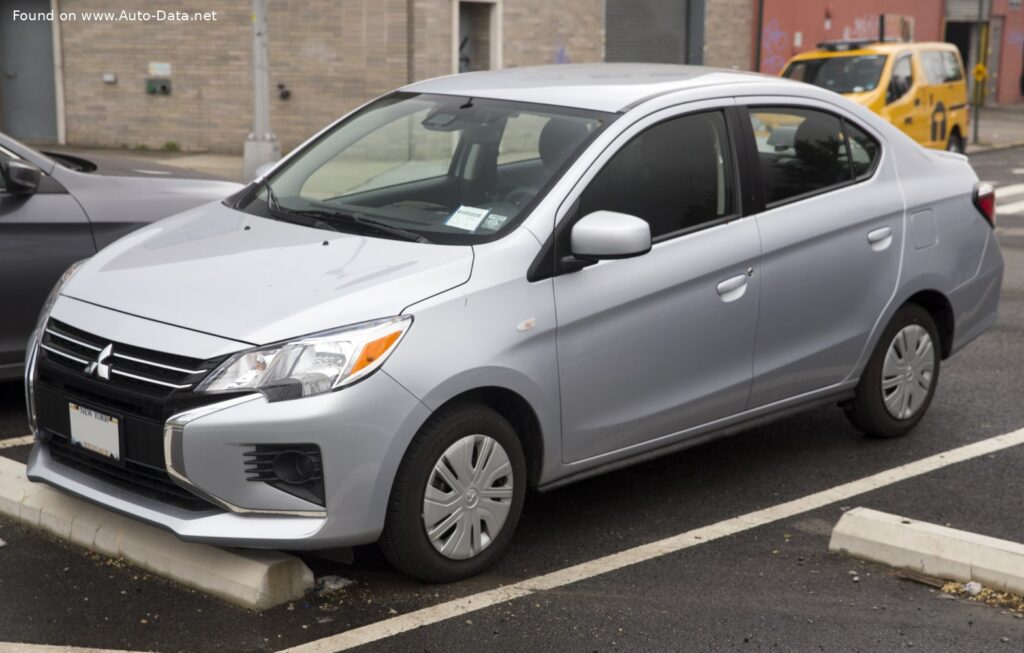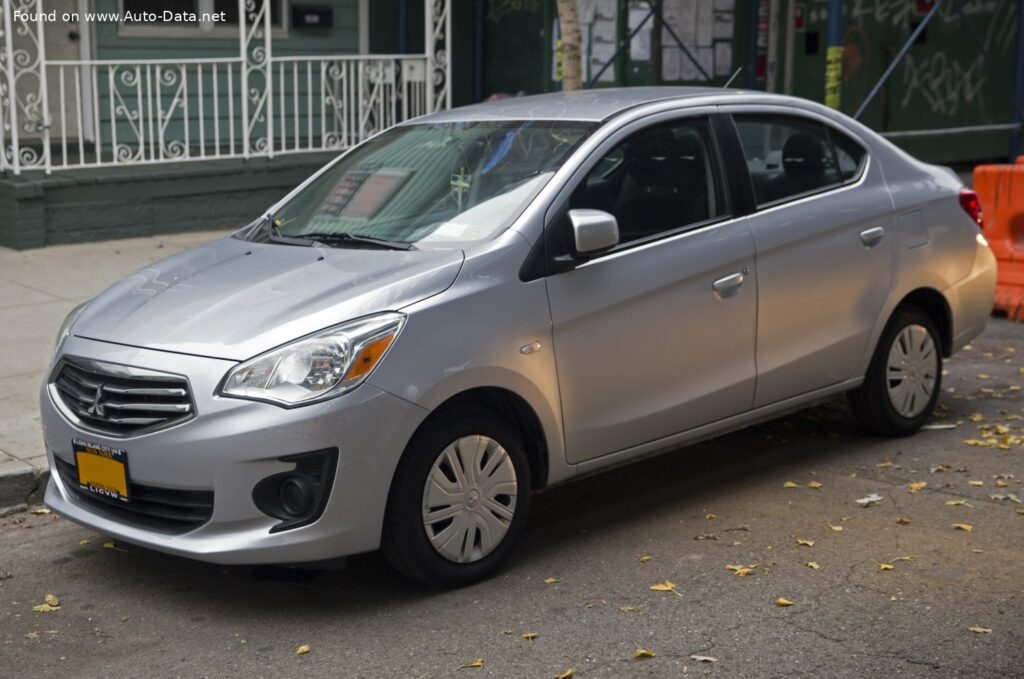
The Mitsubishi Mirage G4 (A10) 1.2 MIVEC (78 Hp) represents a significant offering in the subcompact sedan segment, a vehicle designed with a strong emphasis on affordability, fuel efficiency, and urban maneuverability. Launched in March 2013 and produced until November 2019, this generation of the Mirage G4, also known as the Attrage in some markets, served as Mitsubishi’s global entry-level sedan. It was conceived as a practical and economical choice for drivers in various international markets, including the United States, where it competed in a highly competitive budget-friendly category.
Building upon the success of the Mirage hatchback, the G4 variant introduced a conventional sedan body style, offering increased trunk capacity and a more traditional appearance favored by many consumers. Its powertrain architecture relies on an internal combustion engine driving the front wheels, a common and cost-effective setup for its class. The 1.2 MIVEC (Mitsubishi Innovative Valve timing Electronic Control system) engine was a core component of its strategy, promising reliable performance with exceptional fuel economy, making the Mitsubishi Mirage G4 (A10) a compelling option for budget-conscious buyers and those prioritizing low running costs.
Engine & Performance: The Efficient Heart of the Mitsubishi Mirage G4 (A10)
At the core of the Mitsubishi Mirage G4 (A10) 1.2 MIVEC (78 Hp) lies a compact yet capable 1.2-liter (1193 cm3 or 72.8 cu. in.) naturally aspirated inline three-cylinder engine, designated by the code 3A92. This powerplant is equipped with Mitsubishi’s MIVEC variable valve timing technology, designed to optimize valve lift and timing for improved efficiency and performance across the rev range. It produces a modest but adequate 78 horsepower at 6000 rpm, translating to a power per liter figure of 65.4 Hp/l, characteristic of an engine engineered for economy rather than outright speed.
Torque output stands at 100 Nm (73.76 lb.-ft.) delivered at 4000 rpm. While these figures might seem modest, they are well-suited for the vehicle’s lightweight construction, with a kerb weight of just 2105.41 lbs. (955 kg). This results in a weight-to-power ratio of 12.2 kg/Hp (81.7 Hp/tonne) and a weight-to-torque ratio of 9.6 kg/Nm (104.7 Nm/tonne), indicating that the engine is not overburdened and can provide sufficient acceleration for city driving and highway cruising. The engine features a DOHC (Dual Overhead Camshaft) valvetrain with four valves per cylinder and a compression ratio of 10.5:1, utilizing a multi-port manifold injection system for fuel delivery.
Power is transmitted to the front wheels via a standard 5-speed manual transmission, offering direct engagement and allowing drivers to extract the most efficiency from the small engine. This drivetrain setup contributes significantly to the car’s impressive fuel economy ratings. The combined fuel consumption is rated at 6.7 l/100 km, which translates to an excellent 35.1 US mpg. In urban driving, it achieves 7.1 l/100 km (33.1 US mpg), and on the extra-urban cycle, it boasts 5.9 l/100 km (39.9 US mpg), making it one of the most fuel-efficient non-hybrid vehicles in its class during its production run. The fuel tank capacity is 35 liters (9.25 US gallons), providing a decent range given its high efficiency.
Design & Features: Practicality in a Compact Package
The Mitsubishi Mirage G4 (A10) adopts a conventional four-door, five-seat sedan body type, designed for maximum practicality within its compact footprint. With an overall length of 169.49 inches (4305 mm), a width of 65.71 inches (1669 mm), and a height of 59.21 inches (1504 mm), the G4 is adept at navigating crowded urban environments and fitting into tight parking spaces. Its wheelbase measures 100.39 inches (2550 mm), contributing to a stable ride for its size, while a minimum turning circle of 31.5 feet (9.6 m) ensures excellent maneuverability.
The exterior design is characterized by smooth lines and a functional aesthetic, prioritizing aerodynamics to further enhance fuel efficiency. While not overtly sporty, its appearance is clean and inoffensive, appealing to a broad segment of budget-conscious buyers. Inside, the cabin is designed for functionality and ease of use. Despite its compact exterior dimensions, the Mirage G4 offers a surprisingly spacious interior for its class, accommodating five occupants with reasonable comfort, particularly for shorter journeys. The trunk space is a respectable 12.32 cu. ft. (349 liters), providing ample room for daily errands or weekend luggage, a key advantage of the sedan body style over its hatchback sibling.
In terms of features, the Mirage G4 (A10) focused on providing essential amenities and safety systems without unnecessary frills to keep costs down. Standard safety equipment includes an Anti-lock Braking System (ABS), which was a crucial feature for stability during emergency braking. The vehicle is equipped with ventilated discs at the front and traditional drum brakes at the rear, a common setup for subcompact cars of this era. Steering is handled by an electric power steering rack and pinion system, offering light and effortless steering, particularly beneficial in city driving. The front suspension employs an independent McPherson type, while the rear uses a torsion beam setup, a simple yet effective arrangement for balancing ride comfort and cost. The car typically came with 165/65 R14 or 175/55 R15 tires on 14 or 15-inch wheel rims, respectively.
Mitsubishi Mirage G4 (A10) 1.2 MIVEC (78 Hp) – Technical Specifications
| Category | Specification |
| General Information | |
| Brand | Mitsubishi |
| Model | Mirage G4 (A10) |
| Type (Engine) | 1.2 MIVEC (78 Hp) |
| Production Start | March, 2013 |
| Production End | November, 2019 |
| Powertrain Architecture | Internal Combustion Engine |
| Body Type | Sedan |
| Seats | 5 |
| Doors | 4 |
| Performance Specs | |
| Fuel Consumption (Urban) | 7.1 l/100 km |
| Fuel Consumption (Extra Urban) | 5.9 l/100 km |
| Fuel Consumption (Combined) | 6.7 l/100 km |
| Fuel Type | Petrol (Gasoline) |
| Weight-to-Power Ratio | 12.2 kg/Hp |
| Weight-to-Torque Ratio | 9.6 kg/Nm |
| Engine Specs | |
| Power | 78 Hp @ 6000 rpm |
| Power per Liter | 65.4 Hp/l |
| Torque | 100 Nm @ 4000 rpm |
| Engine Layout | Front, Transverse |
| Engine Model/Code | 3A92 |
| Engine Displacement | 1193 cm3 |
| Number of Cylinders | 3 |
| Engine Configuration | Inline |
| Cylinder Bore | 75 mm |
| Piston Stroke | 90 mm |
| Compression Ratio | 10.5:1 |
| Valves per Cylinder | 4 |
| Fuel Injection System | Multi-port manifold injection |
| Engine Aspiration | Naturally aspirated |
| Valvetrain | DOHC |
| Space, Volume and Weights | |
| Kerb Weight | 955 kg |
| Trunk (boot) Space – Minimum | 349 l |
| Fuel Tank Capacity | 35 l |
| Dimensions | |
| Length | 4305 mm |
| Width | 1669 mm |
| Height | 1504 mm |
| Wheelbase | 2550 mm |
| Drivetrain, Brakes and Suspension Specs | |
| Drivetrain Architecture | Internal Combustion engine drives front wheels |
| Front Suspension | Independent type McPherson |
| Rear Suspension | Torsion |
Legacy and Market Impact
The Mitsubishi Mirage G4 (A10) 1.2 MIVEC (78 Hp) carved out a distinct niche in the global automotive market, particularly appealing to consumers seeking maximum value and minimal running costs. Its primary market impact was felt in its ability to offer an accessible and reliable new car experience at a price point that few competitors could match. In markets like the United States, it served as Mitsubishi’s most affordable offering, often attracting first-time car buyers, students, or those simply looking for a no-frills commuter vehicle.
Its reputation was largely built on its exceptional fuel economy, which often surpassed competitors, and its perceived long-term reliability, a hallmark of Mitsubishi vehicles. While often criticized for its modest power output and basic interior appointments compared to more premium subcompacts, the Mirage G4 never pretended to be anything other than a utilitarian and economical choice. This honesty in its positioning allowed it to find a loyal customer base who prioritized practicality over performance or luxury.
In the highly competitive subcompact segment, the Mirage G4 faced rivals such as the Nissan Versa, Hyundai Accent, Kia Rio, and Chevrolet Spark. While these competitors often offered slightly more refined interiors, more powerful engine options, or more advanced infotainment systems, the Mirage G4 consistently held an edge in terms of initial purchase price and fuel efficiency. This made it particularly strong in emerging markets across Asia and Latin America, where these attributes are paramount.
The Mirage G4’s legacy is one of a pragmatic and resilient vehicle. It demonstrated Mitsubishi’s commitment to providing accessible transportation solutions worldwide. Despite being discontinued in its specific A10 generation in 2019, the Mirage G4 continues in subsequent iterations, underscoring its enduring relevance as a global subcompact workhorse. It remains a testament to the idea that a car doesn’t need to be flashy or powerful to be successful; sometimes, being incredibly efficient, affordable, and reliable is more than enough to make a significant market impact.