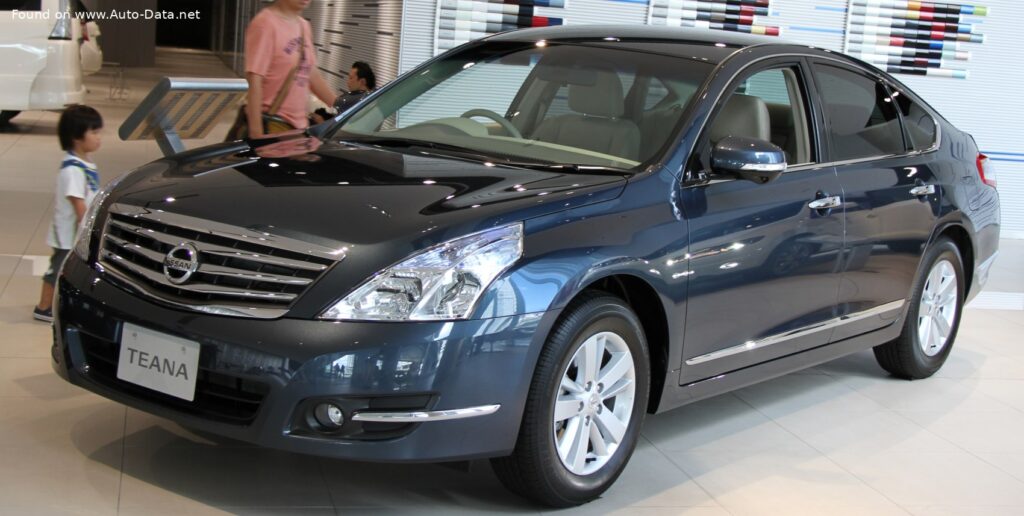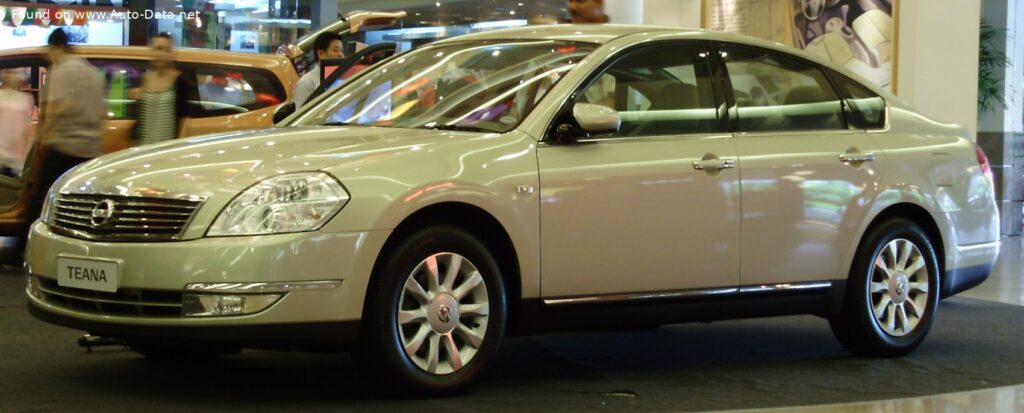
The Nissan Teana 2.3 i V6 24V (173 Hp) represents Nissan’s strategic foray into the mid-size luxury sedan market, primarily targeting international consumers outside of North America. Produced from 2003 to 2008 as the first generation (J31), the Teana aimed to deliver a comfortable, sophisticated, and well-equipped vehicle to compete with established rivals in Asia, the Middle East, parts of Europe, and Latin America. It distinguished itself by offering a smooth V6 powertrain and a focus on interior space and refinement, positioning itself as a compelling alternative to models from Toyota, Honda, and other regional manufacturers.
Engine & Performance: The VQ23DE V6
Powering the Nissan Teana 2.3 i V6 24V (173 Hp) is Nissan’s highly regarded VQ23DE 2.3-liter V6 engine. This engine is part of the celebrated VQ engine family, known for its smooth operation, inherent reliability, and strong performance characteristics. The naturally aspirated engine boasts a displacement of 2349 cm3 (143.34 cu. in.) and utilizes a Double Overhead Camshaft (DOHC) valvetrain with 24 valves, optimizing airflow for efficient combustion. It generates 173 horsepower at 6000 rpm, achieving a power-per-liter ratio of 73.6 HP/l. Torque output is rated at 220 Nm (162.26 lb.-ft.) at 4400 rpm, providing ample power for both everyday driving and highway passing maneuvers.
The engine’s power is channeled to the front wheels via a conventional 4-speed automatic transmission. While not the most advanced transmission technology by modern standards, it was well-suited to the engine’s characteristics, prioritizing smooth and relaxed shifts over sporty responsiveness. The Teana 2.3 i V6 24V achieves a 0 to 60 mph acceleration time of 10.2 seconds and a top speed of 121.79 mph (196 km/h). These figures confirm its positioning as a comfortable cruiser rather than a performance-oriented sedan. Fuel economy is rated at a combined 22.8 US mpg (10.3 l/100 km), with 17.2 US mpg (13.7 l/100 km) in urban driving and 28.3 US mpg (8.3 l/100 km) on the open road. A substantial 18.49 US gallon (70-liter) fuel tank provides a considerable driving range.
Design & Features: “Modern Living” Philosophy
The first-generation Nissan Teana (J31) embodies a design philosophy centered around the “Modern Living” concept, prioritizing a spacious and aesthetically pleasing interior environment. The exterior styling is characterized by clean lines and a dignified, understated elegance, appealing to buyers seeking sophistication without ostentation. As a traditional four-door sedan with seating for five passengers, the Teana offers generous dimensions: a length of 190.75 inches (4845 mm), a width of 69.49 inches (1765 mm), and a height of 58.07 inches (1475 mm). A wheelbase of 109.25 inches (2775 mm) contributes to a spacious cabin and a stable ride quality.
The interior focuses on comfort and practicality. The trunk provides 16.81 cu. ft. (476 liters) of cargo space, suitable for family trips or business needs. The suspension system, featuring coil springs at the front and spring struts at the rear, is tuned for ride comfort, effectively absorbing road imperfections. Safety features include ventilated disc brakes at the front and solid disc brakes at the rear, complemented by an Anti-lock Braking System (ABS) for enhanced control. Steering is precise and predictable thanks to a rack and pinion system. The vehicle is equipped with 205/65 R16 tires, balancing ride comfort with adequate grip. The interior features high-quality materials, ergonomic design, and amenities like automatic climate control and a comprehensive audio system, contributing to a refined and comfortable cabin experience. Ambient lighting and comfortable seating further enhance the overall driving and passenger experience.
Nissan Teana 2.3 i V6 24V (173 Hp) Technical Specifications
| Brand | Nissan |
| Model | Teana |
| Generation | Teana (J31) |
| Type (Engine) | 2.3 i V6 24V (173 Hp) |
| Start of production | 2003 year |
| End of production | 2008 year |
| Powertrain Architecture | Internal Combustion engine |
| Body type | Sedan |
| Seats | 5 |
| Doors | 4 |
| Fuel consumption (economy) – urban | 13.7 l/100 km (17.2 US mpg) |
| Fuel consumption (economy) – extra urban | 8.3 l/100 km (28.3 US mpg) |
| Fuel consumption (economy) – combined | 10.3 l/100 km (22.8 US mpg) |
| Fuel Type | Petrol (Gasoline) |
| Acceleration 0 – 60 mph | 10.2 sec |
| Maximum speed | 196 km/h (121.79 mph) |
| Weight-to-power ratio | 8.8 kg/Hp (114.3 Hp/tonne) |
| Weight-to-torque ratio | 6.9 kg/Nm (145.3 Nm/tonne) |
| Power | 173 Hp @ 6000 rpm |
| Power per liter | 73.6 Hp/l |
| Torque | 220 Nm (162.26 lb.-ft.) @ 4400 rpm |
| Engine layout | Front, Transverse |
| Engine Model/Code | VQ23DE |
| Engine displacement | 2349 cm3 (143.34 cu. in.) |
| Number of cylinders | 6 |
| Engine configuration | V-engine |
| Cylinder Bore | 85 mm (3.35 in.) |
| Piston Stroke | 69 mm (2.72 in.) |
| Number of valves per cylinder | 4 |
| Fuel injection system | Multi-port manifold injection |
| Engine aspiration | Naturally aspirated engine |
| Valvetrain | DOHC |
| Engine oil capacity | 4 l (4.23 US qt) |
| Coolant | 8.2 l (8.66 US qt) |
| Kerb Weight | 1514 kg (3337.8 lbs.) |
| Max. weight | 1990 kg (4387.2 lbs.) |
| Max load | 476 kg (1049.4 lbs.) |
| Trunk (boot) space – minimum | 476 l (16.81 cu. ft.) |
| Fuel tank capacity | 70 l (18.49 US gal) |
| Length | 4845 mm (190.75 in.) |
| Width | 1765 mm (69.49 in.) |
| Height | 1475 mm (58.07 in.) |
| Wheelbase | 2775 mm (109.25 in.) |
| Front track | 1530 mm (60.24 in.) |
| Rear (Back) track | 1535 mm (60.43 in.) |
| Drivetrain Architecture | The Internal combustion engine (ICE) drives the front wheels of the vehicle. |
| Drive wheel | Front wheel drive |
| Number of gears and type of gearbox | 4 gears, automatic transmission |
| Front suspension | Coil spring |
| Rear suspension | Spring Strut |
| Front brakes | Ventilated discs |
| Rear brakes | Disc |
| Assisting systems | ABS (Anti-lock braking system) |
| Steering type | Steering rack and pinion |
| Tires size | 205/65 R16 |
The first-generation Nissan Teana established a significant presence in its target markets as a comfortable, reliable, and subtly luxurious mid-size sedan. While not sold in North America, it successfully competed with vehicles like the Toyota Camry and Honda Accord in regions where it was offered. The Teana’s refined VQ V6 engine, spacious interior, and focus on ride quality made it a popular choice among families and professionals. Its success paved the way for subsequent generations, solidifying the Teana’s position as a key model in Nissan’s international lineup and demonstrating the company’s ability to cater to diverse regional preferences.