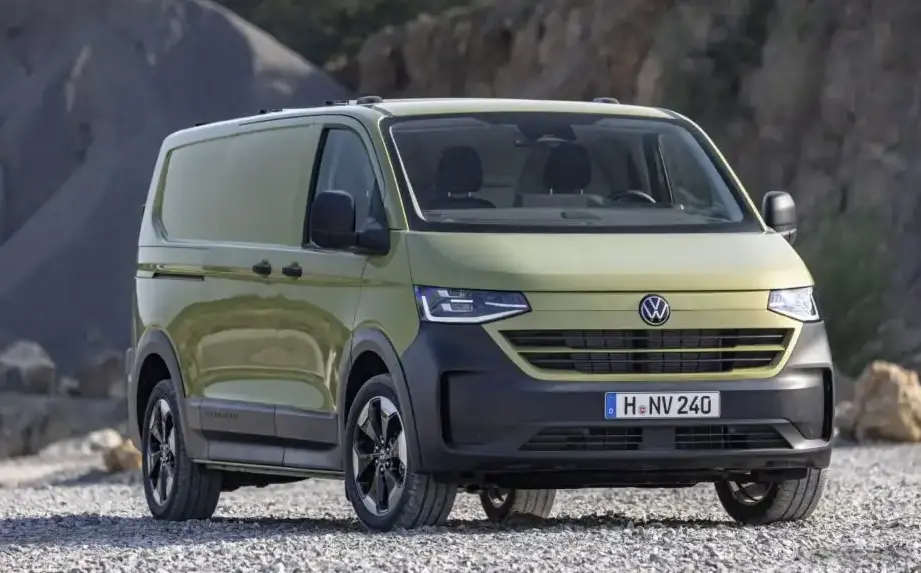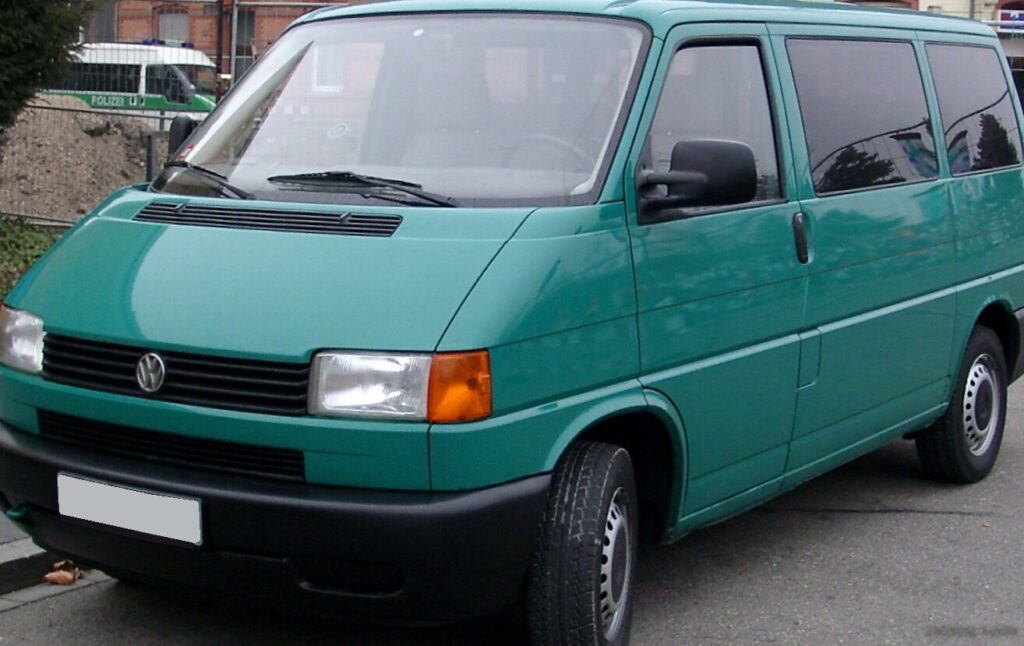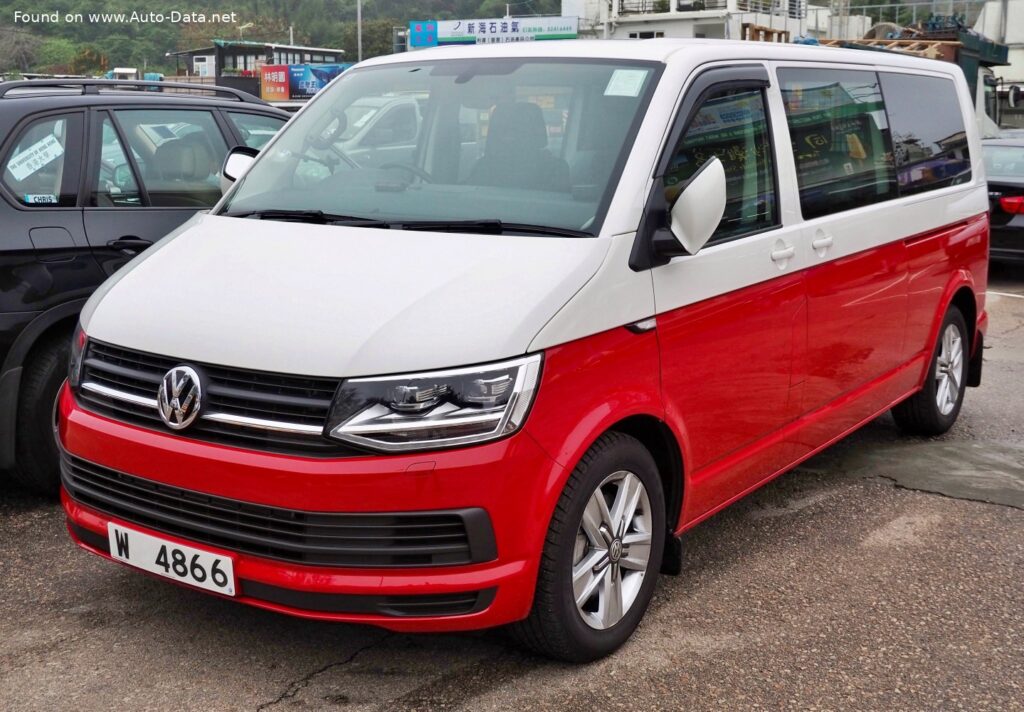
The Volkswagen Transporter (T6) Kombi 2.0 TDI (150 Hp) 4MOTION DSG L2H2 represents the sixth generation of Volkswagen’s iconic Transporter series, a lineage stretching back to the original Type 2 “Bus” of the 1950s. Produced from 2015 to 2019, the T6 built upon the robust foundations of its predecessors, offering a blend of versatility, efficiency, and refined driving dynamics tailored primarily for the European and other international markets. While not a common sight on American roads, where larger, purpose-built vans like the Ford Transit and Mercedes-Benz Sprinter dominate the commercial sector, the Transporter (T6) Kombi is a cornerstone of light commercial and multi-purpose vehicle segments across Europe, Asia, and Australia. This specific variant, the Kombi, signifies its dual-purpose nature, capable of comfortably transporting both passengers and cargo, making it an incredibly flexible solution for businesses and families alike. The “2.0 TDI (150 Hp)” denotes its efficient diesel powertrain, “4MOTION” highlights its advanced all-wheel-drive capability, “DSG” points to its sophisticated automatic transmission, and “L2H2” specifies its long wheelbase and high roof configuration, maximizing interior space.
Engine & Performance of the Volkswagen Transporter (T6) Kombi
At the heart of this particular Transporter (T6) Kombi variant lies a potent yet economical 2.0-liter TDI (Turbocharged Direct Injection) diesel engine. Coded EA288 / CXFA or CXHA, this inline four-cylinder powerplant delivers a respectable 150 horsepower (Hp) at an RPM range of 3250-3750, providing ample thrust for both urban deliveries and highway cruising. Its strength, however, is truly manifested in its torque output: a substantial 250.77 lb-ft (340 Nm) available across a broad rev band from 1500 to 3000 rpm. This low-end torque is crucial for a vehicle designed to carry heavy loads or tow trailers, enabling strong pulling power without excessive engine strain.
Power is efficiently managed by a 7-speed DSG (Direct-Shift Gearbox) automatic transmission, known for its rapid and smooth gear changes, contributing to both fuel efficiency and driving comfort. This sophisticated transmission pairs seamlessly with the 4MOTION all-wheel-drive system. Unlike many conventional 4×4 systems, Volkswagen’s 4MOTION in this architecture primarily drives the front wheels, engaging the rear wheels via an electrically or mechanically operated clutch only when additional traction is needed. This intelligent system optimizes fuel economy during normal driving conditions while providing enhanced grip and stability on slippery surfaces, unpaved roads, or during adverse weather.
Performance figures for the Volkswagen Transporter (T6) Kombi 2.0 TDI (150 Hp) 4MOTION DSG L2H2 are competitive for its class. It accelerates from 0 to 60 mph in approximately 12 seconds, reaching a maximum speed of 106.88 mph (172 km/h). Fuel economy is a significant strong suit, with combined (NEDC) figures ranging from 28.3 to 37.9 US mpg (6.2-8.3 l/100 km), which is commendable for a vehicle of its size and capability, especially with all-wheel drive. CO2 emissions are rated between 161-217 g/km, adhering to the Euro 6 emission standard, highlighting Volkswagen’s commitment to environmental compliance in its primary markets. Further enhancing its efficiency are standard features like the Start & Stop System, which conserves fuel by shutting off the engine during brief stops, and a particulate filter to reduce diesel emissions.
Design & Features: The Versatility of the Volkswagen Transporter (T6) Kombi
The Volkswagen Transporter (T6) Kombi maintains the familiar, functional aesthetic that has defined the Transporter series for decades, evolving with subtle yet significant design updates. Its body type is a classic van, characterized by its practical, boxy silhouette designed to maximize interior space. This specific L2H2 configuration denotes a Long wheelbase (3400 mm or 133.86 inches) and a High roof (2170 mm or 85.43 inches), which translates into an enormous maximum trunk (cargo) space of 7800 liters (275.45 cu. ft.). This makes it an incredibly versatile vehicle, capable of swallowing substantial amounts of cargo or accommodating between 4 and 9 passengers, depending on the seating arrangement.
With 4 to 5 doors, including typically a large sliding side door and a rear tailgate or barn doors, access to both the passenger and cargo areas is excellent. The Kombi variant is specifically designed for flexibility, often featuring removable or reconfigurable seating to switch between passenger transport and cargo hauling with relative ease. The interior, while focused on durability and ergonomics for commercial use, also offers a comfortable and modern environment, reflecting Volkswagen’s passenger car sensibilities.
Dimensions like its length of 208.82 inches (5304 mm) and width of 74.96 inches (1904 mm) (excluding mirrors) contribute to its substantial road presence and interior volume. The high roof allows for comfortable standing room for many adults within the cargo area, a significant advantage for certain commercial applications or camper conversions. Despite its size, a minimum turning circle of 43.31 feet (13.2 m) helps with maneuverability in tighter urban environments. Safety features, while not exhaustively listed in the provided data, include ABS (Anti-lock Braking System) as standard, with modern vehicles of this era typically incorporating a suite of electronic stability controls and airbags to meet stringent European safety standards. The robust chassis, independent McPherson front suspension, and independent coil spring rear suspension with wishbones and transverse stabilizers ensure a stable and compliant ride, even when fully loaded. The hydraulic power steering provides direct feedback and ease of control.
Technical Specifications: Volkswagen Transporter (T6) Kombi 2.0 TDI (150 Hp) 4MOTION DSG L2H2
| Category | Specification |
| General Information | |
| Brand | Volkswagen |
| Model | Transporter |
| Generation | Transporter (T6) Kombi |
| Type (Engine) | 2.0 TDI (150 Hp) 4MOTION DSG L2H2 |
| Start of production | 2015 year |
| End of production | 2019 year |
| Powertrain Architecture | Internal Combustion engine |
| Body type | Van |
| Seats | 4-9 |
| Doors | 4-5 |
| Performance Specs | |
| Fuel consumption (urban NEDC) | 6.9-9.5 l/100 km |
| Fuel consumption (extra urban NEDC) | 5.8-7.8 l/100 km |
| Fuel consumption (combined NEDC) | 6.2-8.3 l/100 km |
| CO2 emissions (NEDC) | 161-217 g/km |
| Fuel Type | Diesel |
| Acceleration 0 – 60 mph | 12 sec (Calculated) |
| Acceleration 0 – 100 km/h | 12.6 sec |
| Maximum speed | 172 km/h |
| Emission standard | Euro 6 |
| Weight-to-power ratio | 13.3 kg/Hp |
| Weight-to-torque ratio | 5.8 kg/Nm |
| Engine Specs | |
| Power | 150 Hp @ 3250-3750 rpm |
| Power per liter | 76.2 Hp/l |
| Torque | 340 Nm @ 1500-3000 rpm |
| Engine layout | Front, Transverse |
| Engine Model/Code | EA288 / CXFA, CXHA |
| Engine displacement | 1968 cm3 |
| Number of cylinders | 4 |
| Engine configuration | Inline |
| Cylinder Bore | 81 mm |
| Piston Stroke | 95.5 mm |
| Compression ratio | 15.5:1 |
| Number of valves per cylinder | 4 |
| Fuel injection system | Diesel Commonrail |
| Engine aspiration | Turbocharger, Intercooler |
| Valvetrain | DOHC |
| Engine oil capacity | 7.4 l |
| Engine systems | Start & Stop System, Particulate filter |
| Space, Volume and Weights | |
| Kerb Weight | 1988-2399 kg |
| Max. weight | 3000-3200 kg |
| Max load | 801-1012 kg |
| Trunk (boot) space – maximum | 7800 l |
| Fuel tank capacity | 70 l |
| AdBlue tank | 13 l |
| Max. roof load | 100 kg |
| Permitted trailer load with brakes (12%) | 2500 kg |
| Permitted trailer load without brakes | 750 kg |
| Permitted towbar download | 100 kg |
| Dimensions | |
| Length | 5304 mm |
| Width | 1904 mm |
| Width including mirrors | 2297 mm |
| Height | 2170 mm |
| Wheelbase | 3400 mm |
| Front overhang | 908 mm |
| Rear overhang | 993 mm |
| Ride height (ground clearance) | 202 mm |
| Minimum turning circle (turning diameter) | 13.2 m |
| Approach angle | 21.2° |
| Departure angle | 16.2° |
| Ramp-over (brakeover) angle | 12.2° |
| Drivetrain, Brakes and Suspension Specs | |
| Drivetrain Architecture | Internal combustion engine (ICE) drives the front wheels permanently, rear wheels driven through an electrically or mechanically operated clutch if necessary. |
| Drive wheel | All wheel drive (4×4) |
| Number of gears and type of gearbox | 7 gears, automatic transmission DSG |
| Front suspension | Independent, type McPherson with coil spring and anti-roll bar |
| Rear suspension | Independent coil spring, Wishbone, Transverse stabilizer |
| Front brakes | Ventilated discs, 308×29.5 mm |
| Rear brakes | Ventilated discs, 294×22 mm |
| Assisting systems | ABS (Anti-lock braking system) |
| Steering type | Steering rack and pinion |
| Power steering | Hydraulic Steering |
| Tires size | 205/65 R16; 215/65 R16 |
Legacy & Market Impact of the Volkswagen Transporter (T6) Kombi
The Volkswagen Transporter series boasts one of the richest and most enduring legacies in automotive history, with the T6 generation proudly continuing this tradition. Descended from the legendary Type 2 (T1) “Bus,” the Transporter has consistently evolved to meet the changing demands of commercial and private users worldwide. The T6 Kombi, in particular, solidified its reputation as an exceptionally versatile and reliable vehicle in its primary European market and other global regions where it was sold.
Its market impact in Europe was substantial, serving as a benchmark for versatility and build quality in the light commercial vehicle segment. The Kombi variant was especially popular due to its ability to seamlessly transition between a passenger shuttle and a cargo hauler, making it ideal for small businesses, tradespeople, and large families. Its robust construction, efficient diesel engines, and available 4MOTION all-wheel drive made it a preferred choice for challenging environments or for those requiring extra traction for towing.
Key competitors in the European market during its production years included the Ford Transit Custom, Mercedes-Benz Vito, Renault Trafic, and Opel Vivaro (Vauxhall Vivaro in the UK). While these rivals offered compelling packages, the Transporter often distinguished itself with its strong residual values, Volkswagen’s extensive service network, and a perceived higher level of refinement and driving dynamics that blurred the lines between a commercial van and a passenger car. The available DSG transmission and advanced 4MOTION system were also significant differentiators, offering a more car-like driving experience and superior all-weather capability compared to many front-wheel-drive-only competitors.
Historically, the Transporter series holds a significant place as a cultural icon, particularly the earlier generations. While the T6 adopted a more modern and functional approach, it carried forward the core values of practicality, durability, and a distinctive, understated design. Its influence extends beyond commercial fleets; it’s a popular base for campervan conversions, epitomizing the spirit of adventure and freedom that Volkswagen’s vans have long represented. The Transporter (T6) Kombi 2.0 TDI (150 Hp) 4MOTION DSG L2H2, therefore, is not just a commercial vehicle; it’s a testament to Volkswagen’s engineering prowess and its ability to produce a multi-purpose machine that is both highly capable and remarkably efficient, embodying a legacy of automotive excellence that continues to resonate globally, even if its direct presence in the American market remains limited.