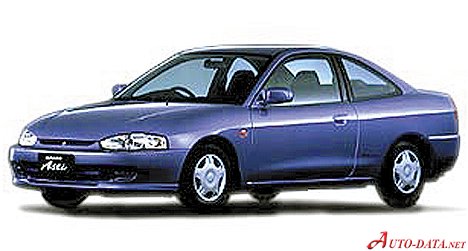
The Mitsubishi Mirage V Asti (CJO) 1.3 i 12V (88 Hp) represents a compelling chapter in the fifth generation of the Mitsubishi Mirage lineage, a line renowned globally for its compact dimensions, fuel efficiency, and commendable reliability. Introduced in 1996 and produced until 2002, this particular variant, often referred to simply as the Mirage Asti, carved out a niche in the compact coupe segment, primarily targeting markets in Japan and other Asian and European regions where smaller, more agile vehicles were highly valued. Unlike the more common sedan and hatchback body styles of the Mirage that saw broader international distribution, the Asti coupe offered a sportier, two-door alternative, blending practicality with a touch of youthful appeal.
Mitsubishi Mirage V Asti (CJO): A Detailed Overview
This specific model, equipped with a 1.3-liter, 12-valve engine producing 88 horsepower, was positioned as an economical yet sprightly option within its class. While not a powerhouse, its lightweight construction and efficient powertrain made it an ideal choice for urban environments and daily commuting, offering a balance of performance and cost-effectiveness. The Mirage V Asti (CJO) 1.3 i 12V (88 Hp) continued Mitsubishi’s tradition of offering well-engineered, no-nonsense vehicles designed to meet the pragmatic needs of its customers.
Engine & Performance
Under the hood, the Mitsubishi Mirage V Asti (CJO) 1.3 i 12V (88 Hp) featured a transversely mounted 1.3-liter (1298 cm3 or 79.21 cu. in.) inline-four cylinder engine. This naturally aspirated unit utilized a Single OverHead Camshaft (SOHC) valvetrain with four valves per cylinder, a configuration common for achieving a good balance of power and efficiency in compact engines of its era. Fuel delivery was managed by a multi-port manifold injection system, ensuring precise fuel-air mixture for optimal combustion.
The engine produced a respectable 88 horsepower at 6000 rpm, with a peak torque of 79.66 lb.-ft. (108 Nm) arriving at a relatively low 3000 rpm. This torque characteristic meant that the car felt responsive in city driving conditions, where low-end grunt is often more useful than outright top-end power. The power-to-liter ratio stood at 67.8 Hp/l, indicative of a well-tuned, efficient engine for its displacement. The compression ratio of 9.5:1 was standard for a naturally aspirated gasoline engine of this period.
Power was delivered to the front wheels via a 5-speed manual transmission, a setup that allowed the driver to extract the most from the engine while also contributing to the car’s fuel economy. Performance figures included an acceleration from 0 to 60 mph in an estimated 11.9 seconds, with a top speed of 105.63 mph (170 km/h). While these numbers might not excite performance enthusiasts today, they were competitive for a compact coupe in the mid-to-late 1990s, especially one focused on economy and everyday usability. The vehicle’s kerb weight of 2171.55 lbs (985 kg) also played a significant role in its nimble feel and respectable acceleration, resulting in a weight-to-power ratio of 11.2 kg/Hp.
Design & Features
The Mitsubishi Mirage V Asti (CJO) presented itself as a classic two-door coupe, embodying the sporty yet practical design philosophy prevalent in its segment during the late 1990s. Its compact dimensions, measuring 166.54 inches (4230 mm) in length, 66.54 inches (1690 mm) in width, and 53.74 inches (1365 mm) in height, coupled with a wheelbase of 95.08 inches (2415 mm), contributed to its agile handling and ease of maneuverability in congested urban environments. The design was clean and understated, with smooth lines and a modest grille, reflecting the era’s aesthetic preferences for aerodynamic efficiency without excessive ornamentation.
Inside, the Asti coupe offered seating for four occupants, though like many 2+2 coupes, the rear seating was more suitable for occasional use or smaller passengers. Despite its compact exterior, the trunk space was quite generous for its class, providing 14.83 cu. ft. (420 liters) of cargo capacity, making it surprisingly practical for grocery runs or weekend trips. This combination of a sporty exterior and practical interior space was a key selling point for young families or individuals seeking a versatile daily driver.
In terms of features, the Mirage V Asti (CJO) included several amenities considered standard or optional for its time. A hydraulic power steering system, utilizing a steering rack and pinion setup, ensured light and responsive steering, making parking and low-speed maneuvers effortless. Safety was addressed with the inclusion of an Anti-lock Braking System (ABS), a significant assisting system for improved stopping performance under challenging conditions. The braking system itself consisted of ventilated discs at the front and solid discs at the rear, providing adequate stopping power for the vehicle’s weight and performance capabilities. The car rode on 175/70 R13 tires, a common size for compact cars that offered a good balance of comfort, grip, and affordability.
The suspension system, featuring coil springs at both the front and rear, was designed to provide a comfortable ride while maintaining competent handling characteristics. This setup, combined with the front-wheel-drive architecture, contributed to the car’s predictable and stable road manners, making it an easy and confidence-inspiring vehicle to drive.
Technical Specifications
| Category | Specification |
| General Information | |
| Brand | Mitsubishi |
| Model | Mirage |
| Generation | Mirage V Asti (CJO) |
| Type (Engine) | 1.3 i 12V (88 Hp) |
| Start of Production | 1996 year |
| End of Production | 2002 year |
| Powertrain Architecture | Internal Combustion Engine |
| Body Type | Coupe |
| Seats | 4 |
| Doors | 2 |
| Performance Specifications | |
| Fuel Type | Petrol (Gasoline) |
| Acceleration 0 – 60 mph | Calculated by Auto-Data.net 11.9 sec |
| Acceleration 0 – 62 mph (0-100 km/h) | 12.5 sec |
| Maximum Speed | 105.63 mph (170 km/h) |
| Weight-to-Power Ratio | 11.2 kg/Hp, 89.3 Hp/tonne |
| Weight-to-Torque Ratio | 9.1 kg/Nm, 109.6 Nm/tonne |
| Engine Specifications | |
| Power | 88 Hp @ 6000 rpm |
| Power per Liter | 67.8 Hp/l |
| Torque | 79.66 lb.-ft. (108 Nm) @ 3000 rpm |
| Engine Layout | Front, Transverse |
| Engine Displacement | 1298 cm3 (79.21 cu. in.) |
| Number of Cylinders | 4 |
| Engine Configuration | Inline |
| Cylinder Bore | 2.8 in. (71 mm) |
| Piston Stroke | 3.23 in. (82 mm) |
| Compression Ratio | 9.5:1 |
| Number of Valves per Cylinder | 4 |
| Fuel Injection System | Multi-port manifold injection |
| Engine Aspiration | Naturally aspirated engine |
| Valvetrain | OHC |
| Space, Volume and Weights | |
| Kerb Weight | 2171.55 lbs (985 kg) |
| Max. Weight | 3086.47 lbs (1400 kg) |
| Max Load | 914.92 lbs (415 kg) |
| Trunk (boot) Space – Minimum | 14.83 cu. ft. (420 l) |
| Fuel Tank Capacity | 13.21 US gal (50 l) |
| Dimensions | |
| Length | 166.54 in. (4230 mm) |
| Width | 66.54 in. (1690 mm) |
| Height | 53.74 in. (1365 mm) |
| Wheelbase | 95.08 in. (2415 mm) |
| Front Track | 57.09 in. (1450 mm) |
| Rear (Back) Track | 57.48 in. (1460 mm) |
| Drivetrain, Brakes and Suspension Specifications | |
| Drivetrain Architecture | The Internal combustion engine (ICE) drives the front wheels of the vehicle. |
| Drive Wheel | Front wheel drive |
| Number of Gears and Type of Gearbox | 5 gears, manual transmission |
| Front Suspension | Coil spring |
| Rear Suspension | Coil spring |
| Front Brakes | Ventilated discs |
| Rear Brakes | Disc |
| Assisting Systems | ABS (Anti-lock braking system) |
| Steering Type | Steering rack and pinion |
| Power Steering | Hydraulic Steering |
| Tires Size | 175/70 R13 |
Legacy and Market Impact of the Mitsubishi Mirage V Asti (CJO)
The Mitsubishi Mirage V Asti (CJO) 1.3 i 12V (88 Hp) played a significant role in Mitsubishi’s global strategy for compact vehicles during the late 1990s and early 2000s. While the Mirage nameplate itself was widely recognized in various forms across different continents, the Asti coupe variant primarily catered to specific tastes in Asian and European markets, where its blend of compact dimensions, fuel efficiency, and a slightly sportier coupe aesthetic found an appreciative audience.
Its reputation was largely built on Mitsubishi’s hallmark traits of reliability and affordability. Owners often praised the Mirage Asti for its low running costs, ease of maintenance, and dependable performance, making it a popular choice for first-time car buyers, students, or as a secondary family vehicle. The 1.3-liter engine, while not designed for high-performance thrills, proved to be robust and economical, contributing to the car’s overall practicality.
In its primary markets, the Mirage Asti faced competition from a range of other compact coupes and hatchbacks. Key rivals included models such as the Honda Civic Coupe (especially the more economical variants), the Toyota Corolla Levin/Trueno (in Japan), and similar offerings from Nissan, Mazda, and even some European manufacturers like the Opel Astra Coupe or Ford Escort Coupe, depending on the specific region. What set the Asti apart was its distinctive styling within the Mirage family and its proven mechanicals, offering a reliable alternative to its competitors.
Historically, the Mirage V Asti (CJO) stands as an example of how manufacturers adapted a core model to suit diverse market preferences. While the sedan and hatchback Mirages were workhorses, the Asti provided a dash of style and a more personal driving experience without sacrificing the core values of the Mirage brand. Its enduring legacy is that of a practical, unpretentious, and reliable compact coupe that delivered exactly what it promised: economical transportation with a hint of sportiness, contributing to Mitsubishi’s global presence in the compact car segment before the brand shifted its focus more heavily towards SUVs and crossovers in later years.