
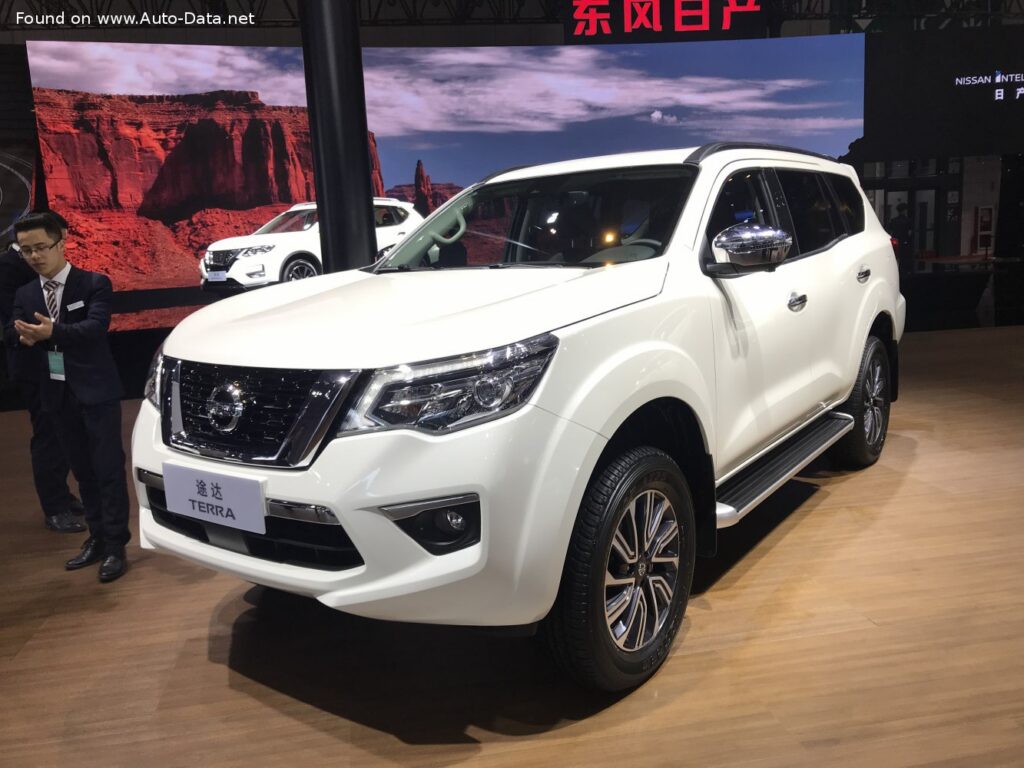
The Nissan Terra, in its first generation (2018-2021), represents Nissan’s robust entry into the mid-size, body-on-frame SUV segment, primarily targeting markets in Asia, the Middle East, and other regions where durability, off-road capability, and passenger capacity are paramount. Specifically, the Nissan Terra 2.5i (193 Hp) variant, produced from 2018 to 2021, emerged as a practical and dependable seven-seater designed to tackle diverse terrains and demanding family or commercial use. Sharing its underpinnings with the Nissan Navara pickup truck, the Terra was engineered to offer a blend of ruggedness and everyday usability, positioning itself as a formidable competitor against other ladder-frame SUVs in its class.
Overview of the Nissan Terra 2.5i (193 Hp)
The Nissan Terra, introduced in 2018, filled a critical gap in Nissan’s global SUV lineup, offering a more traditional, truck-based alternative to its popular unibody crossovers like the X-Trail (Rogue in North America) and Qashqai. The first-generation Terra, which includes the 2.5i (193 Hp) model, was designed from the ground up to be a highly capable and versatile sport utility vehicle. Its architecture, derived from the Navara, provided a strong foundation for both on-road comfort and significant off-road prowess. This particular variant, powered by a naturally aspirated 2.5-liter gasoline engine, was a popular choice in markets where petrol engines are preferred or more readily available than diesel options, offering a balance of power, refinement, and fuel efficiency.
Marketed as a reliable family hauler and a rugged workhorse, the Terra emphasized practicality and space. Its seven-seat configuration made it an ideal choice for larger families or for commercial operators requiring substantial passenger and cargo capacity. The vehicle’s design language adopted Nissan’s contemporary aesthetic, featuring the prominent “V-motion” grille and muscular body lines, signaling its robust character. Production for this generation spanned from 2018 to 2021, during which it solidified its reputation as a dependable and value-driven option in its segment.
Engine & Performance
At the heart of the Nissan Terra 2.5i (193 Hp) is Nissan’s well-regarded QR25 gasoline engine. This 2.5-liter (2488 cm³ or 151.83 cu. in.) inline-four cylinder engine is naturally aspirated, reflecting a design philosophy focused on reliability and smooth power delivery rather than outright performance. It produces a healthy 193 horsepower at 6000 rpm, which is a respectable output for a non-turbocharged engine of this displacement. The peak torque of 245 Nm (180.7 lb-ft) arrives at a usable 4000 rpm, providing ample pulling power for daily driving and light towing tasks.
The engine benefits from Nissan’s dual C-VTC (Continuously Variable Valve Timing Control) system, which optimizes valve timing for improved fuel efficiency and broader torque delivery across the rev range. This technology helps the naturally aspirated engine feel responsive and provides a consistent power curve. With a compression ratio of 10:1, the engine is designed for efficiency on regular unleaded gasoline, meeting the China VIb emission standard, indicative of its modern emissions control technology for its primary markets.
Power is sent to the rear wheels via a 6-speed manual transmission, a choice that emphasizes driver engagement and robust mechanical simplicity, often preferred in certain markets for its durability and lower maintenance costs. The rear-wheel-drive architecture, combined with the body-on-frame construction, contributes to the Terra’s sturdy feel and its capability for carrying heavy loads or navigating challenging terrain. The vehicle’s weight-to-power ratio stands at 9.3 kg/Hp (107.3 Hp/tonne), and its weight-to-torque ratio is 7.3 kg/Nm (136.2 Nm/tonne), indicating a balanced approach to its powertrain for its intended utility.
In terms of fuel economy, the Nissan Terra 2.5i (193 Hp) achieves a combined consumption of 8.9 liters per 100 kilometers, which translates to approximately 26.4 US miles per gallon. This figure is competitive for a seven-seater, body-on-frame SUV of its size, highlighting the efficiency benefits of its engine design and manual transmission.
Design & Features
The Nissan Terra 2.5i (193 Hp) is characterized by its traditional SUV proportions and rugged styling. As a 5-door, 7-seat SUV, it prioritizes interior space and versatility. The exterior design features a prominent Nissan V-motion grille flanked by large headlights, giving it a commanding presence. Muscular fender flares and a high ground clearance further underscore its off-road aspirations and durable nature.
Dimensionally, the Terra measures 4882 mm (192.2 inches) in length, 1850 mm (72.83 inches) in width, and 1835 mm (72.24 inches) in height. Its substantial wheelbase of 2850 mm (112.2 inches) contributes significantly to interior roominess and ride stability. With a curb weight of 1799 kg (3966.12 lbs), the Terra feels substantial and secure on the road. The vehicle boasts a generous ground clearance of 225 mm (8.86 inches), an approach angle of 32.0°, and a departure angle of 27.0°, making it well-equipped to handle rough roads and mild off-road excursions without scraping its underbelly.
Inside, the Terra is designed for practicality and comfort, especially for its seven occupants. While specific luxury features may vary by market and trim, the focus is on durable materials and ergonomic design. The seating configuration is flexible, allowing for various cargo and passenger arrangements. For a vehicle of its era and market segment, standard features would typically include air conditioning, power windows, and an infotainment system, though the manual transmission variant emphasizes a more utilitarian approach.
The vehicle’s suspension system is engineered to provide a comfortable ride while maintaining robust capability. It features a double wishbone setup at the front, offering precise steering and good road holding. The rear utilizes an independent multi-link spring suspension with a stabilizer, a more sophisticated arrangement than a traditional leaf spring setup often found in truck-based SUVs, contributing to improved ride comfort and handling dynamics, particularly when unladen. Braking is handled by ventilated discs at the front for effective stopping power, complemented by drum brakes at the rear, a common and cost-effective solution for vehicles in this class. The inclusion of ABS (Anti-lock Braking System) as a standard assisting system enhances safety, preventing wheel lock-up during hard braking. Hydraulic power steering provides a traditional, communicative steering feel, suitable for both urban driving and off-road maneuvering. The Terra rides on 255/60 R18 tires mounted on 18-inch wheels, providing a good balance of grip, comfort, and durability.
Technical Specifications
| Category | Specification |
| Brand | Nissan |
| Model | Terra |
| Generation | Terra (First Generation) |
| Type (Engine) | 2.5i (193 Hp) |
| Start of Production | 2018 year |
| End of Production | 2021 year |
| Powertrain Architecture | Internal Combustion engine |
| Body Type | SUV |
| Seats | 7 |
| Doors | 5 |
| Performance Specs | |
| Fuel Consumption (Combined) | 8.9 l/100 km (26.4 US mpg) |
| Fuel Type | Petrol (Gasoline) |
| Emission Standard | China VIb |
| Weight-to-Power Ratio | 9.3 kg/Hp (107.3 Hp/tonne) |
| Weight-to-Torque Ratio | 7.3 kg/Nm (136.2 Nm/tonne) |
| Engine Specs | |
| Power | 193 Hp @ 6000 rpm |
| Power per Liter | 77.6 Hp/l |
| Torque | 245 Nm @ 4000 rpm (180.7 lb.-ft. @ 4000 rpm) |
| Engine Model/Code | QR25 |
| Engine Displacement | 2488 cm³ (151.83 cu. in.) |
| Number of Cylinders | 4 |
| Engine Configuration | Inline |
| Compression Ratio | 10:1 |
| Engine Aspiration | Naturally aspirated engine |
| Valvetrain | Dual C-VTC |
| Space, Volume and Weights | |
| Kerb Weight | 1799 kg (3966.12 lbs) |
| Dimensions | |
| Length | 4882 mm (192.2 in.) |
| Width | 1850 mm (72.83 in.) |
| Height | 1835 mm (72.24 in.) |
| Wheelbase | 2850 mm (112.2 in.) |
| Front Track | 1570 mm (61.81 in.) |
| Rear (Back) Track | 1570 mm (61.81 in.) |
| Ride Height (Ground Clearance) | 225 mm (8.86 in.) |
| Minimum Turning Circle (Turning Diameter) | 11.4 m (37.4 ft.) |
| Approach Angle | 32.0° |
| Departure Angle | 27.0° |
| Drivetrain, Brakes and Suspension Specs | |
| Drivetrain Architecture | The Internal combustion engine (ICE) drives the rear wheels of the vehicle. |
| Drive Wheel | Rear wheel drive |
| Number of Gears and Type of Gearbox | 6 gears, manual transmission |
| Front Suspension | Double wishbone |
| Rear Suspension | Independent multi-link spring suspension with stabilizer |
| Front Brakes | Ventilated discs |
| Rear Brakes | Drum |
| Assisting Systems | |
| ABS (Anti-lock braking system) | Yes |
| Power Steering | Hydraulic Steering |
| Tires Size | 255/60 R18 |
| Wheel Rims Size | 18 inches |
Legacy and Market Impact of the Nissan Terra
The Nissan Terra 2.5i (193 Hp), and the Terra line in general, carved out a significant niche in its target markets, reinforcing Nissan’s presence in the rugged SUV segment. While not offered in the North American market, the Terra’s role in regions like Southeast Asia, China, and the Middle East was crucial. It served as a direct competitor to established players such as the Toyota Fortuner, Mitsubishi Pajero Sport, and Isuzu MU-X, all of which are body-on-frame SUVs derived from popular pickup trucks.
The Terra’s reputation was built on its promise of durability, practicality, and genuine off-road capability. Its body-on-frame construction, combined with a robust suspension setup and generous ground clearance, made it well-suited for varying road conditions, from urban commutes to challenging rural tracks. This made it a popular choice among families needing a spacious and reliable vehicle, as well as for commercial operators requiring a sturdy platform for passenger transport or light cargo hauling.
The 2.5-liter gasoline engine, particularly with the manual transmission, appealed to a segment of buyers who valued straightforward mechanics, lower initial costs, and easier maintenance compared to more complex turbocharged or diesel powertrains. Its fuel efficiency, as indicated by the 26.4 US mpg combined rating, further enhanced its appeal as an economical long-term ownership proposition in its class.
Historically, the Nissan Terra represents a strategic move by Nissan to cater to specific market demands for traditional, capable SUVs alongside its more car-like crossovers. It demonstrated Nissan’s understanding of diverse global automotive needs, providing a product that combined modern design cues with time-tested engineering principles. The success of the first-generation Terra laid the groundwork for subsequent updates and reinforced Nissan’s commitment to offering a comprehensive range of utility vehicles globally.
In essence, the Nissan Terra 2.5i (193 Hp) from 2018-2021 stands as a testament to Nissan’s ability to produce a reliable, versatile, and competent mid-size SUV that perfectly met the requirements of its primary markets, offering a compelling blend of ruggedness, family-friendliness, and value.
