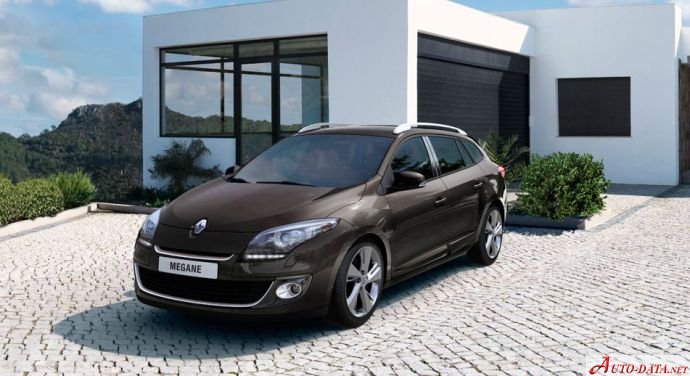
The Renault Megane III Grandtour (Phase II), specifically the GT 2.0 dCi (165 Hp) variant produced between 2012 and 2013, represents a refined iteration of Renault’s popular compact family car. This model is a station wagon, or “estate” as it’s commonly known in Europe, designed to offer a balance of practicality, driving enjoyment, and fuel efficiency. While the Megane was a mainstay in European markets, it wasn’t a significant seller in the United States, where compact station wagons have historically held a smaller market share. The Phase II update brought styling revisions, improved interior materials, and enhanced technology compared to earlier versions of the Megane III.
Renault Megane III Grandtour GT 2.0 dCi: An Overview
The Megane III Grandtour occupied the compact family car segment, competing with vehicles like the Ford Focus Estate, Volkswagen Golf Variant, and Peugeot 308 SW. The “Grandtour” designation signifies the station wagon body style, offering increased cargo capacity compared to the hatchback version. The GT trim level, as seen in this 2.0 dCi model, denotes a sportier focus with enhanced performance and styling cues. This particular version aimed to appeal to drivers seeking a more engaging driving experience without sacrificing the practicality of a wagon.
Engine & Performance
Powering the Megane III Grandtour GT 2.0 dCi is a 1995cc inline-four cylinder diesel engine, designated the M9R 610. This engine produces 165 horsepower at 3750 rpm and a substantial 380 Nm (280.27 lb.-ft.) of torque at 2000 rpm. The engine features a turbocharger with an intercooler, along with a diesel commonrail fuel injection system, contributing to both power output and fuel efficiency. The engine’s 15.1:1 compression ratio is typical for a modern diesel, optimizing combustion for power and economy. This powertrain allows for a 0-100 km/h (0-62 mph) acceleration time of 8.8 seconds, and a 0-60 mph time of approximately 8.4 seconds, making it relatively quick for a diesel-powered wagon. The engine is transversely mounted at the front of the vehicle, driving the front wheels through a six-speed manual transmission. The weight-to-power ratio of 8.7 kg/Hp and weight-to-torque ratio of 3.8 kg/Nm demonstrate a favorable balance between engine output and vehicle mass.
Design & Features
The Renault Megane III Grandtour is a five-door, five-seat station wagon. The Phase II facelift included subtle styling updates to the front and rear fascias, headlights, and grille. The GT trim level added specific design elements such as unique alloy wheels (8J x 18 with 225/40 R 18 tires), a rear diffuser, and sporty interior trim. Inside, the Megane III Grandtour offered a functional and reasonably well-equipped cabin. Standard features typically included air conditioning, power windows, a CD stereo system, and ABS brakes. The Grandtour’s key advantage lies in its spacious interior and generous cargo capacity. With the rear seats up, the trunk offers 524 liters (18.5 cu. ft.) of space, expanding to a substantial 1595 liters (56.33 cu. ft.) with the rear seats folded down. Safety features included ABS, and depending on the specific market and options, could also include Electronic Stability Control (ESC) and multiple airbags. The vehicle’s dimensions are 4559 mm (179.49 in) in length, 1766 mm (69.53 in) in width, and 1461 mm (57.52 in) in height.
Technical Specifications
| Brand | Renault |
| Model | Megane |
| Generation | Megane III Grandtour (Phase II, 2012) |
| Type (Engine) | GT 2.0 dCi (165 Hp) |
| Start of production | 2012 |
| End of production | 2013 |
| Powertrain Architecture | Internal Combustion engine |
| Body type | Station wagon (estate) |
| Seats | 5 |
| Doors | 5 |
| Fuel consumption (urban) | 6.9 l/100 km (34.1 US mpg, 40.9 UK mpg, 14.5 km/l) |
| Fuel consumption (extra urban) | 4.9 l/100 km (48 US mpg, 57.6 UK mpg, 20.4 km/l) |
| Fuel consumption (combined) | 5.6 l/100 km (42 US mpg, 50.4 UK mpg, 17.9 km/l) |
| CO2 emissions | 145 g/km |
| Fuel Type | Diesel |
| Acceleration 0 – 100 km/h | 8.8 sec |
| Acceleration 0 – 62 mph | 8.8 sec |
| Acceleration 0 – 60 mph | 8.4 sec |
| Maximum speed | 215 km/h (133.59 mph) |
| Emission standard | Euro 5 |
| Weight-to-power ratio | 8.7 kg/Hp |
| Weight-to-torque ratio | 3.8 kg/Nm |
| Power | 165 Hp @ 3750 rpm |
| Torque | 380 Nm @ 2000 rpm (280.27 lb.-ft. @ 2000 rpm) |
| Engine layout | Front, Transverse |
| Engine Model/Code | M9R 610 |
| Engine displacement | 1995 cm3 (121.74 cu. in.) |
| Number of cylinders | 4 |
| Engine configuration | Inline |
| Cylinder Bore | 84 mm (3.31 in.) |
| Piston Stroke | 90 mm (3.54 in.) |
| Compression ratio | 15.1:1 |
| Number of valves per cylinder | 4 |
| Fuel injection system | Diesel Commonrail |
| Engine aspiration | Turbocharger, Intercooler |
| Engine oil capacity | 7.4 l (7.82 US qt | 6.51 UK qt) |
| Coolant | 6.6 l (6.97 US qt | 5.81 UK qt) |
| Kerb Weight | 1430 kg (3152.61 lbs.) |
| Max. weight | 1967 kg (4336.49 lbs.) |
| Max load | 537 kg (1183.88 lbs.) |
| Trunk (boot) space – minimum | 524 l (18.5 cu. ft.) |
| Trunk (boot) space – maximum | 1595 l (56.33 cu. ft.) |
| Fuel tank capacity | 60 l (15.85 US gal | 13.2 UK gal) |
| Max. roof load | 80 kg (176.37 lbs.) |
| Permitted trailer load with brakes (12%) | 1500 kg (3306.93 lbs.) |
| Permitted trailer load without brakes | 750 kg (1653.47 lbs.) |
| Permitted towbar download | 75 kg (165.35 lbs.) |
| Length | 4559 mm (179.49 in.) |
| Width | 1766 mm (69.53 in.) |
| Height | 1461 mm (57.52 in.) |
| Wheelbase | 2703 mm (106.42 in.) |
| Front track | 1546 mm (60.87 in.) |
| Rear track | 1547 mm (60.91 in.) |
| Minimum turning circle | 11.05 m (36.25 ft.) |
| Drivetrain | Front wheel drive |
| Number of gears | 6 |
| Gearbox type | Manual |
| Front suspension | Independent type McPherson |
| Rear suspension | Elastic beam |
| Front brakes | Ventilated discs |
| Rear brakes | Disc |
The Renault Megane III Grandtour GT 2.0 dCi (165 Hp) offered a compelling package for European buyers seeking a practical, efficient, and reasonably sporty station wagon. While not officially sold in significant numbers in the US, it represents a well-engineered and popular vehicle in its home market.