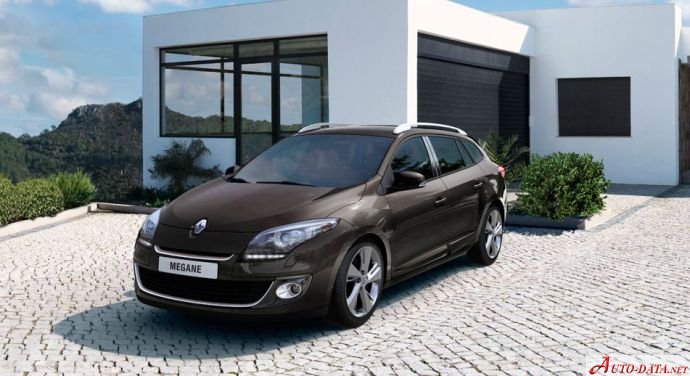
The Renault Megane III Grandtour GT 2.0 TCe (220 Hp) Start&Stop, produced for the 2013 model year, represents a performance-oriented variant of Renault’s popular compact estate car. The Megane III, launched in 2008, aimed to elevate Renault’s presence in the competitive C-segment, offering a blend of practicality, comfort, and style. The Grandtour designation signifies the station wagon (estate) body style, providing increased cargo capacity compared to the hatchback version. This particular GT model, part of the Phase II refresh introduced in 2012, focused on enhancing driving dynamics and visual appeal, targeting buyers seeking a more engaging experience. While the Megane was not officially sold in the United States, it was a significant player in the European market, competing with vehicles like the Volkswagen Golf Estate, Ford Focus Estate, and Peugeot 308 SW.
Renault Megane III Grandtour GT: A Performance Estate
The Megane III Grandtour GT 2.0 TCe occupied a niche within the Megane lineup, bridging the gap between mainstream models and the more focused Renaultsport versions. It aimed to deliver a sporty driving experience without sacrificing the everyday usability expected of a family estate. The Phase II updates brought subtle styling revisions, improved interior materials, and enhanced technology, further refining the Megane’s appeal. The inclusion of the Start&Stop system reflected Renault’s commitment to improving fuel efficiency and reducing emissions.
Engine & Performance
At the heart of the Megane III Grandtour GT lies a 2.0-liter turbocharged inline-four cylinder engine, designated F4R 874. This powerplant produces 220 horsepower at 5500 rpm and 340 Nm (250.77 lb.-ft.) of torque at 2400 rpm. The turbocharger and intercooler work in concert to deliver strong performance across a broad rev range. Power is delivered to the front wheels via a six-speed manual transmission. This configuration allows for a 0-100 km/h (0-62 mph) acceleration time of 7.6 seconds, and a 0-60 mph time of 7.2 seconds, with a maximum speed of 240 km/h (149.13 mph). The engine’s specific output is 110.1 horsepower per liter, demonstrating its relatively high level of tuning. The weight-to-power ratio of 6.3 kg/Hp and weight-to-torque ratio of 4.1 kg/Nm further highlight the car’s performance credentials. The Start&Stop system automatically shuts off the engine when the vehicle is stationary, contributing to improved fuel economy in urban driving conditions.
Design & Features
The Renault Megane III Grandtour is a five-door, five-seat station wagon. The Grandtour body style provides a generous 524 liters (18.5 cu. ft.) of trunk space with the rear seats up, expanding to 1595 liters (56.33 cu. ft.) when the seats are folded down. The GT model featured subtle styling enhancements to differentiate it from other Megane variants, including unique alloy wheels (8J x 18 with 225/40 R18 92Y tires), a more aggressive front bumper, and revised rear diffuser. Inside, the GT model typically included sport seats, aluminum pedal caps, and other cosmetic upgrades. Standard safety features included ABS (Anti-lock braking system), ventilated front disc brakes, and disc brakes on the rear axle. The car’s dimensions are 4559 mm (179.49 in.) in length, 1766 mm (69.53 in.) in width, and 1461 mm (57.52 in.) in height, with a wheelbase of 2703 mm (106.42 in.).
Technical Specifications
| Brand | Renault |
| Model | Megane |
| Generation | Megane III Grandtour (Phase II, 2012) |
| Type (Engine) | GT 2.0 TCe (220 Hp) Start&Stop |
| Start of production | 2013 |
| End of production | 2013 |
| Powertrain Architecture | Internal Combustion engine |
| Body type | Station wagon (estate) |
| Seats | 5 |
| Doors | 5 |
| Fuel consumption (urban) | 9.6 l/100 km (24.5 US mpg, 29.4 UK mpg, 10.4 km/l) |
| Fuel consumption (extra urban) | 6 l/100 km (39.2 US mpg, 47.1 UK mpg, 16.7 km/l) |
| Fuel consumption (combined) | 7.3 l/100 km (32.2 US mpg, 38.7 UK mpg, 13.7 km/l) |
| CO2 emissions | 169 g/km |
| Fuel Type | Petrol (Gasoline) |
| Acceleration 0 – 100 km/h | 7.6 sec |
| Acceleration 0 – 62 mph | 7.6 sec |
| Acceleration 0 – 60 mph | 7.2 sec |
| Maximum speed | 240 km/h (149.13 mph) |
| Emission standard | Euro 5 |
| Weight-to-power ratio | 6.3 kg/Hp |
| Weight-to-torque ratio | 4.1 kg/Nm |
| Power | 220 Hp @ 5500 rpm |
| Torque | 340 Nm @ 2400 rpm (250.77 lb.-ft. @ 2400 rpm) |
| Engine layout | Front, Transverse |
| Engine Model/Code | F4R 874 |
| Engine displacement | 1998 cm3 (121.93 cu. in.) |
| Number of cylinders | 4 |
| Engine configuration | Inline |
| Cylinder Bore | 82.7 mm (3.26 in.) |
| Piston Stroke | 93 mm (3.66 in.) |
| Compression ratio | 9.3:1 |
| Number of valves per cylinder | 4 |
| Fuel injection system | Multi-port manifold injection |
| Engine aspiration | Turbocharger, Intercooler |
| Engine oil capacity | 5.4 l (5.71 US qt | 4.75 UK qt) |
| Coolant | 6.5 l (6.87 US qt | 5.72 UK qt) |
| Kerb Weight | 1388 kg (3060.02 lbs.) |
| Max. weight | 1909 kg (4208.62 lbs.) |
| Max load | 521 kg (1148.61 lbs.) |
| Trunk (boot) space – minimum | 524 l (18.5 cu. ft.) |
| Trunk (boot) space – maximum | 1595 l (56.33 cu. ft.) |
| Fuel tank capacity | 60 l (15.85 US gal | 13.2 UK gal) |
| Max. roof load | 80 kg (176.37 lbs.) |
| Permitted trailer load with brakes (12%) | 1506 kg (3320.16 lbs.) |
| Permitted towbar download | 75 kg (165.35 lbs.) |
| Length | 4559 mm (179.49 in.) |
| Width | 1766 mm (69.53 in.) |
| Height | 1461 mm (57.52 in.) |
| Wheelbase | 2703 mm (106.42 in.) |
| Front track | 1546 mm (60.87 in.) |
| Rear track | 1547 mm (60.91 in.) |
| Minimum turning circle | 11.05 m (36.25 ft.) |
| Drivetrain | Front wheel drive |
| Number of gears | 6 gears, manual transmission |
| Front suspension | Independent type McPherson |
| Rear suspension | Elastic beam |
| Front brakes | Ventilated discs |
| Rear brakes | Disc |
The Renault Megane III Grandtour GT 2.0 TCe (220 Hp) Start&Stop offered a compelling package for buyers seeking a practical and engaging estate car. Its turbocharged engine, sporty styling, and available features made it a noteworthy contender in the European C-segment.