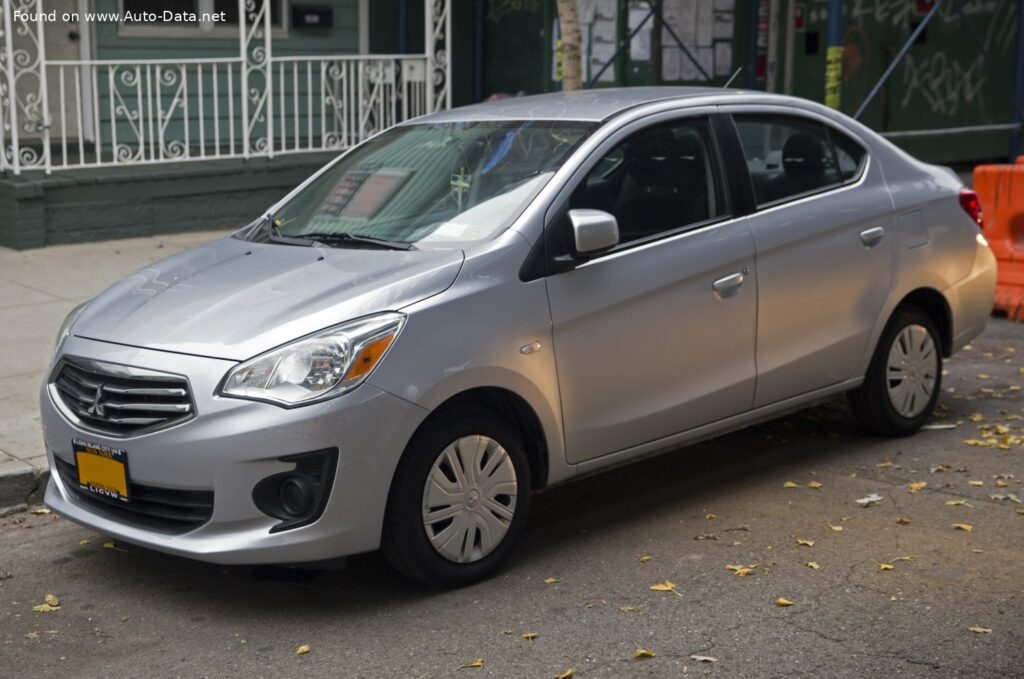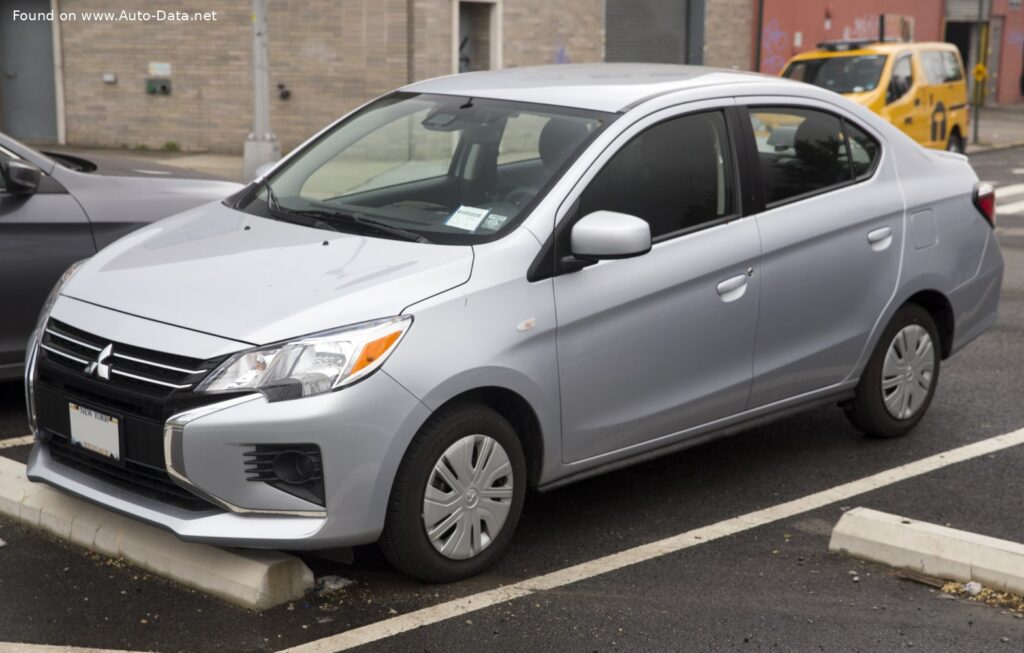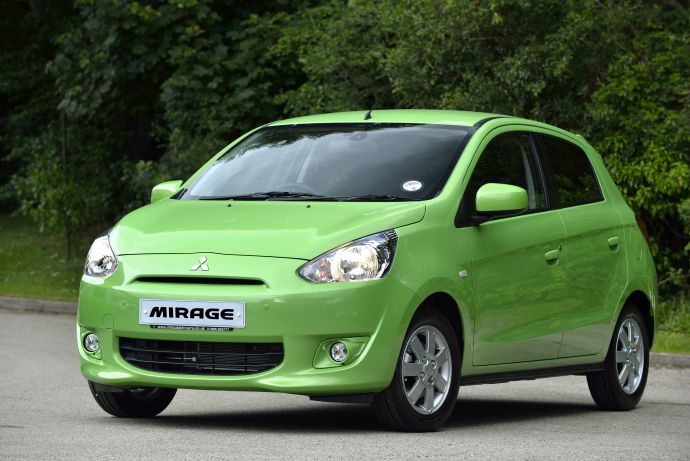
The Mitsubishi Mirage VI Hatchback 1.2 MIVEC (74 Hp) CVT represents a significant iteration in Mitsubishi’s long-standing tradition of producing economical and reliable subcompact vehicles. Introduced for the 2014 model year and continuing through 2016, this sixth-generation Mirage hatchback was conceived as a global car, prioritizing fuel efficiency, affordability, and urban maneuverability. It quickly established itself as a practical choice for budget-conscious buyers and those seeking a no-frills commuter car across various international markets, including its eventual reintroduction to the North American market, albeit typically with slightly higher horsepower figures in the US. This particular variant, featuring the 1.2-liter MIVEC engine paired with a Continuously Variable Transmission (CVT), exemplifies the model’s core mission: to deliver accessible transportation with minimal running costs.
The Mitsubishi Mirage VI: A Global Subcompact
The Mitsubishi Mirage, a nameplate with a history dating back to 1978, was revived for its sixth generation as a global subcompact car designed to meet diverse market demands. The Mirage VI Hatchback, specifically the 1.2 MIVEC (74 Hp) CVT model produced between 2014 and 2016, was engineered from the ground up to be lightweight and aerodynamically efficient. Its primary role was to serve as an entry-level vehicle, offering a compelling blend of low purchase price, impressive fuel economy, and straightforward mechanics. While the Mirage has been sold in numerous countries, its philosophy of providing essential motoring at an accessible price point has remained consistent, making it a popular choice in regions where affordability and efficiency are paramount. Its compact dimensions and tight turning radius made it particularly well-suited for congested city environments.
Engine & Performance Characteristics
At the heart of the Mitsubishi Mirage VI Hatchback 1.2 MIVEC (74 Hp) CVT lies a meticulously engineered 1.2-liter (1193 cm3 or 72.8 cu. in.) 3A92 inline three-cylinder engine. This naturally aspirated powerplant features a Double Overhead Camshaft (DOHC) valvetrain with four valves per cylinder and Mitsubishi’s proprietary MIVEC (Mitsubishi Innovative Valve timing Electronic Control) system. The MIVEC technology optimizes valve timing for improved fuel efficiency and a broader torque band, even in a small-displacement engine. With a compression ratio of 10.5:1 and multi-port manifold injection, this engine generates a modest but effective 74 horsepower at 6000 rpm. Torque output stands at 100 Nm (73.76 lb.-ft.) delivered at 4000 rpm, providing adequate pulling power for city driving and maintaining highway speeds.
Power is channeled to the front wheels via an automatic Continuously Variable Transmission (CVT). This type of gearbox is instrumental in the Mirage’s exceptional fuel economy, as it allows the engine to operate at its most efficient rpm range by seamlessly adjusting gear ratios. The powertrain architecture is a conventional front, transverse engine layout, driving the front wheels. This setup, combined with the lightweight kerb weight of 2028.25 to 2050.3 lbs., results in a weight-to-power ratio of 12.4 kg/Hp (80.4 Hp/tonne) and a weight-to-torque ratio of 9.2 kg/Nm (108.7 Nm/tonne). These figures underscore the vehicle’s design ethos of maximizing performance and efficiency from a small engine through careful weight management.
Fuel economy is a standout feature for this Mirage variant. The official combined fuel consumption is an impressive 5.9 liters per 100 km, translating to approximately 39.9 US mpg. Urban driving yields 6.4 l/100 km (36.8 US mpg), while extra-urban (highway) consumption drops to 5.3 l/100 km (44.4 US mpg). These figures highlight the CVT’s effectiveness and the engine’s inherent efficiency, making the Mirage an economical choice for daily commuting. The fuel tank capacity of 9.25 US gallons further contributes to its long range between fill-ups, an attractive prospect for cost-conscious drivers.
Design and Practical Features
The Mitsubishi Mirage VI Hatchback adopts a practical and unpretentious design, focusing on functionality and aerodynamic efficiency. As a 5-door hatchback with seating for five, it offers a versatile and accessible package. Its compact dimensions—148.82 inches in length, 65.59 inches in width, and 59.09 inches in height—make it remarkably agile and easy to park in tight urban spaces. The relatively long wheelbase of 96.46 inches for its overall length contributes to a stable ride and maximizes interior volume within its small footprint. A notable design element is its low drag coefficient (Cd) of 0.28, which significantly contributes to its excellent fuel economy by reducing wind resistance.
Despite its compact exterior, the Mirage offers surprising interior practicality. The trunk (boot) space ranges from a respectable 17.2 cu. ft. with the rear seats up, expanding to a generous 47 cu. ft. when the rear seats are folded down. This flexibility allows for carrying a variety of cargo, from groceries to larger items, enhancing its utility as a daily driver. The vehicle’s maximum load capacity ranges from 970.03 to 992.08 lbs., further underscoring its practical design.
The Mirage VI is equipped with a standard chassis setup for its class. The front suspension features independent McPherson struts with coil springs and an anti-roll bar, providing a comfortable ride and predictable handling. The rear suspension utilizes a torsion beam setup, a cost-effective and space-efficient solution that is common in subcompact vehicles. Braking power is provided by ventilated discs at the front and traditional drum brakes at the rear, a system that is adequate for the vehicle’s power and weight. An Anti-lock Braking System (ABS) is included as a standard safety feature, enhancing safety during emergency stops.
Steering is managed by an electric power-assisted rack and pinion system, which offers light effort at low speeds for easy maneuvering and a more weighted feel at higher speeds. The minimum turning circle of 30.18 feet is exceptionally tight, making U-turns and parking effortless. The vehicle rides on 165/65 R14 tires mounted on 14-inch wheel rims, a combination that prioritizes ride comfort and fuel efficiency over aggressive handling, aligning with the car’s overall character. With a ground clearance of 6.3 inches, it is also capable of navigating minor road imperfections without issue.
Mitsubishi Mirage VI Technical Specifications
| Brand | Mitsubishi |
| Model | Mirage |
| Generation | Mirage VI Hatchback |
| Type (Engine) | 1.2 MIVEC (74 Hp) CVT |
| Start of Production | 2014 year |
| End of Production | 2016 year |
| Powertrain Architecture | Internal Combustion engine |
| Body type | Hatchback |
| Seats | 5 |
| Doors | 5 |
| Fuel consumption (economy) – urban | 6.4 l/100 km (36.8 US mpg) |
| Fuel consumption (economy) – extra urban | 5.3 l/100 km (44.4 US mpg) |
| Fuel consumption (economy) – combined | 5.9 l/100 km (39.9 US mpg) |
| Fuel Type | Petrol (Gasoline) |
| Weight-to-power ratio | 12.4 kg/Hp, 80.4 Hp/tonne |
| Weight-to-torque ratio | 9.2 kg/Nm, 108.7 Nm/tonne |
| Power | 74 Hp @ 6000 rpm. |
| Power per liter | 62 Hp/l |
| Torque | 100 Nm @ 4000 rpm (73.76 lb.-ft. @ 4000 rpm) |
| Engine layout | Front, Transverse |
| Engine Model/Code | 3A92 |
| Engine displacement | 1193 cm3 (72.8 cu. in.) |
| Number of cylinders | 3 |
| Engine configuration | Inline |
| Cylinder Bore | 75 mm (2.95 in.) |
| Piston Stroke | 90 mm (3.54 in.) |
| Compression ratio | 10.5:1 |
| Number of valves per cylinder | 4 |
| Fuel injection system | Multi-port manifold injection |
| Engine aspiration | Naturally aspirated engine |
| Valvetrain | DOHC |
| Kerb Weight | 920-930 kg (2028.25 – 2050.3 lbs.) |
| Max. weight | 1370 kg (3020.33 lbs.) |
| Max load | 440-450 kg (970.03 – 992.08 lbs.) |
| Trunk (boot) space – minimum | 487 l (17.2 cu. ft.) |
| Trunk (boot) space – maximum | 1331 l (47 cu. ft.) |
| Fuel tank capacity | 35 l (9.25 US gal) |
| Length | 3780 mm (148.82 in.) |
| Width | 1666 mm (65.59 in.) |
| Height | 1501 mm (59.09 in.) |
| Wheelbase | 2450 mm (96.46 in.) |
| Minimum turning circle (turning diameter) | 9.2 m |