
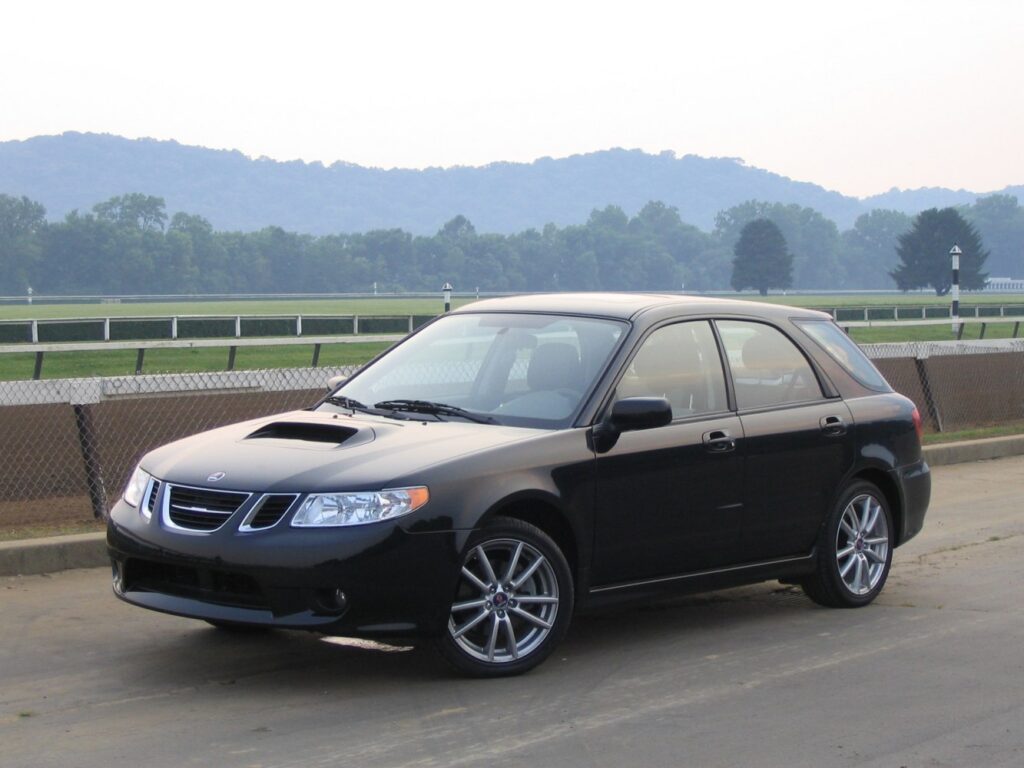
The Saab 9-2X 2.0 i 16V T Aero (230 Hp) represents a fascinating and somewhat unusual chapter in the history of the Swedish automotive brand, Saab. Launched in 2004 and produced until 2006, this particular model was a direct result of General Motors’ ownership of Saab and its concurrent stake in Fuji Heavy Industries, the parent company of Subaru. Designed specifically for the North American market, the 9-2X was a rebadged and mildly restyled version of the Subaru Impreza WRX wagon, earning it the affectionate nickname “Saabaru.” Its purpose was to broaden Saab’s appeal to a younger, performance-oriented demographic while offering a practical, all-wheel-drive alternative to its more traditional luxury sedans and wagons. The 9-2X aimed to blend Saab’s distinctive design philosophy and interior refinement with Subaru’s proven rally-bred performance and robust engineering, creating a unique offering in the compact premium wagon segment.
The Saab 9-2X 2.0 i 16V T Aero in Detail
Engine & Performance
At the heart of the Saab 9-2X 2.0 i 16V T Aero (230 Hp) lies a potent and highly regarded powertrain, inherited directly from its Subaru WRX lineage. The engine is a 1994 cm3 (121.68 cu. in.) 2.0-liter, 16-valve, turbocharged and intercooled Boxer-four, known by its internal code EJ205. This horizontally opposed engine configuration is a signature Subaru characteristic, offering a low center of gravity and contributing to the car’s balanced handling. It delivers a robust 230 horsepower at 6000 rpm, translating to an impressive power-per-liter output of 115.3 Hp/l. Torque peaks at 294 Nm (216.84 lb.-ft.) at 4000 rpm, providing strong acceleration and responsive mid-range power. The engine’s compression ratio of 8:1 is typical for a turbocharged unit, optimized for boost pressure, and it utilizes a multi-port manifold injection system for precise fuel delivery. Coupled with a 5-speed manual transmission, this powertrain allows the 9-2X Aero to achieve a maximum speed of 227 km/h (141.05 mph), making it a genuinely quick and engaging vehicle for its class.
The performance capabilities are further underscored by its weight-to-power ratio of 6.3 kg/Hp (159.2 Hp/tonne) and a weight-to-torque ratio of 4.9 kg/Nm (203.5 Nm/tonne). Fuel economy, while not its primary selling point, was respectable for a performance-oriented all-wheel-drive vehicle of its era. Urban driving returned approximately 11.8 l/100 km (19.9 US mpg), while extra-urban cruising improved to 8.7 l/100 km (27 US mpg). The combination of a powerful turbocharged Boxer engine and a capable all-wheel-drive system ensured that the 9-2X Aero offered confident performance in a variety of driving conditions, from spirited highway merges to challenging weather scenarios.
Design & Features
The design of the Saab 9-2X was a careful exercise in rebadging, aimed at integrating Subaru’s practical and performance-oriented platform into Saab’s distinctive aesthetic language. The body type is a 5-door station wagon, providing excellent versatility and cargo capacity. While the core structure was Subaru, Saab designers implemented several changes to the front and rear fascias to align with the brand’s identity. This included a new Saab-specific grille, headlights, hood, and front bumper, along with redesigned taillights and a rear bumper that gave it a more refined and less aggressive appearance than its Subaru counterpart. These modifications helped the 9-2X blend more seamlessly into the Saab showroom lineup of the time.
Inside, Saab made efforts to enhance the cabin’s perceived quality and comfort. While the basic layout remained Subaru’s, Saab introduced higher-quality materials, improved sound deadening, and Saab-specific seats, along with a revised dashboard trim. The ergonomic layout was straightforward and driver-focused, characteristic of both Saab and Subaru philosophies. With seating for five occupants, the 9-2X offered practical space for families or individuals needing cargo versatility. The trunk space was generous, ranging from 790 liters (27.9 cu. ft.) with the rear seats up to an expansive 1744 liters (61.59 cu. ft.) when the rear seats were folded down, making it a highly functional vehicle for hauling gear. Key features included all-wheel drive (AWD) as standard, a 5-speed manual transmission for engaging driving, and safety systems like ABS (Anti-lock Braking System) for enhanced control during braking. The vehicle rode on 215/45 R17 tires, providing ample grip and handling precision, supported by a spring strut suspension setup at both front and rear axles and ventilated disc brakes at the front.
Technical Specifications
| Category | Specification |
| Brand | Saab |
| Model | 9-2X |
| Generation | 9-2X |
| Type (Engine) | 2.0 i 16V T Aero (230 Hp) |
| Start of Production | 2004 year |
| End of Production | 2006 year |
| Powertrain Architecture | Internal Combustion engine |
| Body Type | Station wagon (estate) |
| Seats | 5 |
| Doors | 5 |
| Fuel Consumption (economy) – urban | 11.8 l/100 km (19.9 US mpg) |
| Fuel Consumption (economy) – extra urban | 8.7 l/100 km (27 US mpg) |
| Fuel Type | Petrol (Gasoline) |
| Maximum Speed | 227 km/h (141.05 mph) |
| Weight-to-Power Ratio | 6.3 kg/Hp, 159.2 Hp/tonne |
| Weight-to-Torque Ratio | 4.9 kg/Nm, 203.5 Nm/tonne |
| Power | 230 Hp @ 6000 rpm. |
| Power per liter | 115.3 Hp/l |
| Torque | 294 Nm @ 4000 rpm. (216.84 lb.-ft. @ 4000 rpm) |
| Engine Layout | Front, Longitudinal |
| Engine Model/Code | EJ205 |
| Engine Displacement | 1994 cm3 (121.68 cu. in.) |
| Number of Cylinders | 4 |
| Engine Configuration | Boxer |
| Cylinder Bore | 92 mm (3.62 in.) |
| Piston Stroke | 75 mm (2.95 in.) |
| Compression Ratio | 8:1 |
| Number of Valves per Cylinder | 4 |
| Fuel Injection System | Multi-port manifold injection |
| Engine Aspiration | Turbocharger, Intercooler |
| Engine Oil Capacity | 4 l (4.23 US qt) |
| Coolant Capacity | 8.1 l (8.56 US qt) |
| Kerb Weight | 1445 kg (3185.68 lbs.) |
| Trunk (boot) space – minimum | 790 l (27.9 cu. ft.) |
| Trunk (boot) space – maximum | 1744 l (61.59 cu. ft.) |
| Fuel Tank Capacity | 60 l (15.85 US gal) |
| Length | 4460 mm (175.59 in.) |
| Width | 1695 mm (66.73 in.) |
| Height | 1465 mm (57.68 in.) |
| Wheelbase | 2525 mm (99.41 in.) |
| Front Track | 1465 mm (57.68 in.) |
| Rear (Back) Track | 1455 mm (57.28 in.) |
| Minimum Turning Circle (turning diameter) | 10.8 m (35.43 ft.) |
| Drive Wheel | All wheel drive (4×4) |
| Number of Gears and Type of Gearbox | 5 gears, manual transmission |
| Front Suspension | Spring Strut |
| Rear Suspension | Spring Strut |
| Front Brakes | Ventilated discs |
| Rear Brakes | Disc |
| Assisting Systems | ABS (Anti-lock braking system) |
| Steering Type | Steering rack and pinion |
| Tires Size | 215/45 R17 |
Legacy and Market Impact of the Saab 9-2X 2.0 i 16V T Aero (230 Hp)
The Saab 9-2X’s legacy is intrinsically tied to its unique origin as the “Saabaru.” Introduced during a period when Saab was struggling to maintain its market share and distinctive identity under General Motors’ stewardship, the 9-2X was an attempt to fill a gap in the brand’s North American lineup, particularly for a compact, performance-oriented all-wheel-drive vehicle. It aimed to offer the spirited driving dynamics of the Subaru WRX combined with a slightly more upscale interior and a distinctive exterior aesthetic that, at least from the front, clearly identified it as a Saab.
Despite its short production run from 2004 to 2006, the 9-2X developed a dedicated cult following. Enthusiasts appreciated its blend of Subaru’s robust mechanicals – especially the potent EJ205 Boxer engine and symmetrical all-wheel-drive system – with Saab’s more refined styling and interior touches. It was seen by many as a sleeper performance wagon, offering impressive acceleration and handling without the overt boy-racer styling of its Subaru sibling. Its subtle elegance made it an appealing choice for those who desired WRX performance but preferred a more understated look.
In terms of market impact, the 9-2X competed in a niche segment against vehicles like the Volkswagen Jetta GLI wagon (though less performance-focused) and potentially entry-level Audi A4 Avant models. However, its most direct competitor was, ironically, the Subaru Impreza WRX wagon itself. The 9-2X offered a slightly different value proposition: a more premium feel and unique styling for a marginal price increase over the WRX. While it didn’t achieve massive sales volumes, it successfully introduced Saab to a new segment of buyers who might not have considered the brand otherwise.
The 9-2X also represents a significant footnote in the history of automotive industry alliances. It was one of several “badge-engineered” vehicles resulting from GM’s global strategy, which saw platforms and components shared across brands. For Saab, it was a practical solution to offer a competitive product without the immense cost of developing an entirely new platform. For Subaru, it provided additional production volume for its Impreza platform. Today, the Saab 9-2X 2.0 i 16V T Aero is remembered as a capable and distinctive performance wagon, cherished by its owners for its unique blend of Swedish design sensibilities and Japanese engineering prowess, a true “Saabaru” that stands out in automotive history.
