
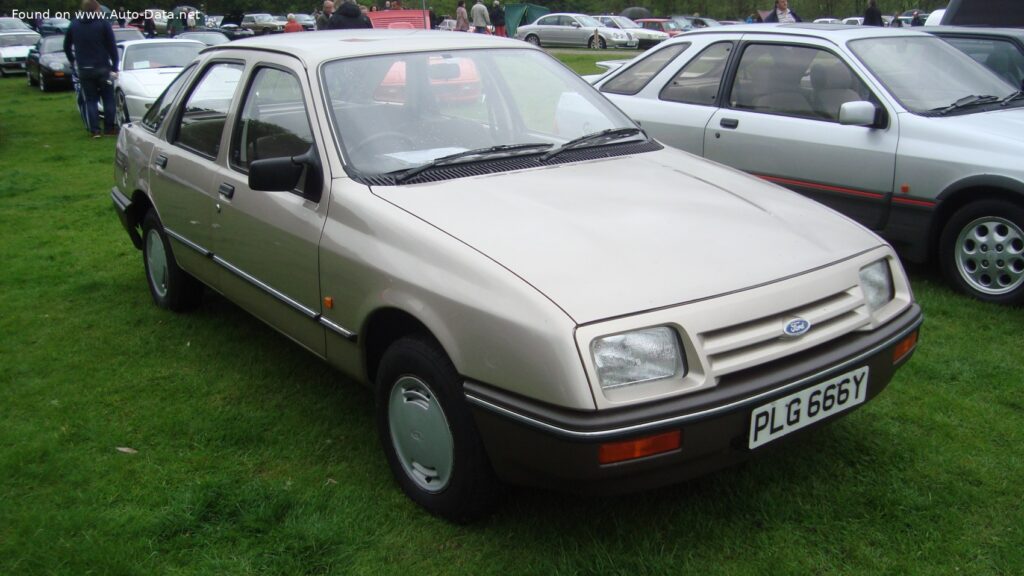
The Ford Sierra, launched in 1982, represented a significant departure for Ford of Europe, replacing the long-running and increasingly dated Cortina. The Ford Sierra Hatchback I 1.6 (75 Hp), specifically, was a key model in establishing the Sierra’s presence in the competitive mid-size family car segment. While not initially sold in the United States, the Sierra was a hugely important vehicle in the European market, offering a modern design, improved aerodynamics, and a focus on driving dynamics compared to its predecessor. It was available in various body styles, including a saloon (sedan), estate (wagon), and the popular hatchback, with the 1.6-liter engine serving as a core offering in the range.
The Ford Sierra: A European Revolution
The Sierra marked a shift in Ford’s design philosophy. The Cortina, while successful, was perceived as somewhat conservative. The Sierra, with its more angular and aerodynamic shape, was a deliberate attempt to modernize Ford’s image and appeal to a new generation of buyers. The hatchback version, in particular, offered increased practicality and versatility, catering to the growing demand for family-friendly vehicles. The Sierra’s development was heavily influenced by the need to improve fuel efficiency and reduce weight, reflecting the changing automotive landscape of the early 1980s. It was a car designed for the modern European driver, prioritizing both economy and enjoyment.
Engine & Performance
The 1.6-liter engine powering this variant of the Ford Sierra is a naturally aspirated, inline-four cylinder unit. Producing 75 horsepower at 4900 rpm, it wasn’t designed for outright speed, but rather for providing adequate and reliable performance for everyday driving. The engine’s power-to-liter ratio of 47 hp/liter was respectable for the time. Fuel delivery was managed by a carburetor, a common technology in the early 1980s, though less efficient than later fuel injection systems. The engine’s longitudinal front-engine layout, coupled with rear-wheel drive, provided a balanced driving experience, offering a degree of handling precision that was unusual for family cars of the era. The 4-speed manual transmission allowed drivers to effectively manage the engine’s power band. While 0-60 mph times weren’t a primary focus, the Sierra 1.6 offered sufficient acceleration for typical commuting and highway driving. The engine displacement of 1597 cm3 (97.45 cubic inches) was a common size for European family cars, balancing performance with fuel economy.
Design & Features
The Ford Sierra Hatchback I 1.6 (75 Hp) is characterized by its distinct three or five-door hatchback body style. The hatchback configuration provided enhanced accessibility and cargo space compared to traditional saloon cars. The Sierra’s design prioritized aerodynamics, resulting in a lower drag coefficient than its predecessor, contributing to improved fuel efficiency. Inside, the Sierra offered seating for five passengers, making it a practical choice for families. The interior design, while functional, was relatively simple, reflecting the automotive standards of the early 1980s. Safety features were limited by the standards of the time, but included basic seatbelts. The Sierra’s suspension system, featuring a conventional setup with coil springs and dampers, aimed to provide a comfortable ride while maintaining reasonable handling characteristics. The car’s relatively lightweight construction further contributed to its agility. The 60-liter (15.85 US gallons) fuel tank provided a reasonable driving range. The Sierra’s overall design represented a significant step forward in terms of both aesthetics and practicality for Ford of Europe.
Technical Specifications
| Brand | Ford |
| Model | Sierra |
| Generation | Sierra Hatchback I |
| Type (Engine) | 1.6 (75 Hp) |
| Start of production | 1982 |
| End of production | 1986 |
| Powertrain Architecture | Internal Combustion engine |
| Body type | Hatchback |
| Seats | 5 |
| Doors | 3/5 |
| Fuel Type | Petrol (Gasoline) |
| Power | 75 Hp @ 4900 rpm |
| Power per litre | 47 Hp/l |
| Engine layout | Front, Longitudinal |
| Engine displacement | 1597 cm3 / 97.45 cu. in. |
| Number of cylinders | 4 |
| Engine configuration | Inline |
| Number of valves per cylinder | 2 |
| Fuel injection system | Carburettor |
| Engine aspiration | Naturally aspirated engine |
| Valvetrain | OHC |
| Fuel tank capacity | 60 l / 15.85 US gal / 13.2 UK gal |
| Length | 4425 mm / 174.21 in. |
| Width | 1694 mm / 66.69 in. |
| Height | 1407 mm / 55.39 in. |
| Wheelbase | 2608 mm / 102.68 in. |
| Front track | 1452 mm / 57.17 in. |
| Rear track | 1468 mm / 57.8 in. |
| Drivetrain Architecture | Rear wheel drive. Internal Combustion engine (ICE) |
| Drive wheel | Rear wheel drive |
| Number of gears and type of gearbox | 4 gears, manual transmission |
| Front brakes | Disc |
| Rear brakes | Drum |
The Ford Sierra, and specifically the 1.6-liter hatchback variant, played a crucial role in reshaping Ford’s image in Europe. It offered a compelling combination of practicality, affordability, and driving dynamics, making it a popular choice among families and commuters. While it never officially reached American shores, the Sierra’s influence on automotive design and engineering in Europe was significant, paving the way for future Ford models and setting a new standard for the mid-size family car segment.
