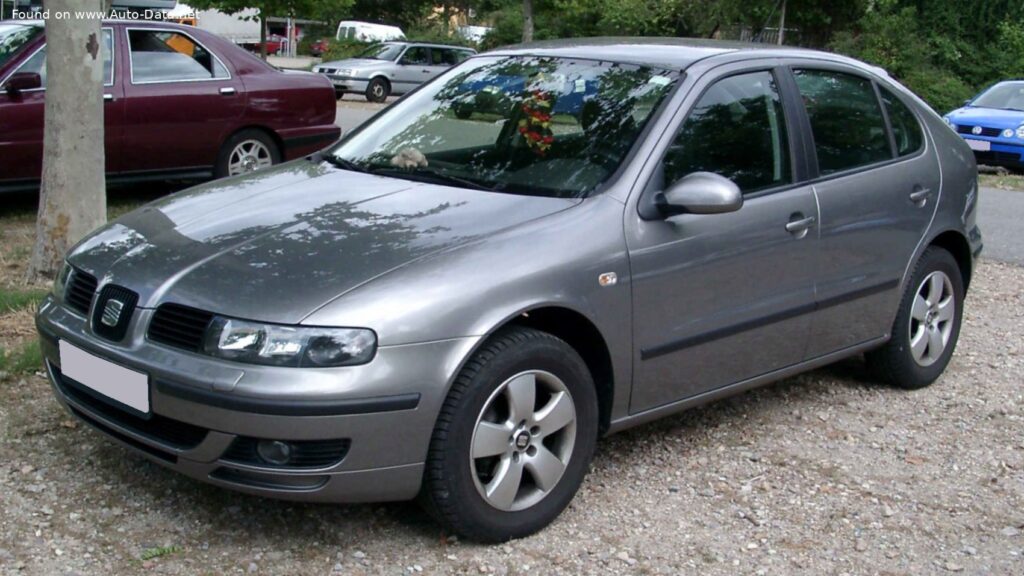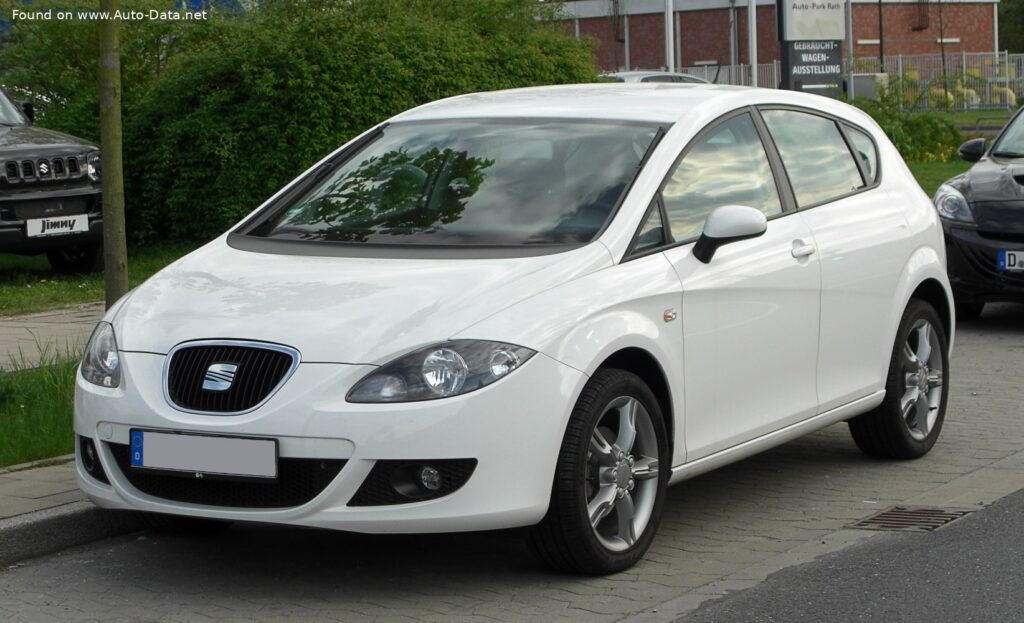
The SEAT León II (1P) 2.0 TDI 16V (140 hp) Automatic, produced from 2005 to 2009, represents a significant evolution in SEAT’s compact hatchback offerings. Positioned within the European C-segment, the León aimed to provide a sporty and practical alternative to established rivals like the Volkswagen Golf, Ford Focus, and Opel Astra. While SEAT is not a major presence in the North American market, the León II was a key model for the brand in Europe, showcasing a blend of design, performance, and value. This generation marked a departure from the first León, offering a more refined driving experience and a more contemporary aesthetic.
SEAT León II (1P): A European Compact Hatchback
The León II, internally designated as the 1P chassis code, was a crucial model for SEAT, demonstrating the brand’s increasing independence and design maturity under the ownership of the Volkswagen Group. It shared its platform with the Volkswagen Golf Mk5, Audi A3, and Škoda Octavia, benefiting from the economies of scale and engineering expertise within the group. The 2.0 TDI 16V variant, equipped with a six-speed automatic transmission, was a popular choice for buyers seeking a balance between fuel efficiency and performance. It catered to drivers prioritizing everyday usability with a touch of sporting character.
Engine & Performance
The heart of the León II 2.0 TDI 16V is a 1.968-liter inline four-cylinder diesel engine, designated the EA188 / BKD. This engine utilizes pump-nozzle (unit injector) fuel injection and a turbocharger with an intercooler to deliver 140 horsepower at 4,000 rpm and 320 Nm (236.02 lb-ft) of torque between 1,750 and 2,500 rpm. The automatic transmission, featuring six forward gears, allows for smooth and efficient power delivery. Performance figures include a 0-100 km/h (0-62 mph) acceleration time of 9.3 seconds and a 0-60 mph time of 8.8 seconds, with a maximum speed of 205 km/h (127.38 mph). The engine’s power-to-weight ratio is 9.4 kg/hp, and its torque-to-weight ratio is 4.1 kg/Nm, contributing to a responsive driving experience. The engine meets Euro 4 emission standards.
Design & Features
The SEAT León II adopted a distinctive hatchback body style, offering five seats and five doors. Its design, penned by Walter de Silva, was characterized by clean lines, a sporty stance, and a focus on practicality. The interior was designed with driver comfort and functionality in mind, featuring a straightforward layout and quality materials for the time. Key features included ABS (Anti-lock Braking System), electric power steering, and a McPherson strut front suspension paired with a torsion beam rear suspension. The vehicle’s dimensions are 4,315 mm (169.88 in) in length, 1,768 mm (69.61 in) in width, and 1,458 mm (57.4 in) in height, with a wheelbase of 2,578 mm (101.5 in). The trunk offers a minimum capacity of 341 liters (12.04 cu. ft.).
Safety and Technology
For its time, the León II offered a reasonable level of safety equipment, primarily centered around the ABS system. While lacking the advanced driver-assistance systems found in modern vehicles, the León II provided a solid foundation for safe driving. The focus was on providing a stable and predictable handling experience, aided by the well-tuned suspension and responsive steering. The inclusion of an automatic transmission further enhanced ease of use, particularly in urban driving conditions. The vehicle’s electric power steering contributed to reduced driver effort and improved fuel efficiency.
Technical Specifications
| Brand | Seat |
| Model | Leon |
| Generation | Leon II (1P) |
| Type (Engine) | 2.0 TDI 16V (140 Hp) Automatic |
| Start of production | July, 2005 |
| End of production | 2009 |
| Powertrain Architecture | Internal Combustion engine |
| Body type | Hatchback |
| Seats | 5 |
| Doors | 5 |
| Fuel Type | Diesel |
| Acceleration 0 – 100 km/h | 9.3 sec |
| Acceleration 0 – 62 mph | 9.3 sec |
| Acceleration 0 – 60 mph | 8.8 sec |
| Maximum speed | 205 km/h (127.38 mph) |
| Emission standard | Euro 4 |
| Weight-to-power ratio | 9.4 kg/Hp |
| Weight-to-torque ratio | 4.1 kg/Nm |
| Power | 140 Hp @ 4000 rpm |
| Torque | 320 Nm @ 1750-2500 rpm (236.02 lb.-ft. @ 1750-2500 rpm) |
| Engine layout | Front, Transverse |
| Engine Model/Code | EA188 / BKD |
| Engine displacement | 1968 cm3 (120.09 cu. in.) |
| Number of cylinders | 4 |
| Engine configuration | Inline |
| Cylinder Bore | 81 mm (3.19 in.) |
| Piston Stroke | 95.5 mm (3.76 in.) |
| Compression ratio | 18.5:1 |
| Number of valves per cylinder | 4 |
| Fuel injection system | Pump-nozzle (Unit Injector) |
| Engine aspiration | Turbocharger, Intercooler |
| Engine oil capacity | 3.8 l (4.02 US qt | 3.34 UK qt) |
| Coolant | 8 l (8.45 US qt | 7.04 UK qt) |
| Kerb Weight | 1315 kg (2899.08 lbs.) |
| Max. weight | 1925 kg (4243.9 lbs.) |
| Max load | 610 kg (1344.82 lbs.) |
| Trunk (boot) space – minimum | 341 l (12.04 cu. ft.) |
| Fuel tank capacity | 55 l (14.53 US gal | 12.1 UK gal) |
| Max. roof load | 75 kg (165.35 lbs.) |
| Permitted trailer load with brakes (12%) | 1400 kg (3086.47 lbs.) |
| Permitted trailer load without brakes | 710 kg (1565.28 lbs.) |
| Length | 4315 mm (169.88 in.) |
| Width | 1768 mm (69.61 in.) |
| Height | 1458 mm (57.4 in.) |
| Wheelbase | 2578 mm (101.5 in.) |
| Front track | 1525-1533 mm (60.04 – 60.35 in.) |
| Rear (Back) track | 1509-1517 mm (59.41 – 59.72 in.) |
| Front overhang | 949 mm (37.36 in.) |
| Rear overhang | 788 mm (31.02 in.) |
| Minimum turning circle (turning diameter) | 10.7 m (35.1 ft.) |
| Drivetrain Architecture | The Internal combustion engine (ICE) drives the front wheels of the vehicle. |
| Drive wheel | Front wheel drive |
| Number of gears and type of gearbox | 6 gears, automatic transmission |
| Front suspension | Independent, type McPherson with coil spring and anti-roll bar |
| Rear suspension | Torsion |
| Front brakes | Ventilated discs |
| Rear brakes | Disc |
| Assisting systems | ABS (Anti-lock braking system) |
| Steering type | Steering rack and pinion |
| Power steering | Electric Steering |
| Tires size | 225/45 R17 |
| Wheel rims size | 7J x 17 |