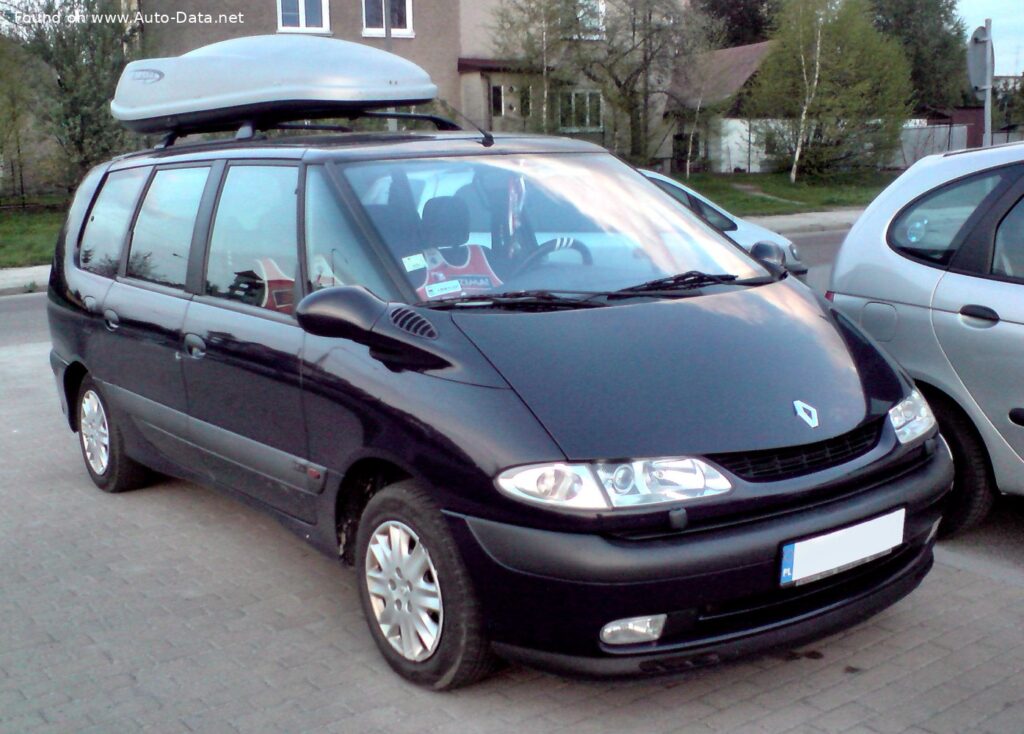
The Renault Grand Espace III (JE, Phase II), produced from 2000 to 2002, represents a significant iteration of Renault’s popular multi-purpose vehicle (MPV). Positioned as a large family vehicle, the Grand Espace offered seven-seat capacity and a spacious interior, catering to the growing demand for versatile transportation in Europe. This generation built upon the success of its predecessors, refining the design and enhancing features while maintaining the Espace’s reputation for practicality and comfort. The 3.0 V6 24V automatic variant, detailed here, was a top-of-the-line offering, providing strong performance for long-distance travel and family duties.
Renault Grand Espace III: A Detailed Overview
The Espace, first launched in 1984, pioneered the modern MPV segment. While never officially sold in the United States, the Espace was a dominant force in the European market, consistently ranking among the best-selling vehicles in its class. The Grand Espace III, and specifically the Phase II update from 2000, addressed customer feedback and incorporated technological advancements of the time. It aimed to provide a premium MPV experience, blending practicality with a degree of sophistication. The Phase II updates included minor cosmetic changes and refinements to the interior trim and equipment levels.
Engine & Performance
The heart of the Grand Espace III 3.0 V6 is a naturally aspirated 2.9-liter V6 engine, designated L7X. This powerplant produces 190 horsepower at 5750 rpm and 267 Nm (196.93 lb.-ft.) of torque at 4000 rpm. The engine features a multi-port fuel injection system and a double overhead camshaft (DOHC) valvetrain with four valves per cylinder. This configuration delivers a relatively smooth and refined driving experience, suitable for both city driving and highway cruising. Power is delivered to the front wheels via a four-speed automatic transmission. Acceleration from 0 to 100 km/h (0-62 mph) takes 10.6 seconds, while 0-60 mph is achieved in 10.1 seconds. The vehicle boasts a maximum speed of 206 km/h (128 mph). While not a performance-oriented vehicle, the V6 engine provides ample power for a full load of passengers and luggage. Fuel economy is rated at 11.6 liters per 100 kilometers (20.3 US mpg) combined, reflecting the engine’s size and the vehicle’s weight.
Design & Features
The Renault Grand Espace III is a five-door minivan, characterized by its tall, boxy silhouette designed to maximize interior space. The Phase II model received subtle styling updates, including revised front and rear fascias. The interior is designed for practicality and comfort, with seating for up to seven passengers arranged in a 2-3-2 configuration. The rear seats can be folded or removed to create a larger cargo area. The trunk offers a minimum capacity of 520 liters (18.36 cu. ft.), expanding to a substantial 3075 liters (108.59 cu. ft.) with the rear seats folded. Features included hydraulic power steering, ABS (Anti-lock Braking System), and ventilated front disc brakes. The suspension utilizes an independent McPherson strut setup at the front and a semi-independent coil spring arrangement at the rear, providing a comfortable ride. Safety features, while not as comprehensive as modern standards, included ABS and a robust body structure. The focus was on providing a safe and practical environment for families.
Technical Specifications
| Brand | Renault |
| Model | Espace |
| Generation | Grand Espace III (JE, Phase II, 2000) |
| Type (Engine) | 3.0 V6 24V (190 Hp) Automatic |
| Start of production | 2000 |
| End of production | 2002 |
| Powertrain Architecture | Internal Combustion engine |
| Body type | Minivan, MPV |
| Seats | 7 |
| Doors | 5 |
| Fuel consumption (urban) | 16.3 l/100 km (14.4 US mpg, 17.3 UK mpg, 6.1 km/l) |
| Fuel consumption (extra urban) | 8.9 l/100 km (26.4 US mpg, 31.7 UK mpg, 11.2 km/l) |
| Fuel consumption (combined) | 11.6 l/100 km (20.3 US mpg, 24.4 UK mpg, 8.6 km/l) |
| CO2 emissions | 273 g/km |
| Fuel Type | Petrol (Gasoline) |
| Acceleration 0 – 100 km/h | 10.6 sec |
| Acceleration 0 – 62 mph | 10.6 sec |
| Acceleration 0 – 60 mph | 10.1 sec |
| Maximum speed | 206 km/h (128 mph) |
| Emission standard | Euro 2 |
| Weight-to-power ratio | 9.4 kg/Hp, 105.8 Hp/tonne |
| Weight-to-torque ratio | 6.7 kg/Nm, 148.7 Nm/tonne |
| Power | 190 Hp @ 5750 rpm |
| Power per litre | 64.5 Hp/l |
| Torque | 267 Nm @ 4000 rpm (196.93 lb.-ft. @ 4000 rpm) |
| Engine layout | Front, Transverse |
| Engine Model/Code | L7X |
| Engine displacement | 2946 cm3 (179.78 cu. in.) |
| Number of cylinders | 6 |
| Engine configuration | V-engine |
| Cylinder Bore | 87 mm (3.43 in.) |
| Piston Stroke | 82.6 mm (3.25 in.) |
| Compression ratio | 10.5:1 |
| Number of valves per cylinder | 4 |
| Fuel injection system | Multi-port manifold injection |
| Engine aspiration | Naturally aspirated engine |
| Valvetrain | DOHC |
| Engine oil capacity | 4.9 l (5.18 US qt | 4.31 UK qt) |
| Coolant | 8 l (8.45 US qt | 7.04 UK qt) |
| Kerb Weight | 1795 kg (3957.3 lbs.) |
| Max. weight | 2510 kg (5533.6 lbs.) |
| Max load | 715 kg (1576.31 lbs.) |
| Trunk (boot) space – minimum | 520 l (18.36 cu. ft.) |
| Trunk (boot) space – maximum | 3075 l (108.59 cu. ft.) |
| Fuel tank capacity | 78 l (20.61 US gal | 17.16 UK gal) |
| Max. roof load | 80 kg (176.37 lbs.) |
| Permitted trailer load with brakes (12%) | 2000 kg (4409.25 lbs.) |
| Permitted trailer load without brakes | 750 kg (1653.47 lbs.) |
| Length | 4787 mm (188.46 in.) |
| Width | 1810 mm (71.26 in.) |
| Width including mirrors | 2070 mm (81.5 in.) |
| Height | 1775 mm (69.88 in.) |
| Wheelbase | 2874 mm (113.15 in.) |
| Front track | 1534 mm (60.39 in.) |
| Rear (Back) track | 1540 mm (60.63 in.) |
| Front overhang | 929 mm (36.57 in.) |
| Rear overhang | 984 mm (38.74 in.) |
| Ride height (ground clearance) | 110 mm (4.33 in.) |
| Minimum turning circle (turning diameter) | 11.5 m (37.73 ft.) |
| Drivetrain Architecture | Front wheel drive |
| Number of gears and type of gearbox | 4 gears, automatic transmission |
| Front suspension | Independent, type McPherson with coil spring and anti-roll bar |
| Rear suspension | Semi-independent, coil spring |
| Front brakes | Ventilated discs |
| Rear brakes | Disc |
| Assisting systems | ABS (Anti-lock braking system) |
| Steering type | Steering rack and pinion |
| Power steering | Hydraulic Steering |
| Tires size | 225/55 R16 |
| Wheel rims size | 16 |