
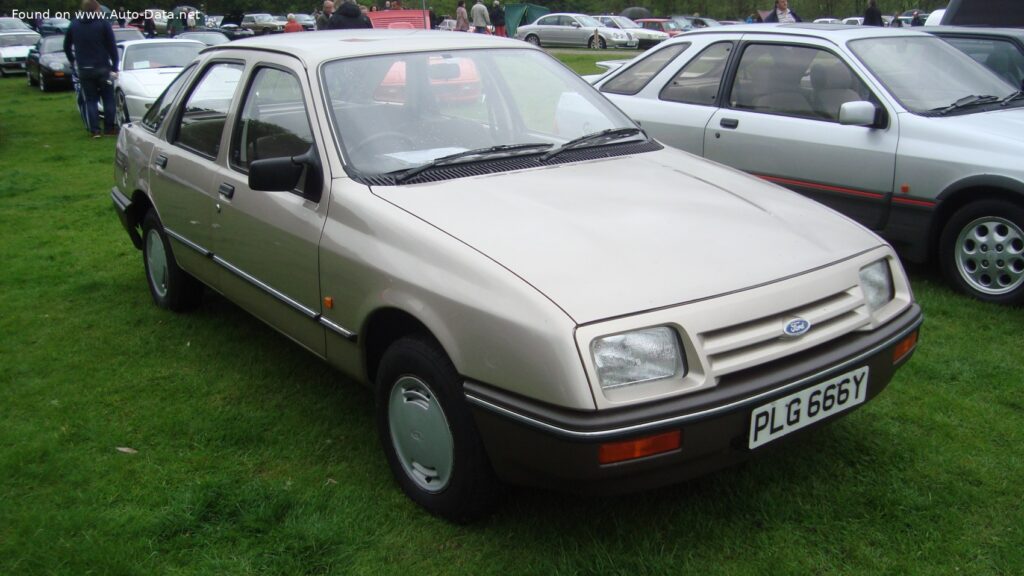
The Ford Sierra, launched in 1982, represented a significant departure for Ford of Europe, replacing the long-running and increasingly dated Cortina. The Ford Sierra Hatchback I 2.0 (90 Hp), specifically, was a key model in establishing the Sierra’s presence in the competitive mid-size family car segment. Designed to offer improved aerodynamics, interior space, and a more modern driving experience, the Sierra aimed to appeal to a broader range of buyers. While not initially sold in the United States, the Sierra was a crucial vehicle for Ford in Europe, paving the way for future models and showcasing the company’s commitment to innovation. The first generation Sierra, produced from 1982 to 1987, came in various body styles, including a saloon (sedan), estate (wagon), and the popular hatchback, with the 2.0-liter engine being a mid-range offering.
The Ford Sierra Hatchback I 2.0: A Detailed Overview
The Sierra marked a shift in Ford’s design philosophy. Unlike the boxy Cortina, the Sierra featured a more streamlined, aerodynamic profile, influenced by contemporary designs from manufacturers like Audi and BMW. This focus on aerodynamics wasn’t purely aesthetic; it contributed to improved fuel efficiency and reduced wind noise. The hatchback body style, in particular, offered increased practicality and versatility compared to the traditional saloon, making it a popular choice for families and those needing a flexible vehicle. The Sierra was intended to be a world car, but ultimately, its design and features were primarily tailored for the European market.
Engine & Performance
The Ford Sierra Hatchback I 2.0 (90 Hp) was powered by a 1.998-liter (121.93 cubic inches) inline four-cylinder petrol engine. This engine, producing 90 horsepower at 5100 rpm, wasn’t a powerhouse by modern standards, but it provided adequate performance for everyday driving. The power-to-litre ratio was 45 hp/l. The engine utilized a naturally aspirated configuration and a carburettor fuel injection system, which was typical for the early 1980s. The longitudinal engine layout, coupled with rear-wheel drive, provided a balanced driving experience, although it differed from the increasingly common front-wheel-drive setups of the time. The 5-speed manual transmission allowed drivers to effectively manage the engine’s power and optimize fuel economy. While acceleration figures weren’t particularly impressive, the Sierra 2.0 offered a comfortable cruising speed and sufficient power for overtaking maneuvers. The engine’s OHC valvetrain contributed to its relatively smooth operation.
Design & Features
The Sierra Hatchback I’s design was characterized by its clean lines and relatively simple, functional interior. The hatchback configuration provided easy access to the cargo area, making it more practical for carrying luggage or larger items. The interior offered seating for five passengers, although rear passenger space was somewhat limited. Safety features, while basic by today’s standards, included ventilated disc brakes on the front wheels and drum brakes on the rear. The Sierra’s suspension system was designed to provide a comfortable ride, balancing handling with everyday usability. The 3 or 5-door configuration offered varying levels of accessibility. The Sierra’s interior materials were durable and designed to withstand the rigors of daily use. The dashboard layout was straightforward and functional, with clearly labeled controls. The focus was on providing a practical and reliable vehicle rather than luxurious appointments.
Technical Specifications
| Brand | Ford |
| Model | Sierra |
| Generation | Sierra Hatchback I |
| Type (Engine) | 2.0 (90 Hp) |
| Start of production | 1982 |
| End of production | 1984 |
| Powertrain Architecture | Internal Combustion engine |
| Body type | Hatchback |
| Seats | 5 |
| Doors | 3/5 |
| Fuel Type | Petrol (Gasoline) |
| Power | 90 Hp @ 5100 rpm |
| Power per litre | 45 Hp/l |
| Engine layout | Front, Longitudinal |
| Engine displacement | 1998 cm3 |
| Engine displacement (US) | 121.93 cu. in. |
| Number of cylinders | 4 |
| Engine configuration | Inline |
| Number of valves per cylinder | 2 |
| Fuel injection system | Carburettor |
| Engine aspiration | Naturally aspirated engine |
| Valvetrain | OHC |
| Fuel tank capacity | 60 l |
| Fuel tank capacity (US) | 15.85 US gal |
| Fuel tank capacity (UK) | 13.2 UK gal |
| Length | 4425 mm |
| Length (US) | 174.21 in. |
| Width | 1694 mm |
| Width (US) | 66.69 in. |
| Height | 1407 mm |
| Height (US) | 55.39 in. |
| Wheelbase | 2608 mm |
| Wheelbase (US) | 102.68 in. |
| Front track | 1452 mm |
| Front track (US) | 57.17 in. |
| Rear track | 1468 mm |
| Rear track (US) | 57.8 in. |
| Drivetrain Architecture | Internal Combustion engine (ICE) drives the rear wheels |
| Drive wheel | Rear wheel drive |
| Number of gears | 5 |
| Type of gearbox | Manual transmission |
| Front brakes | Ventilated discs |
| Rear brakes | Drum |
The Ford Sierra Hatchback I 2.0 (90 Hp) played a vital role in Ford of Europe’s strategy during the 1980s. It offered a modern alternative to its predecessor, the Cortina, and provided a competitive option in the mid-size family car market. While not a performance car, the 2.0-liter engine provided a good balance of power and fuel economy. The Sierra’s aerodynamic design and practical hatchback body style contributed to its popularity, and it remains a fondly remembered vehicle for many European car enthusiasts. Its legacy extends beyond its sales figures, influencing the design and engineering of subsequent Ford models.
