
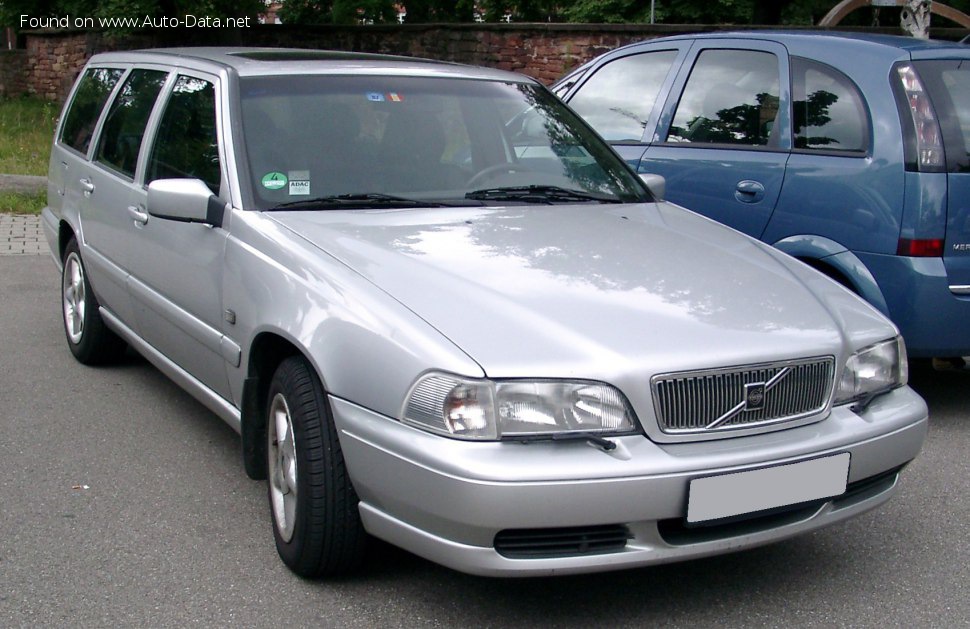
The Volvo V70 I 2.5, produced between 1996 and 2000, represents Volvo’s initial foray into the premium mid-size wagon segment. Positioned as a more practical and spacious alternative to traditional sedans, the V70 aimed to combine Volvo’s renowned safety with a versatile and comfortable driving experience. This first generation V70 was a key model for Volvo, particularly in Europe, where the station wagon body style enjoys significant popularity. While not initially a high-volume seller in the United States, it established the V70 as a benchmark for luxury and functionality in the wagon class.
Volvo V70 I: A Detailed Overview
The V70 I, built on Volvo’s P80 platform (shared with the S70 sedan), was designed to appeal to buyers seeking a vehicle capable of handling both daily commuting and active lifestyles. It offered a blend of Scandinavian design, robust engineering, and a focus on passenger safety – hallmarks of the Volvo brand. The 2.5-liter engine variant, producing 144 horsepower, was a common offering, providing a balance between fuel economy and adequate performance for typical driving conditions.
Engine & Performance
The Volvo V70 I 2.5 is powered by a naturally aspirated 2.435-liter (148.59 cubic inches) inline-five cylinder gasoline engine, designated the B5252S. This engine produces 144 horsepower at 5400 rpm and 206 Newton-meters (151.94 lb.-ft.) of torque at 3600 rpm. Power delivery is managed through a four-speed automatic transmission, directing power to the front wheels. Acceleration from 0 to 100 km/h (0-62 mph) takes 10.8 seconds, while 0 to 60 mph is achieved in approximately 10.3 seconds. The V70 I 2.5 has a top speed of 195 km/h (121.17 mph). The engine’s configuration, while unusual compared to more common inline-four or V6 layouts, contributes to a smooth and relatively refined driving experience. The weight-to-power ratio is 10.2 kg/Hp, and the weight-to-torque ratio is 7.1 kg/Nm.
Design & Features
The V70 I features a classic station wagon profile, characterized by a long roofline and a generous cargo area. Its design emphasizes practicality and functionality, while still maintaining a degree of understated elegance. The interior is designed with comfort and usability in mind, offering seating for five passengers. Key features include a spacious cabin, comfortable seats, and a large cargo area that expands significantly when the rear seats are folded down. Safety was a paramount concern for Volvo, and the V70 I incorporates features such as Anti-lock Braking System (ABS) as standard equipment. The vehicle’s dimensions are substantial, measuring 4730 mm (186.22 inches) in length, 1760 mm (69.29 inches) in width, and 1430 mm (56.3 inches) in height. The wheelbase is 2660 mm (104.72 inches). The drag coefficient of 0.32 contributes to reasonable aerodynamic efficiency for a vehicle of its size and shape.
Technical Specifications
| Brand | Volvo |
| Model | V70 |
| Generation | V70 I |
| Type (Engine) | 2.5 (144 Hp) Automatic |
| Start of production | 1996 |
| End of production | 2000 |
| Powertrain Architecture | Internal Combustion engine |
| Body type | Station wagon (estate) |
| Seats | 5 |
| Doors | 5 |
| Fuel consumption (urban) | 14.2 l/100 km (16.6 US mpg / 19.9 UK mpg) |
| Fuel consumption (extra urban) | 8 l/100 km (29.4 US mpg / 35.3 UK mpg) |
| Fuel Type | Petrol (Gasoline) |
| Acceleration 0 – 100 km/h | 10.8 sec |
| Acceleration 0 – 62 mph | 10.8 sec |
| Acceleration 0 – 60 mph | 10.3 sec |
| Maximum speed | 195 km/h (121.17 mph) |
| Weight-to-power ratio | 10.2 kg/Hp |
| Weight-to-torque ratio | 7.1 kg/Nm |
| Power | 144 Hp @ 5400 rpm |
| Power per litre | 59.1 Hp/l |
| Torque | 206 Nm @ 3600 rpm (151.94 lb.-ft. @ 3600 rpm) |
| Engine layout | Front, Transverse |
| Engine Model/Code | B5252S |
| Engine displacement | 2435 cm3 (148.59 cu. in.) |
| Number of cylinders | 5 |
| Engine configuration | Inline |
| Cylinder Bore | 83 mm (3.27 in.) |
| Piston Stroke | 90 mm (3.54 in.) |
| Compression ratio | 10:1 |
| Number of valves per cylinder | 2 |
| Fuel injection system | Multi-port manifold injection |
| Engine aspiration | Naturally aspirated engine |
| Valvetrain | DOHC |
| Engine oil capacity | 5.8 l (6.13 US qt | 5.1 UK qt) |
| Coolant | 7.2 l (7.61 US qt | 6.34 UK qt) |
| Kerb Weight | 1470 kg (3240.8 lbs.) |
| Max. weight | 1970 kg (4343.11 lbs.) |
| Max load | 500 kg (1102.31 lbs.) |
| Trunk (boot) space – minimum | 420 l (14.83 cu. ft.) |
| Trunk (boot) space – maximum | 1580 l (55.8 cu. ft.) |
| Fuel tank capacity | 70 l (18.49 US gal | 15.4 UK gal) |
| Length | 4730 mm (186.22 in.) |
| Width | 1760 mm (69.29 in.) |
| Height | 1430 mm (56.3 in.) |
| Wheelbase | 2660 mm (104.72 in.) |
| Front track | 1520 mm (59.84 in.) |
| Rear (Back) track | 1470 mm (57.87 in.) |
| Drag coefficient (Cd) | 0.32 |
| Drive wheel | Front wheel drive |
| Number of gears and type of gearbox | 4 gears, automatic transmission |
| Front suspension | Wishbone |
| Rear suspension | Coil spring |
| Front brakes | Ventilated discs |
| Rear brakes | Disc |
| Assisting systems | ABS (Anti-lock braking system) |
| Steering type | Steering rack and pinion |
| Power steering | Hydraulic Steering |
| Tires size | 195/60 R15 |
| Wheel rims size | 15 |
The Volvo V70 I 2.5, while not the most powerful or technologically advanced wagon of its era, remains a compelling choice for those seeking a safe, practical, and comfortable vehicle with a distinct Scandinavian character. Its blend of spaciousness, reliability, and understated style has ensured its continued appeal among enthusiasts and families alike.
