
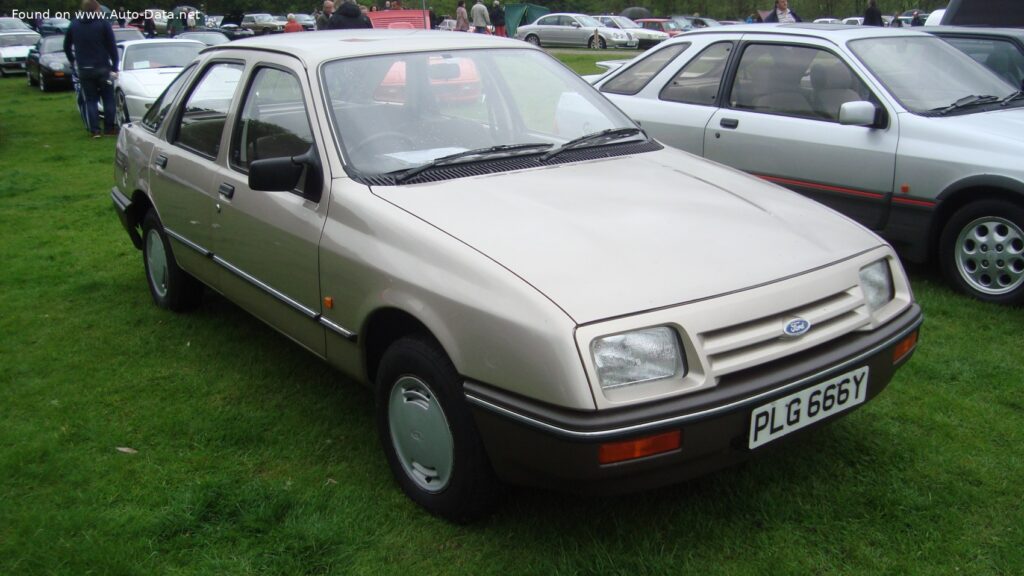
The Ford Sierra, launched in 1982, represented a significant departure for Ford of Europe, replacing the long-running and increasingly dated Cortina and Taunus models. The Sierra was a thoroughly modern design for its time, embracing aerodynamic styling and a new platform. The Ford Sierra Hatchback I 2.0i (115 Hp), produced from 1985 to 1986, was a key variant within the first generation, offering a blend of performance and practicality. It was primarily aimed at the European market, where hatchbacks were gaining popularity, and offered a more sporting alternative to traditional saloons. While not officially sold in the United States, the Sierra is a notable example of 1980s Ford engineering and design, showcasing the company’s commitment to innovation in the face of increasing competition.
The Ford Sierra: A European Success Story
The Sierra was Ford’s attempt to create a unified European model, replacing a confusing array of regional variants. Its design, penned under the direction of Uwe Bahnsen, was controversial at launch due to its sharp angles and lack of traditional chrome trim. However, it proved to be aerodynamically efficient, contributing to improved fuel economy and performance. The Sierra’s monocoque construction was also a significant advancement, offering improved strength and reduced weight compared to its predecessors. The hatchback body style, particularly the 5-door version, quickly became popular, appealing to families and those seeking a versatile vehicle. The 2.0i model, with its fuel injection and increased power output, catered to drivers who desired a more engaging driving experience.
Engine & Performance
The heart of the Sierra 2.0i is a 1,993 cc (121.62 cubic inches) inline-four cylinder engine. This naturally aspirated powerplant produces 115 horsepower at 5500 rpm and 160 Nm (118.01 lb-ft) of torque at 4000 rpm. The engine utilizes multi-port fuel injection and a double overhead camshaft (DOHC) valvetrain, contributing to its relatively high specific output of 57.7 hp per liter. Power is delivered to the rear wheels via a five-speed manual transmission. The longitudinal engine layout, coupled with rear-wheel drive, provided a balanced driving experience, favored by enthusiasts. While not a high-performance machine by modern standards, the 2.0i offered respectable acceleration and cruising ability for its era. The engine’s responsiveness and the engaging manual gearbox made it a fun car to drive on winding roads.
Design & Features
The Sierra Hatchback I is characterized by its distinctively angular three or five-door hatchback body style. The design prioritized aerodynamic efficiency, resulting in a sleek silhouette. Inside, the Sierra offered a functional and relatively spacious cabin for its size. The interior design was typical of the 1980s, with durable materials and a focus on practicality. Safety features, while limited by the standards of today, included ventilated disc brakes on the front wheels and drum brakes on the rear. The Sierra’s suspension system, featuring independent front suspension and a live rear axle, provided a comfortable ride and decent handling. The 60-liter (15.85 US gallons) fuel tank offered a reasonable driving range. The Sierra’s design represented a clear break from the more conservative styling of the Cortina and Taunus, embracing a more modern and aerodynamic aesthetic.
Technical Specifications
| Brand | Ford |
| Model | Sierra |
| Generation | Sierra Hatchback I |
| Type (Engine) | 2.0i (115 Hp) |
| Start of production | 1985 |
| End of production | 1986 |
| Powertrain Architecture | Internal Combustion engine |
| Body type | Hatchback |
| Seats | 5 |
| Doors | 3/5 |
| Fuel Type | Petrol (Gasoline) |
| Power | 115 Hp @ 5500 rpm |
| Power per litre | 57.7 Hp/l |
| Torque | 160 Nm @ 4000 rpm |
| Torque (lb-ft) | 118.01 lb.-ft. @ 4000 rpm |
| Engine layout | Front, Longitudinal |
| Engine displacement | 1993 cm3 |
| Engine displacement (cu. in.) | 121.62 cu. in. |
| Number of cylinders | 4 |
| Engine configuration | Inline |
| Cylinder Bore | 90.8 mm |
| Cylinder Bore (in.) | 3.57 in. |
| Piston Stroke | 77 mm |
| Piston Stroke (in.) | 3.03 in. |
| Number of valves per cylinder | 4 |
| Fuel injection system | Multi-port manifold injection |
| Engine aspiration | Naturally aspirated engine |
| Valvetrain | DOHC |
| Fuel tank capacity | 60 l |
| Fuel tank capacity (US gal) | 15.85 US gal |
| Fuel tank capacity (UK gal) | 13.2 UK gal |
| Length | 4425 mm |
| Length (in.) | 174.21 in. |
| Width | 1694 mm |
| Width (in.) | 66.69 in. |
| Height | 1407 mm |
| Height (in.) | 55.39 in. |
| Wheelbase | 2608 mm |
| Wheelbase (in.) | 102.68 in. |
| Front track | 1452 mm |
| Front track (in.) | 57.17 in. |
| Rear track | 1468 mm |
| Rear track (in.) | 57.8 in. |
| Minimum turning circle | 10 m |
| Minimum turning circle (ft.) | 32.81 ft. |
| Drivetrain Architecture | ICE, Rear wheel drive |
| Drive wheel | Rear wheel drive |
| Number of gears | 5 |
| Gearbox type | Manual transmission |
| Front brakes | Ventilated discs |
| Rear brakes | Drum |
The Ford Sierra, and specifically the 2.0i Hatchback, represents a pivotal moment in Ford of Europe’s history. It was a bold design that embraced modernity and aerodynamic efficiency. While not a performance icon, the 2.0i offered a compelling blend of practicality, comfort, and driving enjoyment, making it a popular choice for European drivers in the mid-1980s. Its legacy continues to influence Ford’s design and engineering philosophies today.
