
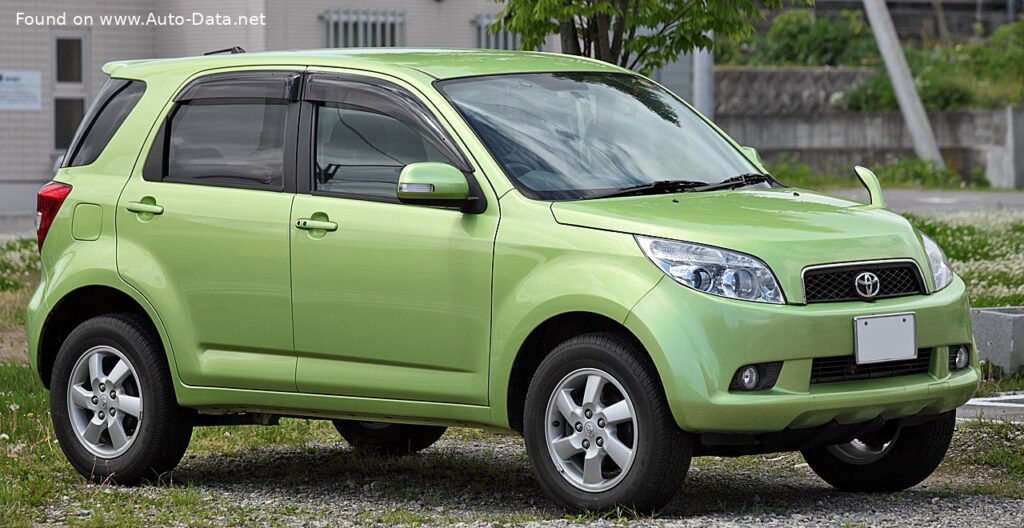
The Toyota Rush 1.5 (109 Hp) 4WD is a compact Sport Utility Vehicle (SUV) produced by Toyota from 2006 to 2008. Primarily aimed at the Indonesian and Southeast Asian markets, the Rush was designed to offer affordable four-wheel drive capability in a relatively small package. It filled a niche for families needing a versatile vehicle capable of handling both urban commutes and rougher terrain. While not officially sold in the United States, understanding the Rush provides insight into Toyota’s global strategy of offering regionally tailored vehicles. This article details the specifications, design, and technical aspects of the Toyota Rush 1.5 4WD.
Toyota Rush 1.5 4WD: An Overview
The Toyota Rush, launched in December 2006, was built on a body-on-frame chassis, a construction method more common in trucks and traditional SUVs than in modern crossover vehicles. This design choice contributed to its robust build and off-road capability. The Rush was positioned as a more affordable alternative to larger SUVs like the Toyota Fortuner, offering a practical and durable option for families and individuals in developing markets. The 1.5-liter engine, while not exceptionally powerful, provided adequate performance for its intended use, and the available four-wheel drive system enhanced its versatility. Production ceased in 2008, with the model being superseded by a redesigned Rush in later years.
Engine & Performance
The Toyota Rush 1.5 4WD is powered by the 3SZ-VE 1.5-liter inline four-cylinder gasoline engine. This naturally aspirated engine produces 109 horsepower at 6000 rpm and 141 Nm (104 lb.-ft.) of torque at 4400 rpm. The engine’s power-to-weight ratio is 10.8 kg/Hp, or 92.4 Hp/tonne, while the torque-to-weight ratio is 8.4 kg/Nm, or 119.5 Nm/tonne. The engine features a multi-port fuel injection system and a double overhead camshaft (DOHC) valvetrain with four valves per cylinder. The engine displacement is 1495 cm3 (91.23 cu. in.), with a bore of 72 mm (2.83 in.) and a stroke of 91.8 mm (3.61 in.). A compression ratio of 10:1 is employed. The engine is longitudinally mounted in the middle of the vehicle. The Rush utilizes a five-speed manual transmission, delivering power to all four wheels via a 4×4 drivetrain. Fuel economy is rated at 6.58 l/100 km (35.7 US mpg, 42.9 UK mpg, 15.2 km/l) in extra-urban driving conditions.
Design & Features
The Toyota Rush 1.5 4WD is a five-door SUV with seating for five passengers. Its body-on-frame construction contributes to a more rugged feel compared to unibody SUVs. The exterior design is functional and utilitarian, reflecting its target market and intended use. The vehicle measures 3995 mm (157.28 in.) in length, 1695 mm (66.73 in.) in width, and 1705 mm (67.13 in.) in height, with a wheelbase of 2580 mm (101.57 in.). The front and rear tracks measure 1445 mm (56.89 in.) and 1460 mm (57.48 in.) respectively. The minimum turning circle is 9.8 m (32.15 ft.).
Inside, the Rush offers a basic but practical interior. Features include an electric power steering system and an Anti-lock Braking System (ABS) for enhanced safety. The suspension consists of an independent McPherson strut setup at the front and a torsion beam arrangement at the rear. Brakes are disc type at the front and drum type at the rear. The vehicle rides on 215/65R16 tires. The Rush’s 50-liter (13.21 US gal, 11 UK gal) fuel tank provides a reasonable driving range. The kerb weight of the vehicle is 1180 kg (2601.45 lbs.).
Technical Specifications
| Brand | Toyota |
| Model | Rush |
| Generation | Rush |
| Type (Engine) | 1.5 (109 Hp) 4WD |
| Start of production | December, 2006 |
| End of production | 2008 |
| Powertrain Architecture | Internal Combustion engine |
| Body type | SUV |
| Seats | 5 |
| Doors | 5 |
| Fuel consumption (extra urban) | 6.58 l/100 km (35.7 US mpg, 42.9 UK mpg, 15.2 km/l) |
| Fuel Type | Petrol (Gasoline) |
| Emission standard | Euro 4 |
| Weight-to-power ratio | 10.8 kg/Hp |
| Power | 109 Hp @ 6000 rpm |
| Torque | 141 Nm @ 4400 rpm (104 lb.-ft. @ 4400 rpm) |
| Engine layout | Middle, Longitudinal |
| Engine Model/Code | 3SZ-VE |
| Engine displacement | 1495 cm3 (91.23 cu. in.) |
| Number of cylinders | 4 |
| Engine configuration | Inline |
| Cylinder Bore | 72 mm (2.83 in.) |
| Piston Stroke | 91.8 mm (3.61 in.) |
| Compression ratio | 10:1 |
| Number of valves per cylinder | 4 |
| Fuel injection system | Multi-port manifold injection |
| Engine aspiration | Naturally aspirated engine |
| Valvetrain | DOHC |
| Engine oil capacity | 3.2 l (3.38 US qt | 2.82 UK qt) |
| Coolant | 5.5 l (5.81 US qt | 4.84 UK qt) |
| Kerb Weight | 1180 kg (2601.45 lbs.) |
| Fuel tank capacity | 50 l (13.21 US gal | 11 UK gal) |
| Length | 3995 mm (157.28 in.) |
| Width | 1695 mm (66.73 in.) |
| Height | 1705 mm (67.13 in.) |
| Wheelbase | 2580 mm (101.57 in.) |
| Front track | 1445 mm (56.89 in.) |
| Rear track | 1460 mm (57.48 in.) |
| Minimum turning circle | 9.8 m (32.15 ft.) |
| Drive wheel | All wheel drive (4×4) |
| Number of gears | 5 |
| Gearbox type | Manual transmission |
| Front suspension | Independent type McPherson |
| Rear suspension | Torsion |
| Front brakes | Disc |
| Rear brakes | Drum |
| Assisting systems | ABS (Anti-lock braking system) |
| Steering type | Steering rack and pinion |
| Power steering | Electric Steering |
| Tires size | 215/65R16 |
The Toyota Rush 1.5 4WD, while not a high-performance vehicle, offered a compelling combination of affordability, practicality, and four-wheel drive capability. Its body-on-frame construction and robust design made it well-suited for the challenging road conditions often found in its primary markets. Although not sold in the US, it represents a significant part of Toyota’s global vehicle portfolio and demonstrates the company’s ability to adapt to diverse market needs.
