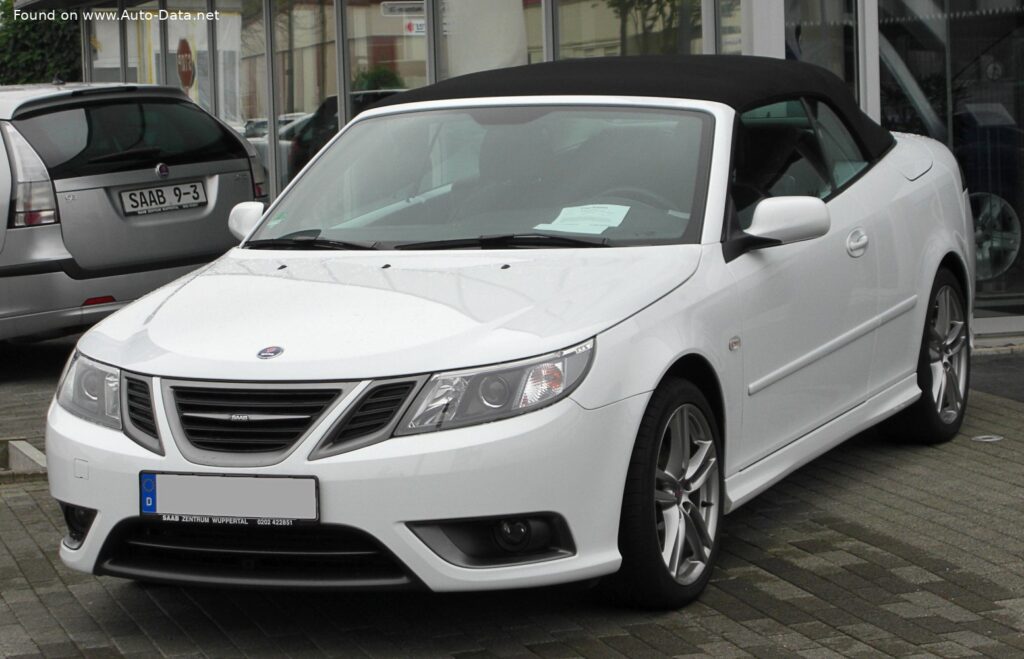
The Saab 9-3 Convertible II, specifically the facelifted version introduced in September 2007, represents a blend of Scandinavian design and turbocharged performance within the premium compact convertible segment. Produced through December 2010, this iteration of the 9-3 Convertible aimed to refine the original model with updated styling, improved features, and enhanced efficiency. The 1.8t variant, powered by a 150 horsepower engine, was a key offering, providing a balance between spirited driving and reasonable fuel consumption. While Saab as a brand faced significant challenges during this period, the 9-3 Convertible II remained a distinctive and appealing option for those seeking an open-top driving experience with a touch of individuality.
Saab 9-3 Convertible II (2007-2010) 1.8t: Overview
The 9-3 Convertible II facelift built upon the foundation laid by its predecessor, offering a more contemporary aesthetic and a subtly revised interior. Positioned as a competitor to models like the Audi A3 Cabriolet, BMW 1 Series Convertible, and Volvo C70, the Saab distinguished itself through its unique Scandinavian design language and a focus on driver-centric ergonomics. The 1.8t engine, a staple of the Saab lineup, provided a responsive and enjoyable driving experience, particularly when paired with the available manual transmission. The convertible top offered a balance between open-air freedom and weather protection, making it a versatile vehicle for various climates.
Engine & Performance
At the heart of the 2007-2010 Saab 9-3 Convertible II 1.8t lies a 1.8-liter inline-four cylinder engine, designated the B207E. This engine utilizes a turbocharger and intercooler to boost power output to 150 horsepower at 5500 rpm, and 240 Nm (177.01 lb.-ft.) of torque available between 2000 and 3500 rpm. The engine features multi-port fuel injection and a double overhead camshaft (DOHC) valvetrain with four valves per cylinder. This configuration delivers a power-to-liter ratio of 75.1 hp/l. The engine’s transverse front-engine layout contributes to balanced handling. Performance figures include a 0-100 km/h (0-62 mph) acceleration time of 10.5 seconds and a top speed of 205 km/h (127.38 mph). The weight-to-power ratio of 11 kg/Hp and weight-to-torque ratio of 6.9 kg/Nm contribute to a reasonably responsive driving experience. A six-speed manual transmission was standard, allowing for driver engagement and control.
Design & Features
The Saab 9-3 Convertible II is a two-door, four-seat cabriolet. The facelifted model featured revised front and rear styling, including a new grille, headlights, and taillights. The interior was updated with improved materials and a more modern dashboard design. Key features included a power-operated soft top, available leather upholstery, and a range of comfort and convenience options. Safety features, crucial for a modern convertible, included ABS (Anti-lock Braking System). The vehicle’s dimensions are 4647 mm (182.95 in) in length, 1780 mm (70.08 in) in width, and 1437 mm (56.57 in) in height. The wheelbase measures 2675 mm (105.31 in). Trunk space ranges from 258 liters (9.11 cu. ft.) to 352 liters (12.43 cu. ft.) depending on the top position. The kerb weight varies between 1650-1835 kg (3637.63 – 4045.48 lbs.), depending on the specific configuration and options.
Technical Specifications
| Brand | Saab |
| Model | 9-3 |
| Generation | 9-3 Convertible II (facelift 2007) |
| Type (Engine) | 1.8t (150 Hp) |
| Start of production | September, 2007 |
| End of production | December, 2010 |
| Powertrain Architecture | Internal Combustion engine |
| Body type | Cabriolet |
| Seats | 4 |
| Doors | 2 |
| Fuel consumption (economy) – urban (NEDC) | 11 l/100 km (21.4 US mpg, 25.7 UK mpg, 9.1 km/l) |
| Fuel consumption (economy) – extra urban (NEDC) | 5.9 l/100 km (39.9 US mpg, 47.9 UK mpg, 16.9 km/l) |
| Fuel consumption (economy) – combined (NEDC) | 7.8 l/100 km (30.2 US mpg, 36.2 UK mpg, 12.8 km/l) |
| CO2 emissions (NEDC) | 186 g/km |
| Fuel Type | Petrol (Gasoline) |
| Acceleration 0 – 100 km/h | 10.5 sec |
| Acceleration 0 – 62 mph | 10.5 sec |
| Acceleration 0 – 60 mph | 10 sec |
| Maximum speed | 205 km/h (127.38 mph) |
| Emission standard | Euro 4 |
| Weight-to-power ratio | 11 kg/Hp, 90.9 Hp/tonne |
| Weight-to-torque ratio | 6.9 kg/Nm, 145.5 Nm/tonne |
| Power | 150 Hp @ 5500 rpm |
| Power per litre | 75.1 Hp/l |
| Torque | 240 Nm @ 2000-3500 rpm (177.01 lb.-ft. @ 2000-3500 rpm) |
| Engine layout | Front, Transverse |
| Engine Model/Code | B207E |
| Engine displacement | 1998 cm3 (121.93 cu. in.) |
| Number of cylinders | 4 |
| Engine configuration | Inline |
| Cylinder Bore | 86 mm (3.39 in.) |
| Piston Stroke | 86 mm (3.39 in.) |
| Compression ratio | 9.5:1 |
| Number of valves per cylinder | 4 |
| Fuel injection system | Multi-port manifold injection |
| Engine aspiration | Turbocharger, Intercooler |
| Valvetrain | DOHC |
| Engine oil capacity | 6 l (6.34 US qt | 5.28 UK qt) |
| Coolant | 7.5 l (7.93 US qt | 6.6 UK qt) |
| Kerb Weight | 1650-1835 kg (3637.63 – 4045.48 lbs.) |
| Max. weight | 2040-2140 kg (4497.43 – 4717.89 lbs.) |
| Max load | 305-390 kg (672.41 – 859.8 lbs.) |
| Trunk (boot) space – minimum | 258 l (9.11 cu. ft.) |
| Trunk (boot) space – maximum | 352 l (12.43 cu. ft.) |
| Fuel tank capacity | 58 l (15.32 US gal | 12.76 UK gal) |
| Permitted trailer load with brakes (12%) | 1600 kg (3527.4 lbs.) |
| Permitted trailer load without brakes | 750 kg (1653.47 lbs.) |
| Length | 4647 mm (182.95 in.) |
| Width | 1780 mm (70.08 in.) |
| Width including mirrors | 2038 mm (80.24 in.) |
| Height | 1437 mm (56.57 in.) |
| Wheelbase | 2675 mm (105.31 in.) |
| Front track | 1524 mm (60 in.) |
| Rear (Back) track | 1506 mm (59.29 in.) |
| Front overhang | 981 mm (38.62 in.) |
| Rear overhang | 991 mm (39.02 in.) |
| Minimum turning circle (turning diameter) | 11.4 m (37.4 ft.) |
| Drive wheel | Front wheel drive |
| Number of gears and type of gearbox | 6 gears, manual transmission |
| Front suspension | Independent, type McPherson with coil spring and anti-roll bar |
| Rear suspension | Independent multi-link spring suspension with stabilizer |
| Front brakes | Ventilated discs, 285 mm |
| Rear brakes | Disc, 278 mm |
| Assisting systems | ABS (Anti-lock braking system) |
| Steering type | Steering rack and pinion |
| Power steering | Hydraulic Steering |
| Tires size | 215/55 R16; 225/45 R17; 235/45 R17; 225/45 R18 |
| Wheel rims size | 6.5J x 16; 7J x 17; 7.5J x 17; 7.5J x 18 |