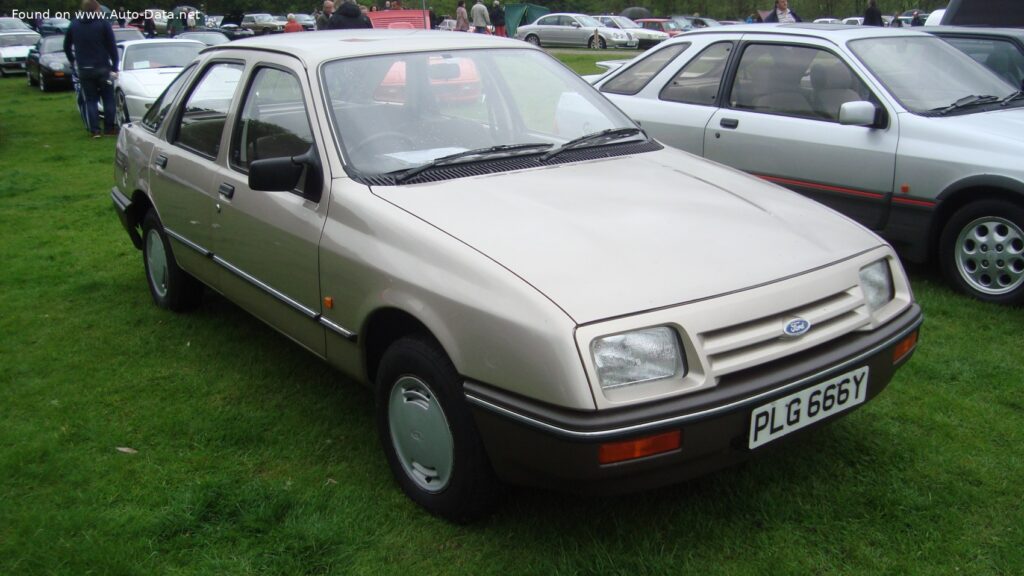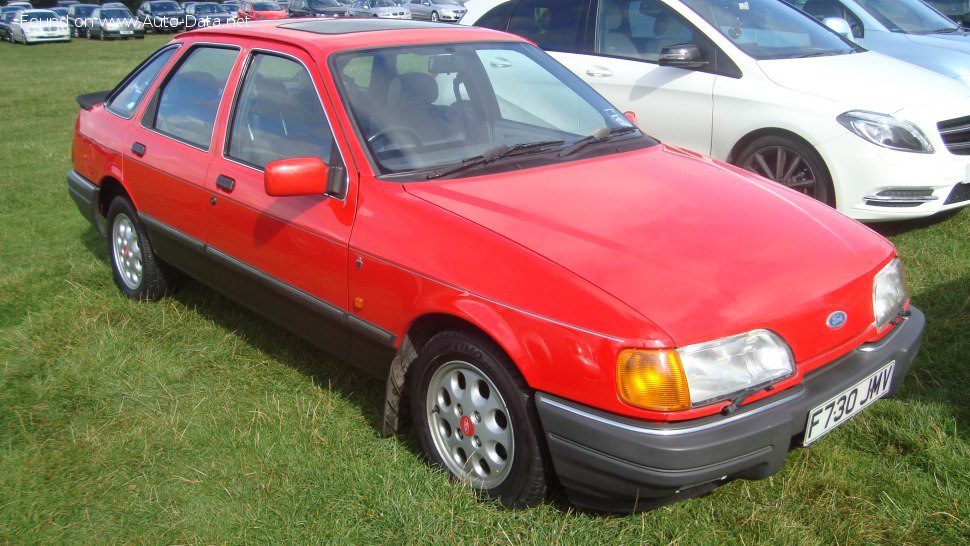
The Ford Sierra Hatchback II 1.8, produced between 1988 and 1993, represents a significant evolution in Ford of Europe’s mid-size family car lineup. Replacing the aging Cortina, the Sierra was a thoroughly modern design for its time, embracing aerodynamic styling and a rear-wheel-drive layout that prioritized driving dynamics. While not officially sold in the United States, the Sierra was a hugely popular vehicle in Europe, competing with models like the Opel/Vauxhall Astra, Volkswagen Jetta, and Peugeot 305. The 1.8-liter variant, producing 87 horsepower, served as a practical and affordable entry point into the Sierra range, offering a balance between performance and fuel economy for everyday drivers.
The Ford Sierra Hatchback II 1.8: A European Family Car
The Sierra marked a departure from Ford’s traditionally boxy designs, adopting a more streamlined and aerodynamic profile. This was a deliberate effort to improve fuel efficiency and reduce drag, reflecting the growing importance of these factors in the late 1980s. The Hatchback II designation refers to the second iteration of the Sierra hatchback, which included minor styling updates and mechanical refinements compared to the original model launched in 1982. The Sierra’s impact extended beyond its aesthetics; it introduced a new level of sophistication and driving pleasure to the family car segment in Europe.
Engine & Performance
The heart of the Sierra 1.8 is a 1.8-liter inline-four cylinder petrol engine. This naturally aspirated engine, displacing 1796 cubic centimeters (109.6 cubic inches), produces 87 horsepower. While this output may seem modest by modern standards, it provided adequate performance for the Sierra’s intended purpose. The engine’s power-to-liter ratio is 48.4 horsepower per liter, indicating a relatively efficient design for its era. Fuel delivery is managed by a carburetor, a common technology in the late 1980s, though less efficient than fuel injection. The engine is longitudinally mounted at the front of the vehicle, driving the rear wheels through a five-speed manual transmission. This rear-wheel-drive configuration, while becoming less common in family cars, contributed to the Sierra’s engaging handling characteristics. The Sierra 1.8 wasn’t designed for outright speed, but rather for reliable and economical transportation. Acceleration figures were typical for the period, with a 0-60 mph time estimated around 11-12 seconds. The fuel tank capacity of 60 liters (15.85 US gallons) provided a reasonable driving range.
Design & Features
The Sierra Hatchback II is a five-door, five-seat hatchback. Its body style offered a practical combination of passenger space and cargo versatility. The hatchback configuration allowed for easy access to the rear storage area, making it suitable for families and those needing to transport larger items. The Sierra’s design prioritized functionality, but also incorporated contemporary styling cues of the late 1980s. The interior was relatively simple and functional, with durable materials and a focus on practicality. Safety features were limited by the standards of the time, but typically included seatbelts and a collapsible steering column. The Sierra’s suspension system consisted of MacPherson struts at the front and a live axle with trailing arms at the rear. This setup provided a comfortable ride and predictable handling. The ventilated disc brakes at the front and drum brakes at the rear offered adequate stopping power. The minimum turning circle of 10 meters (32.81 feet) made it relatively maneuverable in urban environments. The Sierra’s dimensions – 4425 mm (174.21 inches) in length, 1694 mm (66.69 inches) in width, and 1407 mm (55.39 inches) in height – positioned it squarely within the mid-size family car segment.
Technical Specifications
| Brand | Ford |
| Model | Sierra |
| Generation | Sierra Hatchback II |
| Type (Engine) | 1.8 (87 Hp) |
| Start of production | 1988 |
| End of production | 1993 |
| Powertrain Architecture | Internal Combustion engine |
| Body type | Hatchback |
| Seats | 5 |
| Doors | 5 |
| Fuel Type | Petrol (Gasoline) |
| Power | 87 Hp |
| Power per litre | 48.4 Hp/l |
| Engine layout | Front, Longitudinal |
| Engine displacement | 1796 cm3 |
| Engine displacement (US) | 109.6 cu. in. |
| Number of cylinders | 4 |
| Engine configuration | Inline |
| Number of valves per cylinder | 2 |
| Fuel injection system | Carburettor |
| Engine aspiration | Naturally aspirated engine |
| Fuel tank capacity | 60 l |
| Fuel tank capacity (US) | 15.85 US gal |
| Fuel tank capacity (UK) | 13.2 UK gal |
| Length | 4425 mm |
| Length (US) | 174.21 in. |
| Width | 1694 mm |
| Width (US) | 66.69 in. |
| Height | 1407 mm |
| Height (US) | 55.39 in. |
| Wheelbase | 2608 mm |
| Wheelbase (US) | 102.68 in. |
| Front track | 1452 mm |
| Front track (US) | 57.17 in. |
| Rear track | 1468 mm |
| Rear track (US) | 57.8 in. |
| Minimum turning circle | 10 m |
| Minimum turning circle (US) | 32.81 ft. |
| Drivetrain Architecture | Rear wheel drive |
| Drive wheel | Rear wheel drive |
| Number of gears | 5 |
| Type of gearbox | Manual transmission |
| Front brakes | Ventilated discs |
| Rear brakes | Drum |
The Ford Sierra Hatchback II 1.8, while not a performance icon, remains a fondly remembered vehicle in Europe. It represented a significant step forward in terms of design, aerodynamics, and driving dynamics for Ford, and provided a practical and affordable transportation solution for countless families during its production run. Its rear-wheel-drive layout and relatively simple mechanicals also make it a popular choice among classic car enthusiasts today.