
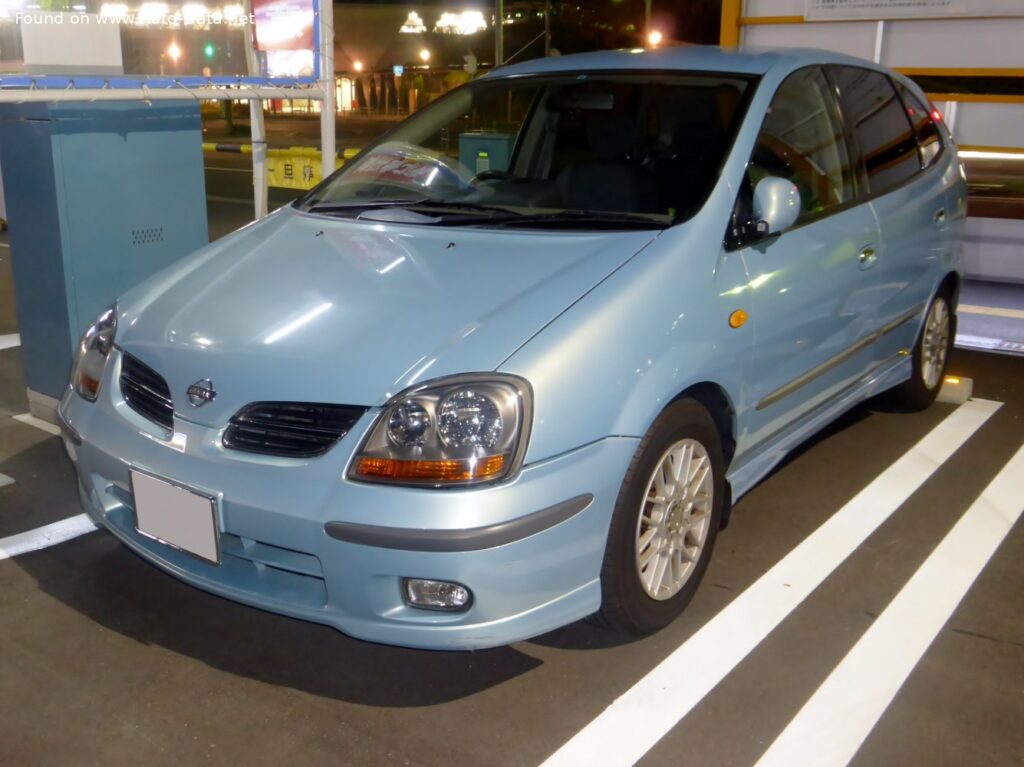
The Nissan Tino (V10), produced between 1999 and 2002, was a compact minivan primarily aimed at the European market. While not officially sold in the United States, it represents Nissan’s effort to cater to the growing demand for small, versatile family vehicles in Europe and Japan. Positioned as a practical and affordable option, the Tino offered a blend of space, functionality, and reasonable running costs. It served as a competitor to vehicles like the Renault Scenic and Citroën Xsara Picasso, offering a similar level of practicality within a slightly more conservative design package. The Tino’s development focused on providing a comfortable and efficient vehicle for everyday use, emphasizing interior space and ease of driving.
Nissan Tino (V10): An Overview
The V10 generation of the Nissan Tino was a single generation model, representing Nissan’s foray into the compact minivan segment. It was based on the Nissan Sunny (Sentra in North America) platform, sharing many mechanical components. The Tino distinguished itself with its five-door configuration, offering easy access for passengers and cargo. Its design was relatively understated, prioritizing functionality over flamboyant styling, a common characteristic of Japanese automotive design during that period. The vehicle was designed to appeal to families seeking a practical and reliable mode of transportation.
Engine & Performance
The Nissan Tino V10 1.5 i 16V was powered by a 1.5-liter inline four-cylinder gasoline engine. This engine produced 105 horsepower at 6000 rpm and 135 Nm (99.57 lb.-ft.) of torque at 4400 rpm. While not a performance-oriented vehicle, the engine provided adequate power for everyday driving conditions. The power-to-weight ratio of 65.2 Hp/tonne allowed for reasonable acceleration, and the engine’s naturally aspirated configuration contributed to its reliability. The engine featured a multi-port fuel injection system and a double overhead camshaft (DOHC) valvetrain, optimizing combustion efficiency and power delivery. The Tino was equipped with a five-speed manual transmission, providing drivers with direct control over gear selection. Front-wheel drive was standard, contributing to fuel efficiency and simplified mechanical complexity. The weight-to-power ratio of 15.3 kg/Hp and weight-to-torque ratio of 11.9 kg/Nm further illustrate the vehicle’s focus on practicality rather than outright performance.
Design & Features
The Nissan Tino V10 adopted a traditional minivan silhouette, characterized by its tall roofline and boxy shape. This design maximized interior space, providing ample headroom and legroom for passengers. The vehicle’s five-door configuration offered convenient access to both the front and rear seats. The interior was designed with practicality in mind, featuring durable materials and a functional layout. The Tino could comfortably accommodate five passengers, making it suitable for small families. Trunk space was a key consideration, offering 440 liters (15.54 cu. ft.) with the rear seats up and expanding to 1030 liters (36.37 cu. ft.) when folded down. Safety features for the time included an Anti-lock Braking System (ABS), which helped to improve braking performance and stability. The steering system utilized a hydraulic power steering rack and pinion, providing responsive and precise handling. The vehicle’s suspension, consisting of coil springs on both the front and rear axles, offered a comfortable ride quality. The Tino’s exterior dimensions – 4270 mm (168.11 in.) in length, 1760 mm (69.29 in.) in width, and 1610 mm (63.39 in.) in height – positioned it within the compact minivan segment.
Technical Specifications
| Brand | Nissan |
| Model | Tino |
| Generation | Tino (V10) |
| Type (Engine) | 1.5 i 16V (105 Hp) |
| Start of production | 1999 year |
| End of production | 2002 year |
| Powertrain Architecture | Internal Combustion engine |
| Body type | Minivan |
| Seats | 5 |
| Doors | 5 |
| Fuel Type | Petrol (Gasoline) |
| Weight-to-power ratio | 15.3 kg/Hp |
| Weight-to-torque ratio | 11.9 kg/Nm |
| Power | 105 Hp @ 6000 rpm |
| Power per litre | 70.1 Hp/l |
| Torque | 135 Nm @ 4400 rpm |
| Torque (lb.-ft.) | 99.57 lb.-ft. @ 4400 rpm |
| Engine layout | Front, Transverse |
| Engine displacement | 1497 cm3 |
| Engine displacement (cu. in.) | 91.35 cu. in. |
| Number of cylinders | 4 |
| Engine configuration | Inline |
| Cylinder Bore | 73.6 mm |
| Cylinder Bore (in.) | 2.9 in. |
| Piston Stroke | 88 mm |
| Piston Stroke (in.) | 3.46 in. |
| Compression ratio | 9.9:1 |
| Number of valves per cylinder | 4 |
| Fuel injection system | Multi-port manifold injection |
| Engine aspiration | Naturally aspirated engine |
| Valvetrain | DOHC |
| Kerb Weight | 1610 kg |
| Kerb Weight (lbs.) | 3549.44 lbs. |
| Max. weight | 1880 kg |
| Max. weight (lbs.) | 4144.69 lbs. |
| Max load | 270 kg |
| Max load (lbs.) | 595.25 lbs. |
| Trunk (boot) space – minimum | 440 l |
| Trunk (boot) space – minimum (cu. ft.) | 15.54 cu. ft. |
| Trunk (boot) space – maximum | 1030 l |
| Trunk (boot) space – maximum (cu. ft.) | 36.37 cu. ft. |
| Fuel tank capacity | 50 l |
| Fuel tank capacity (US gal) | 13.21 US gal |
| Fuel tank capacity (UK gal) | 11 UK gal |
| Length | 4270 mm |
| Length (in.) | 168.11 in. |
| Width | 1760 mm |
| Width (in.) | 69.29 in. |
| Height | 1610 mm |
| Height (in.) | 63.39 in. |
| Wheelbase | 2535 mm |
| Wheelbase (in.) | 99.8 in. |
| Front track | 1535 mm |
| Front track (in.) | 60.43 in. |
| Rear (Back) track | 1510 mm |
| Rear (Back) track (in.) | 59.45 in. |
| Minimum turning circle | 9.8 m |
| Minimum turning circle (ft.) | 32.15 ft. |
| Drivetrain Architecture | Front wheel drive |
| Number of gears | 5 |
| Gearbox type | manual transmission |
| Front suspension | Coil spring |
| Rear suspension | Coil spring |
| Front brakes | Disc |
| Rear brakes | Disc |
| Assisting systems | ABS (Anti-lock braking system) |
| Steering type | Steering rack and pinion |
| Power steering | Hydraulic Steering |
| Tires size | 175/70 R13 |
