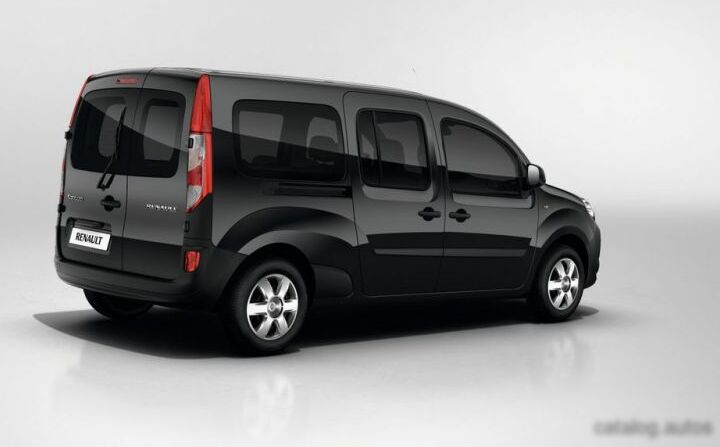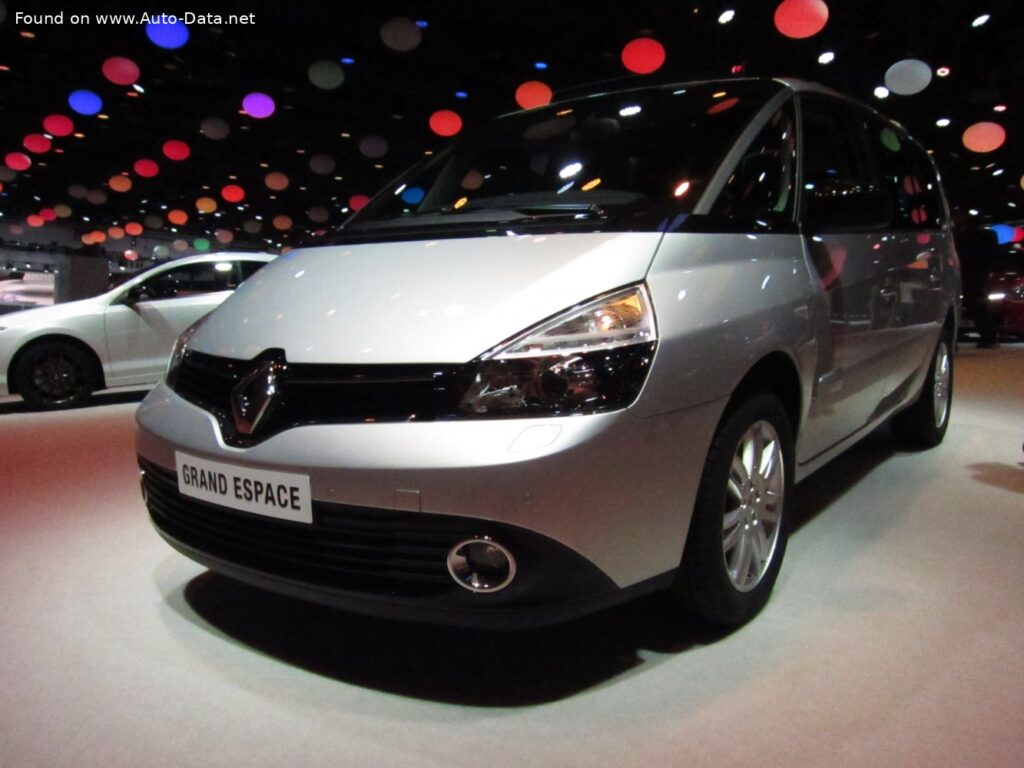
The Renault Grand Espace IV (Phase IV, 2012) 2.0 dCi represents a refinement of Renault’s long-running Espace line, a vehicle that pioneered the modern minivan/MPV (Multi-Purpose Vehicle) segment in Europe. Introduced in 1984, the Espace consistently offered a spacious, versatile, and family-oriented alternative to traditional station wagons and sedans. The fourth generation, launched in 2002, continued this tradition, and the Phase IV update in 2012 brought styling revisions, improved efficiency, and updated technology. While never officially sold in the United States, the Espace was a significant vehicle in the European market, competing with models like the Volkswagen Sharan, Ford Galaxy, and Citroën C8. The 2.0 dCi variant, powered by a diesel engine, was a popular choice for its balance of performance and fuel economy.
Renault Grand Espace IV (Phase IV, 2012) 2.0 dCi: Overview
The Grand Espace IV Phase IV, specifically the 2.0 dCi model, is a seven-seat minivan designed for families and those requiring substantial passenger and cargo space. It falls into the larger end of the MPV segment, offering a generous interior volume and a focus on practicality. The Phase IV update included subtle cosmetic changes to the exterior, along with improvements to the interior trim and available features. The 2.0 dCi engine was a key component of the Espace’s appeal, providing adequate power for comfortable cruising and hauling a full load of passengers and luggage.
Engine & Performance
The heart of the 2012 Renault Grand Espace IV 2.0 dCi is a 1,995 cc (121.74 cu. in.) inline-four cylinder diesel engine, designated the M9R. This engine produces 130 horsepower (Hp) at 4,000 rpm and 320 Newton-meters (236.02 lb.-ft.) of torque at 2,000 rpm. The engine features a turbocharger with an intercooler, enhancing both power and efficiency. Fuel is delivered via a Diesel Commonrail direct injection system, contributing to refined combustion and reduced emissions. The engine’s power-to-weight ratio is 14.9 kg/Hp, and its torque-to-weight ratio is 6 kg/Nm. Performance figures include a 0-100 km/h (0-62 mph) acceleration time of 12 seconds and a maximum speed of 184 km/h (114.33 mph). The engine meets Euro 5 emission standards, reflecting Renault’s commitment to reducing its environmental impact. The engine also incorporates a particulate filter to further minimize emissions.
Design & Features
The Renault Grand Espace IV Phase IV is a five-door minivan with a distinctive, flowing design. Its large glass area provides excellent visibility for all occupants. The vehicle’s length of 4,855 mm (191.14 in) and width of 1,894 mm (74.57 in) contribute to its spacious interior. The key feature of the Grand Espace is its seven-seat configuration, offering flexible seating arrangements to accommodate varying passenger and cargo needs. The rear seats can be folded flat or even removed entirely to maximize cargo space, which ranges from a minimum of 456 liters (16.1 cu. ft.) to a maximum of 3,050 liters (107.71 cu. ft.). Safety features include ABS (Anti-lock Braking System) and ventilated disc brakes on the front wheels, with disc brakes on the rear. The steering is rack and pinion with electric power assistance. The vehicle rides on 17-inch wheels with 225/55 R17 tires. The interior is designed with practicality in mind, featuring durable materials and a functional layout.
Technical Specifications
| Brand | Renault |
| Model | Espace |
| Generation | Grand Espace IV (Phase IV, 2012) |
| Type (Engine) | 2.0 dCi (130 Hp) |
| Start of production | 2012 |
| End of production | 2013 |
| Powertrain Architecture | Internal Combustion engine |
| Body type | Minivan, MPV |
| Seats | 7 |
| Doors | 5 |
| Fuel consumption (urban) | 7 l/100 km (33.6 US mpg, 40.4 UK mpg, 14.3 km/l) |
| Fuel consumption (extra urban) | 5 l/100 km (47 US mpg, 56.5 UK mpg, 20 km/l) |
| Fuel consumption (combined) | 5.7 l/100 km (41.3 US mpg, 49.6 UK mpg, 17.5 km/l) |
| CO2 emissions | 150 g/km |
| Fuel Type | Diesel |
| Acceleration 0 – 100 km/h | 12 sec |
| Acceleration 0 – 62 mph | 12 sec |
| Acceleration 0 – 60 mph | 11.4 sec |
| Maximum speed | 184 km/h (114.33 mph) |
| Emission standard | Euro 5 |
| Weight-to-power ratio | 14.9 kg/Hp |
| Weight-to-torque ratio | 6 kg/Nm |
| Power | 130 Hp @ 4000 rpm |
| Torque | 320 Nm @ 2000 rpm (236.02 lb.-ft. @ 2000 rpm) |
| Engine layout | Front, Transverse |
| Engine Model/Code | M9R |
| Engine displacement | 1995 cm3 (121.74 cu. in.) |
| Number of cylinders | 4 |
| Engine configuration | Inline |
| Cylinder Bore | 84 mm (3.31 in.) |
| Piston Stroke | 90 mm (3.54 in.) |
| Compression ratio | 16:1 |
| Number of valves per cylinder | 4 |
| Fuel injection system | Diesel Commonrail |
| Engine aspiration | Turbocharger, Intercooler |
| Valvetrain | DOHC |
| Engine oil capacity | 6.6 l (6.97 US qt | 5.81 UK qt) |
| Kerb Weight | 1931 kg (4257.13 lbs.) |
| Max. weight | 2620 kg (5776.11 lbs.) |
| Max load | 689 kg (1518.98 lbs.) |
| Trunk (boot) space – minimum | 456 l (16.1 cu. ft.) |
| Trunk (boot) space – maximum | 3050 l (107.71 cu. ft.) |
| Fuel tank capacity | 83 l (21.93 US gal | 18.26 UK gal) |
| Permitted trailer load with brakes (12%) | 2000 kg (4409.25 lbs.) |
| Permitted trailer load without brakes | 750 kg (1653.47 lbs.) |
| Length | 4855 mm (191.14 in.) |
| Width including mirrors | 1894 mm (74.57 in.) |
| Height | 1801 mm (70.91 in.) |
| Wheelbase | 2868 mm (112.91 in.) |
| Front overhang | 1020 mm (40.16 in.) |
| Rear overhang | 967 mm (38.07 in.) |
| Ride height (ground clearance) | 120 mm (4.72 in.) |
| Minimum turning circle (turning diameter) | 11.8 m (38.71 ft.) |
| Drivetrain Architecture | Front wheel drive |
| Number of gears and type of gearbox | 6 gears, manual transmission |
| Front suspension | Independent type McPherson |
| Rear suspension | Semi-independent, coil spring |
| Front brakes | Ventilated discs |
| Rear brakes | Disc |
| Steering type | Steering rack and pinion |
| Power steering | Electric Steering |
| Tires size | 225/55 R17 |
| Wheel rims size | 17 |