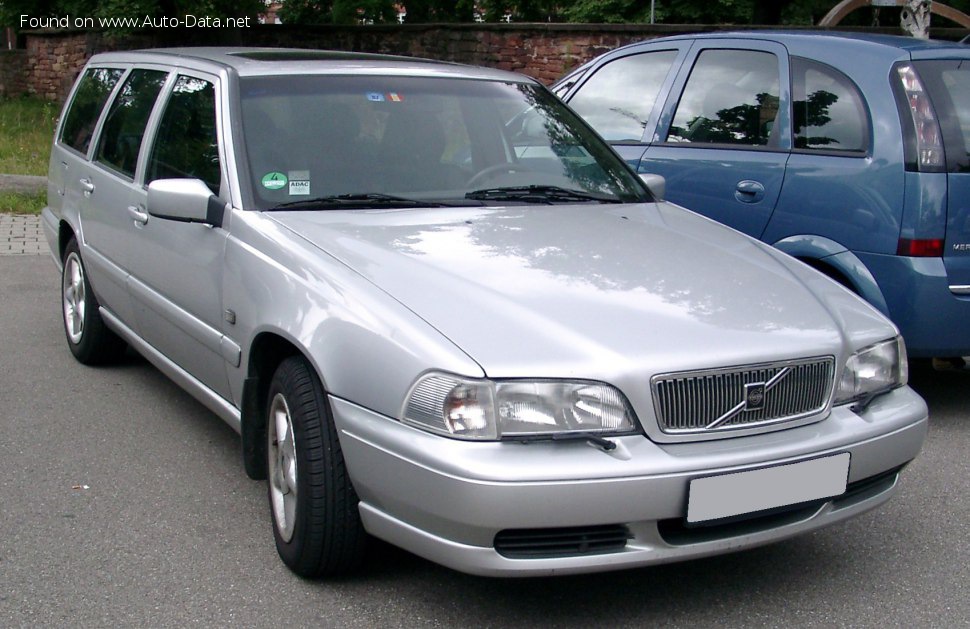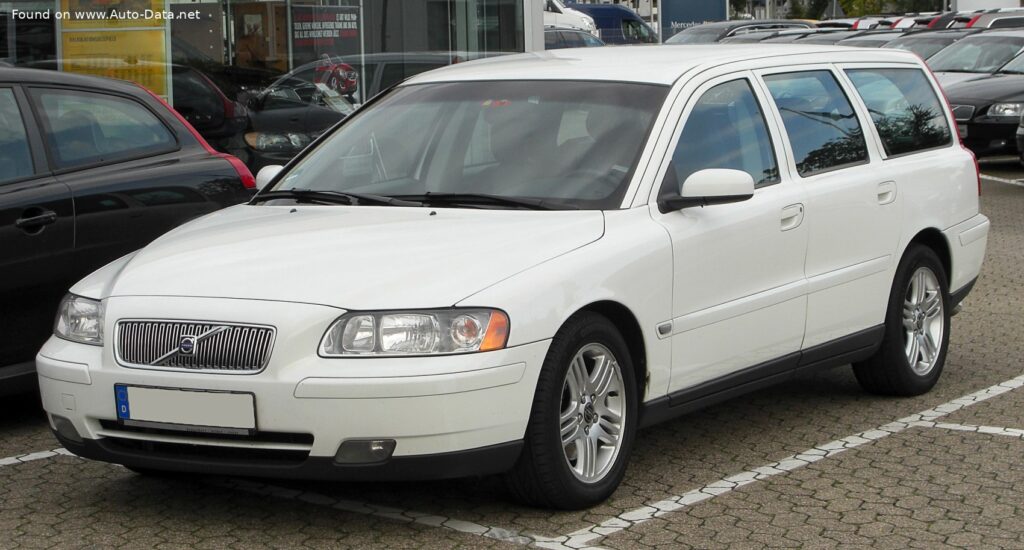
The Volvo V70 II, particularly the facelifted version introduced in 2004, represents a significant evolution in the Swedish automaker’s long-standing tradition of building practical, safe, and comfortable station wagons. Positioned within the mid-size executive car segment, the V70 aimed to provide a compelling alternative to more conventional saloons, offering increased versatility without sacrificing the refinement expected of a premium vehicle. This generation of the V70, produced from 2000 to 2007 (with the facelift spanning 2004-2007), built upon the success of its predecessor, offering improved styling, enhanced safety features, and a range of efficient engines. While not a high-volume seller in the United States, the V70 was a popular choice in Europe, particularly among families and those requiring a vehicle capable of carrying both passengers and substantial cargo.
Volvo V70 II (Facelift 2004) 2.4 Geartronic: An Overview
The 2004 facelift brought subtle but important changes to the V70 II, including revised front and rear styling, updated interior trim, and improvements to the engine range. The 2.4-liter, 170 horsepower variant, coupled with the five-speed Geartronic automatic transmission, was a common configuration, offering a balance between performance and fuel economy. This model catered to drivers seeking a comfortable and capable estate car for everyday use and longer journeys. The Geartronic transmission provided a smooth and convenient driving experience, while the 2.4-liter engine delivered adequate power for most driving situations.
Engine & Performance
The heart of the V70 II 2.4 Geartronic is a 2.4-liter inline five-cylinder petrol (gasoline) engine, designated the B5244S. This naturally aspirated engine produces 170 horsepower at 6000 rpm and 225 Nm (165.95 lb.-ft.) of torque at 4500 rpm. The engine’s configuration – an inline-five – is relatively uncommon and contributes to a distinctive engine note. Power is delivered to the front wheels via a five-speed Geartronic automatic transmission. Acceleration from 0 to 100 km/h (0-62 mph) takes 9.9 seconds, while 0 to 60 mph is achieved in approximately 9.4 seconds. The V70 2.4 has a maximum speed of 215 km/h (133.59 mph). Fuel consumption, as measured using the NEDC standard, is rated at 9.8 l/100 km (24 US mpg) combined, with 13.7 l/100 km (17.2 US mpg) in urban driving and 7.5 l/100 km (31.4 US mpg) on the extra-urban cycle. CO2 emissions are rated at 234 g/km, meeting Euro 4 emission standards.
Design & Features
The Volvo V70 II is a five-door station wagon (estate) designed with a focus on practicality and safety. Its long roofline and generous cargo area provide ample space for passengers and luggage. The 2004 facelift brought a more contemporary look to the front fascia, with revised headlights and a redesigned grille. Inside, the V70 offers a comfortable and well-appointed cabin, typical of Volvo’s commitment to Scandinavian design. Key features include comfortable seating for five, a spacious and versatile cargo area (485 liters minimum, expanding to 1641 liters with the rear seats folded), and a range of safety features. Safety was a paramount concern for Volvo, and the V70 II incorporates features such as ABS (Anti-lock Braking System), side impact protection, and a robust chassis designed to protect occupants in the event of a collision. The vehicle’s suspension utilizes an independent McPherson strut setup at the front and an independent multi-link suspension at the rear, providing a comfortable ride and stable handling. Hydraulic power steering contributes to ease of maneuverability.
Technical Specifications
| Brand | Volvo |
| Model | V70 |
| Generation | V70 II (facelift 2004) |
| Type (Engine) | 2.4 (170 Hp) Geartronic |
| Start of production | 2004 |
| End of production | 2007 |
| Powertrain Architecture | Internal Combustion engine |
| Body type | Station wagon (estate) |
| Seats | 5 |
| Doors | 5 |
| Fuel consumption (urban) | 13.7 l/100 km (17.2 US mpg) |
| Fuel consumption (extra urban) | 7.5 l/100 km (31.4 US mpg) |
| Fuel consumption (combined) | 9.8 l/100 km (24 US mpg) |
| CO2 emissions | 234 g/km |
| Fuel Type | Petrol (Gasoline) |
| Acceleration 0-100 km/h | 9.9 sec |
| Acceleration 0-62 mph | 9.9 sec |
| Acceleration 0-60 mph | 9.4 sec |
| Maximum speed | 215 km/h (133.59 mph) |
| Emission standard | Euro 4 |
| Weight-to-power ratio | 9.2 kg/Hp |
| Weight-to-torque ratio | 6.9 kg/Nm |
| Power | 170 Hp @ 6000 rpm |
| Torque | 225 Nm @ 4500 rpm (165.95 lb.-ft. @ 4500 rpm) |
| Engine layout | Front, Transverse |
| Engine Model/Code | B5244S |
| Engine displacement | 2435 cm3 (148.59 cu. in.) |
| Number of cylinders | 5 |
| Engine configuration | Inline |
| Cylinder Bore | 83 mm (3.27 in.) |
| Piston Stroke | 90 mm (3.54 in.) |
| Number of valves per cylinder | 4 |
| Fuel injection system | Multi-port manifold injection |
| Engine aspiration | Naturally aspirated |
| Valvetrain | DOHC |
| Engine oil capacity | 5.5 l (5.81 US qt | 4.84 UK qt) |
| Coolant capacity | 8.8 l (9.3 US qt | 7.74 UK qt) |
| Kerb Weight | 1562 kg (3443.62 lbs.) |
| Max. weight | 2100 kg (4629.71 lbs.) |
| Max load | 538 kg (1186.09 lbs.) |
| Trunk (boot) space – minimum | 485 l (17.13 cu. ft.) |
| Trunk (boot) space – maximum | 1641 l (57.95 cu. ft.) |
| Fuel tank capacity | 70 l (18.49 US gal | 15.4 UK gal) |
| Max. roof load | 100 kg (220.46 lbs.) |
| Permitted trailer load (braked) | 1800 kg (3968.32 lbs.) |
| Permitted trailer load (unbraked) | 750 kg (1653.47 lbs.) |
| Permitted towbar download | 75 kg (165.35 lbs.) |
| Length | 4710 mm (185.43 in.) |
| Width | 1804 mm (71.02 in.) |
| Height | 1465 mm (57.68 in.) |
| Wheelbase | 2755 mm (108.46 in.) |
| Front track | 1551 mm (61.06 in.) |
| Rear track | 1548 mm (60.94 in.) |
| Minimum turning circle | 11.9 m (39.04 ft.) |
| Drivetrain | Front wheel drive |
| Gearbox | 5 gears, automatic (Geartronic) |
| Front suspension | Independent, McPherson with coil spring and anti-roll bar |
| Rear suspension | Independent multi-link, Transverse stabilizer |
| Front brakes | Ventilated discs |
| Rear brakes | Disc |
| Steering | Steering rack and pinion, Hydraulic Power Steering |
| Tires size | 205/55 R16 |
| Wheel rims size | 7J x 16 |
The Volvo V70 II 2.4 Geartronic, particularly the facelifted version, remains a compelling choice for those seeking a practical, safe, and comfortable station wagon. Its blend of Scandinavian design, robust engineering, and a focus on passenger well-being continues to resonate with drivers today.