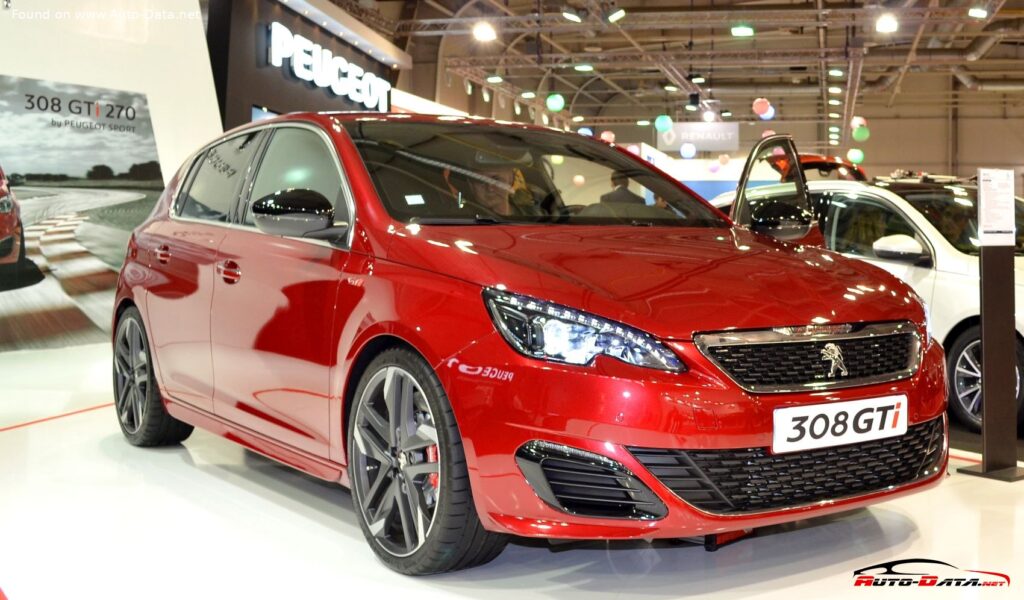
The Peugeot 308 II, specifically the GTi 1.6 THP (270 Hp) model produced between 2015 and 2017, represents a significant evolution in Peugeot’s compact hatchback offerings. This vehicle, designated as Phase I of the 308 II generation, was primarily aimed at the European market, where the C-segment hatchback is exceptionally popular. While not officially sold in the United States, the 308 GTi offered a compelling blend of performance, efficiency, and style, competing with models like the Volkswagen Golf GTI and Ford Focus ST. It distinguished itself through a focus on driver engagement and a sophisticated interior.
Peugeot 308 II GTi: A Performance Hatchback
The 308 II GTi was positioned as the performance variant of the 308 range. It catered to drivers seeking a more dynamic driving experience than the standard models. The Phase I version, launched in 2015, established the GTi as a serious contender in the hot hatch segment. The 308 II represented a departure from its predecessor, featuring a lighter chassis, a more refined interior, and a suite of modern technologies. The GTi variant amplified these improvements with a potent engine and sport-tuned suspension.
Engine & Performance
At the heart of the 308 GTi 1.6 THP lies a 1.6-liter turbocharged four-cylinder gasoline engine, codenamed EP6FDTR. This engine delivers a robust 270 horsepower at 6000 rpm and 330 Nm (243.4 lb.-ft.) of torque at 1900 rpm. The high specific output of 169 hp per liter highlights the engine’s efficiency and advanced technology, including direct fuel injection and an intercooled turbocharger. This powertrain allows for a 0-60 mph (0-96 km/h) acceleration time of approximately 5.7 seconds and a 0-62 mph (0-100 km/h) time of 6 seconds, with a governed top speed of 155.34 mph (250 km/h). The engine is transversely mounted at the front of the vehicle, driving the front wheels. A six-speed manual transmission is standard, providing drivers with precise control over the power delivery. The weight-to-power ratio of 4.5 kg/Hp and weight-to-torque ratio of 3.7 kg/Nm contribute to the car’s responsive handling.
Design & Features
The Peugeot 308 II GTi is a five-door hatchback with a sleek and modern design. Its dimensions are 4253 mm (167.44 in) in length, 1804 mm (71.02 in) in width, and 1446 mm (56.93 in) in height. The wheelbase measures 2617 mm (103.03 in). The GTi variant features distinctive styling cues, including a more aggressive front bumper, a rear diffuser, and unique alloy wheels (19-inch). Inside, the 308 GTi boasts a driver-focused cockpit with supportive sports seats, aluminum pedals, and a compact steering wheel. The interior emphasizes quality materials and a user-friendly layout. Standard features include ABS (Anti-lock Braking System), and a steering rack and pinion system. Trunk space is a practical 470 liters (16.6 cu. ft.). The car’s kerb weight is 1205 kg (2656.57 lbs), contributing to its agile handling. The fuel tank capacity is 53 liters (14 US gal).
Technical Specifications
| Brand | Peugeot |
| Model | 308 |
| Generation | 308 II (Phase I, 2013) |
| Type (Engine) | GTi 1.6 THP (270 Hp) |
| Start of production | 2015 |
| End of production | 2017 |
| Powertrain Architecture | Internal Combustion engine |
| Body type | Hatchback |
| Seats | 5 |
| Doors | 5 |
| Fuel consumption (urban) | 8.1 l/100 km (29 US mpg, 34.9 UK mpg, 12.3 km/l) |
| Fuel consumption (extra urban) | 4.9 l/100 km (48 US mpg, 57.6 UK mpg, 20.4 km/l) |
| Fuel consumption (combined) | 6 l/100 km (39.2 US mpg, 47.1 UK mpg, 16.7 km/l) |
| CO2 emissions | 139 g/km |
| Fuel Type | Petrol (Gasoline) |
| Acceleration 0 – 100 km/h | 6 sec |
| Acceleration 0 – 62 mph | 6 sec |
| Acceleration 0 – 60 mph | 5.7 sec |
| Maximum speed | 250 km/h (155.34 mph) |
| Emission standard | Euro 6 |
| Weight-to-power ratio | 4.5 kg/Hp |
| Weight-to-torque ratio | 3.7 kg/Nm |
| Power | 270 Hp @ 6000 rpm |
| Power per litre | 169 Hp/l |
| Torque | 330 Nm @ 1900 rpm (243.4 lb.-ft. @ 1900 rpm) |
| Engine layout | Front, Transverse |
| Engine Model/Code | EP6FDTR |
| Engine displacement | 1598 cm3 (97.52 cu. in.) |
| Number of cylinders | 4 |
| Engine configuration | Inline |
| Fuel injection system | Direct injection |
| Engine aspiration | Turbocharger, Intercooler |
| Engine oil capacity | 4.3 l (4.54 US qt | 3.78 UK qt) |
| Kerb Weight | 1205 kg (2656.57 lbs) |
| Trunk (boot) space (minimum) | 470 l (16.6 cu. ft.) |
| Fuel tank capacity | 53 l (14 US gal | 11.66 UK gal) |
| Length | 4253 mm (167.44 in) |
| Width | 1804 mm (71.02 in) |
| Width with mirrors folded | 1863 mm (73.35 in) |
| Width including mirrors | 2043 mm (80.43 in) |
| Height | 1446 mm (56.93 in) |
| Wheelbase | 2617 mm (103.03 in) |
| Front track | 1570 mm (61.81 in) |
| Rear track | 1554 mm (61.18 in) |
| Front overhang | 866 mm (34.09 in) |
| Rear overhang | 770 mm (30.31 in) |
| Drivetrain Architecture | Front wheel drive |
| Number of gears and type of gearbox | 6 gears, manual transmission |
| Front brakes | Ventilated discs |
| Rear brakes | Disc |
| Tires size | 235/35 R19 91Y |
| Wheel rims size | 19 |
The Peugeot 308 II GTi 1.6 THP (270 Hp) offered a compelling package for enthusiasts seeking a refined and engaging driving experience in a practical hatchback format. While never officially available in the US market, it remains a noteworthy example of European hot hatch engineering.