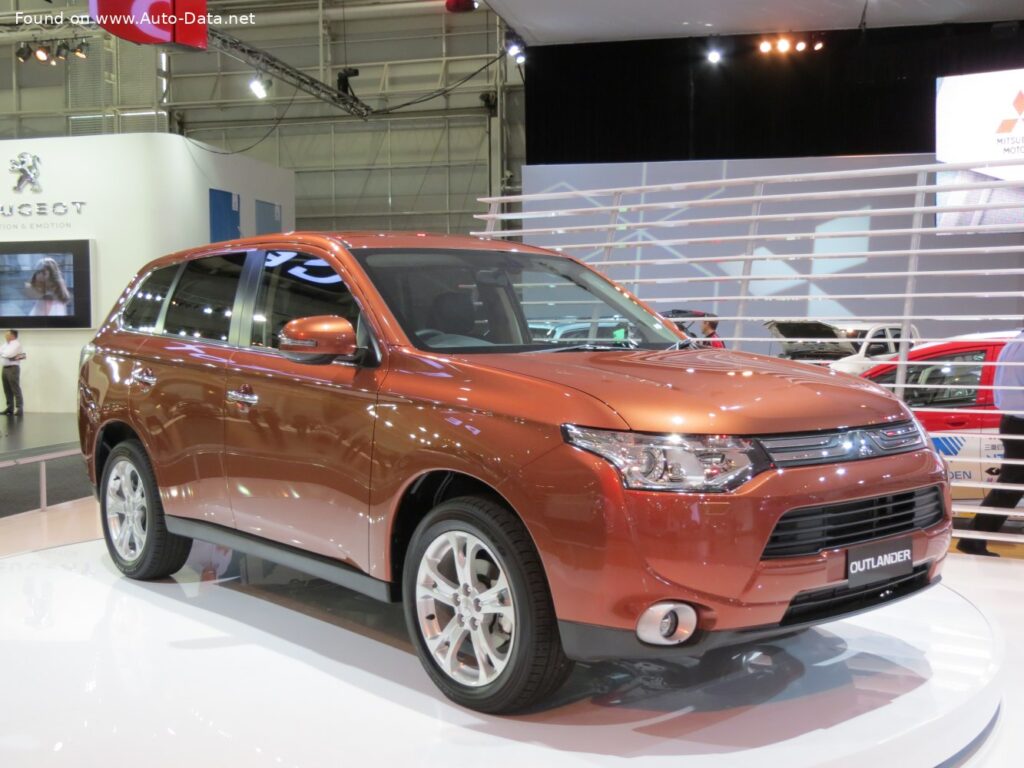
The Mitsubishi Outlander III, produced between 2012 and 2015, represents the third generation of Mitsubishi’s popular crossover SUV. Positioned as a mid-size vehicle, the Outlander III aimed to provide a practical and versatile option for families, blending passenger comfort with available all-wheel drive capability. While not initially a major seller in the North American market, the Outlander III played a significant role in bolstering Mitsubishi’s presence in Europe and other global markets, offering a diesel-powered alternative in regions where gasoline engines were less favored. This particular variant, the 2.2-liter 4WD model, delivered a balance of fuel efficiency and performance, catering to drivers seeking a capable and economical SUV.
Mitsubishi Outlander III 2.2 4WD: An Overview
The Outlander III marked a significant evolution in Mitsubishi’s SUV design language. It offered a more refined interior, improved ride quality, and a range of modern features compared to its predecessors. The 2.2-liter diesel engine was a key component of the European lineup, providing strong torque for comfortable highway cruising and towing capabilities. The availability of all-wheel drive further enhanced its appeal in regions with challenging weather conditions. The vehicle was offered with both manual and automatic transmissions, catering to a wider range of driver preferences.
Engine & Performance
The heart of the Mitsubishi Outlander III 2.2 4WD is a 2.2-liter inline-four cylinder diesel engine, designated the 4N14. This engine produces 150 horsepower at 3500 rpm and a substantial 380 Nm (280.27 lb.-ft.) of torque between 1750 and 2500 rpm. The engine utilizes a turbocharger with an intercooler to enhance power output and efficiency. Fuel is delivered via a diesel commonrail direct injection system, contributing to improved combustion and reduced emissions. The engine’s transverse mounting and front-wheel-drive based architecture, coupled with the available all-wheel-drive system, provide a balanced driving experience. Acceleration from 0 to 100 km/h (0-62 mph) takes 10.2 seconds, while 0 to 60 mph is achieved in approximately 9.7 seconds. The vehicle boasts a maximum speed of 200 km/h (124.27 mph). The Outlander III 2.2 4WD meets Euro 5 emission standards, reflecting Mitsubishi’s commitment to environmental responsibility.
Design & Features
The Mitsubishi Outlander III is a five-door SUV/Crossover with seating for five passengers. Its exterior design features a more sculpted and aerodynamic profile compared to earlier Outlander models. The vehicle’s dimensions are 4665 mm (183.66 in.) in length, 1800 mm (70.87 in.) in width, and 1680 mm (66.14 in.) in height, with a wheelbase of 2670 mm (105.12 in.). The interior offers a comfortable and functional space, with a focus on practicality and ease of use. Key features include a standard anti-lock braking system (ABS), ventilated front disc brakes, and rear disc brakes. The suspension system comprises an independent McPherson strut setup at the front and an independent multi-link suspension at the rear, providing a comfortable ride and responsive handling. Trunk space is versatile, ranging from a minimum of 145 liters (5.12 cu. ft.) with the rear seats up to a maximum of 986 liters (34.82 cu. ft.) with the seats folded down. The minimum turning circle is 10.6 meters (34.78 ft).
Technical Specifications
| Brand | Mitsubishi |
| Model | Outlander |
| Generation | Outlander III |
| Type (Engine) | 2.2 (150 Hp) 4WD |
| Start of production | 2012 |
| End of production | 2015 |
| Powertrain Architecture | Internal Combustion engine |
| Body type | SUV, Crossover |
| Seats | 5 |
| Doors | 5 |
| Fuel consumption (urban) | 6.5 l/100 km (36.2 US mpg, 43.5 UK mpg, 15.4 km/l) |
| Fuel consumption (extra urban) | 4.7 l/100 km (50 US mpg, 60.1 UK mpg, 21.3 km/l) |
| Fuel consumption (combined) | 5.4 l/100 km (43.6 US mpg, 52.3 UK mpg, 18.5 km/l) |
| Fuel Type | Diesel |
| Acceleration 0 – 100 km/h | 10.2 sec |
| Acceleration 0 – 62 mph | 10.2 sec |
| Acceleration 0 – 60 mph | 9.7 sec |
| Maximum speed | 200 km/h (124.27 mph) |
| Emission standard | Euro 5 |
| Weight-to-power ratio | 10.6 kg/Hp |
| Weight-to-torque ratio | 4.2 kg/Nm |
| Power | 150 Hp @ 3500 rpm |
| Torque | 380 Nm @ 1750-2500 rpm (280.27 lb.-ft. @ 1750-2500 rpm) |
| Engine layout | Front, Transverse |
| Engine Model/Code | 4N14 |
| Engine configuration | Inline |
| Fuel injection system | Diesel Commonrail |
| Engine aspiration | Turbocharger, Intercooler |
| Valvetrain | DOHC |
| Engine oil capacity | 5.9 l (6.23 US qt | 5.19 UK qt) |
| Coolant capacity | 8.3 l (8.77 US qt | 7.3 UK qt) |
| Kerb Weight | 1590 kg (3505.35 lbs.) |
| Trunk (boot) space – minimum | 145 l (5.12 cu. ft.) |
| Trunk (boot) space – maximum | 986 l (34.82 cu. ft.) |
| Fuel tank capacity | 60 l (15.85 US gal | 13.2 UK gal) |
| Length | 4665 mm (183.66 in.) |
| Width | 1800 mm (70.87 in.) |
| Height | 1680 mm (66.14 in.) |
| Wheelbase | 2670 mm (105.12 in.) |
| Minimum turning circle | 10.6 m (34.78 ft.) |
| Drive wheel | All wheel drive (4×4) |
| Number of gears | 6 |
| Gearbox type | Manual transmission |
| Front suspension | Independent, type McPherson with coil spring and anti-roll bar |
| Rear suspension | Independent multi-link suspension |
| Front brakes | Ventilated discs |
| Rear brakes | Disc |