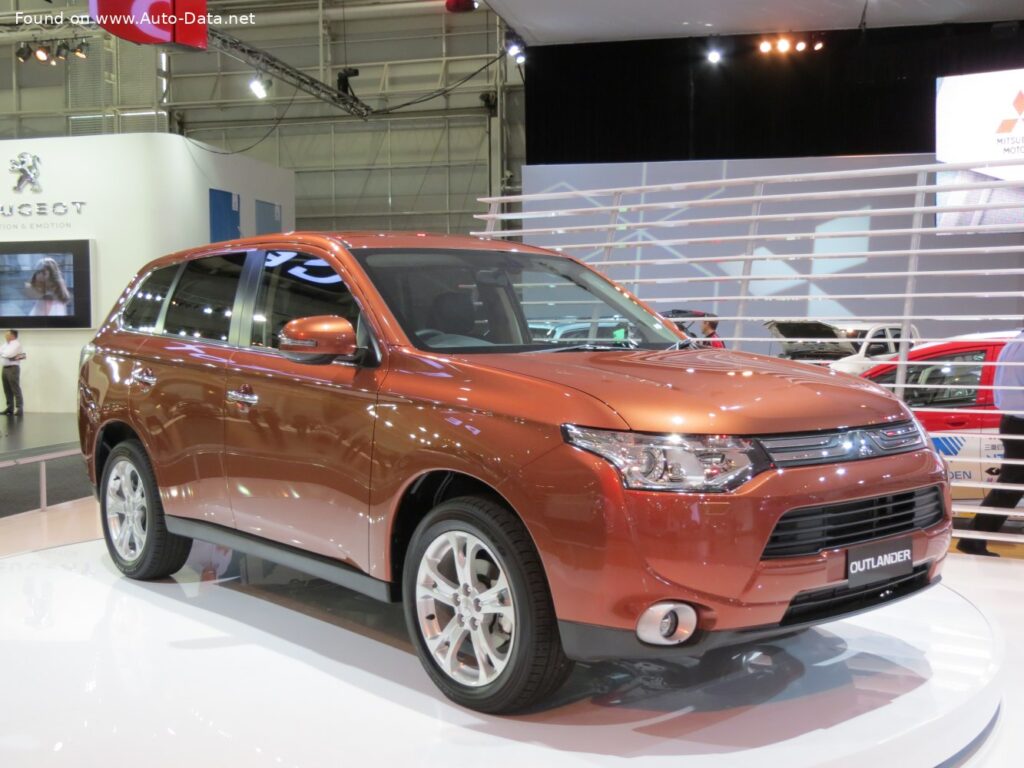
The Mitsubishi Outlander III, produced between 2012 and 2015, represents the third generation of Mitsubishi’s popular crossover SUV. Positioned as a mid-size vehicle, the Outlander III aimed to provide a practical and versatile option for families, blending passenger comfort with available all-wheel drive capability. While not initially a major seller in the North American market compared to competitors like the Honda CR-V or Toyota RAV4, the Outlander III offered a distinctive design and a focus on fuel efficiency, particularly with its diesel engine options available in Europe and other international markets. This article details the specifications and characteristics of the 2.2-liter diesel, 150 horsepower, four-wheel drive, automatic transmission version of the Outlander III.
Mitsubishi Outlander III: Overview and Market Positioning
The Outlander III marked a significant evolution in Mitsubishi’s crossover strategy. Introduced as a replacement for the second-generation Outlander, it featured a more refined exterior design and an updated interior. In Europe, where diesel engines were prevalent, the 2.2-liter diesel variant was a key offering, providing a balance of power and economy. The Outlander III competed in the crowded Crossover SUV segment, emphasizing practicality, available seating for five, and a focus on all-weather capability through its available four-wheel drive system. The vehicle was designed to appeal to buyers seeking a versatile vehicle for both daily commuting and weekend adventures.
Engine & Performance
The 2.2-liter diesel engine powering this version of the Mitsubishi Outlander III is a 4N14 inline four-cylinder unit. It produces 150 horsepower at 3500 rpm and a substantial 360 Nm (265.52 lb.-ft.) of torque between 1500 and 2750 rpm. This torque output provides good low-end responsiveness, making it suitable for towing and navigating varied terrain. The engine utilizes a turbocharger and intercooler to enhance performance and efficiency. Fuel is delivered via a Diesel Commonrail direct injection system. Acceleration from 0 to 100 km/h (0-62 mph) takes 11.7 seconds, while 0 to 60 mph is achieved in approximately 11.1 seconds. The vehicle has a maximum speed of 190 km/h (118.06 mph). Fuel economy is rated at 7.1 l/100 km (33.1 US mpg) in urban conditions, 5.1 l/100 km (46.1 US mpg) on the extra-urban cycle, and a combined figure of 5.8 l/100 km (40.6 US mpg). The engine meets Euro 5 emission standards and incorporates a particulate filter to reduce harmful emissions.
Design & Features
The Mitsubishi Outlander III is a five-door SUV/Crossover with seating for five passengers. Its exterior design features a more sculpted appearance compared to its predecessor, with a prominent front grille and distinctive headlight design. The body measures 4665 mm (183.66 in.) in length, 1800 mm (70.87 in.) in width, and 1680 mm (66.14 in.) in height, with a wheelbase of 2670 mm (105.12 in.). The interior offers a practical layout with a focus on usability. Key features include an independent McPherson strut front suspension and an independent multi-link rear suspension, providing a comfortable ride. Braking is handled by ventilated discs at the front and discs at the rear, assisted by an Anti-lock Braking System (ABS). Trunk space is flexible, ranging from a minimum of 145 liters (5.12 cu. ft.) with the rear seats up to a maximum of 986 liters (34.82 cu. ft.) with the seats folded down. The vehicle’s turning circle is 10.6 meters (34.78 ft).
Technical Specifications
| Brand | Mitsubishi |
| Model | Outlander |
| Generation | Outlander III |
| Type (Engine) | 2.2 (150 Hp) 4WD Automatic |
| Start of production | 2012 |
| End of production | 2015 |
| Powertrain Architecture | Internal Combustion engine |
| Body type | SUV, Crossover |
| Seats | 5 |
| Doors | 5 |
| Fuel consumption (urban) | 7.1 l/100 km (33.1 US mpg) |
| Fuel consumption (extra urban) | 5.1 l/100 km (46.1 US mpg) |
| Fuel consumption (combined) | 5.8 l/100 km (40.6 US mpg) |
| Fuel Type | Diesel |
| Acceleration 0 – 100 km/h | 11.7 sec |
| Acceleration 0 – 62 mph | 11.7 sec |
| Acceleration 0 – 60 mph | 11.1 sec |
| Maximum speed | 190 km/h (118.06 mph) |
| Emission standard | Euro 5 |
| Weight-to-power ratio | 10.7 kg/Hp |
| Weight-to-torque ratio | 4.5 kg/Nm |
| Power | 150 Hp @ 3500 rpm |
| Torque | 360 Nm @ 1500-2750 rpm (265.52 lb.-ft. @ 1500-2750 rpm) |
| Engine layout | Front, Transverse |
| Engine Model/Code | 4N14 |
| Engine configuration | Inline |
| Fuel injection system | Diesel Commonrail |
| Engine aspiration | Turbocharger, Intercooler |
| Valvetrain | DOHC |
| Engine oil capacity | 5.3 l (5.6 US qt | 4.66 UK qt) |
| Coolant capacity | 7.6 l (8.03 US qt | 6.69 UK qt) |
| Kerb Weight | 1610 kg (3549.44 lbs.) |
| Trunk (boot) space – minimum | 145 l (5.12 cu. ft.) |
| Trunk (boot) space – maximum | 986 l (34.82 cu. ft.) |
| Fuel tank capacity | 60 l (15.85 US gal | 13.2 UK gal) |
| Length | 4665 mm (183.66 in.) |
| Width | 1800 mm (70.87 in.) |
| Height | 1680 mm (66.14 in.) |
| Wheelbase | 2670 mm (105.12 in.) |
| Minimum turning circle | 10.6 m (34.78 ft.) |
| Drive wheel | All wheel drive (4×4) |
| Number of gears | 6 |
| Gearbox type | Automatic transmission |
| Front suspension | Independent, McPherson with coil spring and anti-roll bar |
| Rear suspension | Independent multi-link suspension |
| Front brakes | Ventilated discs |
| Rear brakes | Disc |
The Mitsubishi Outlander III 2.2 4WD Automatic offered a compelling package for buyers seeking a versatile and efficient crossover SUV, particularly in markets where diesel engines were favored. Its blend of practicality, available all-wheel drive, and reasonable fuel economy made it a competitive option in its segment.