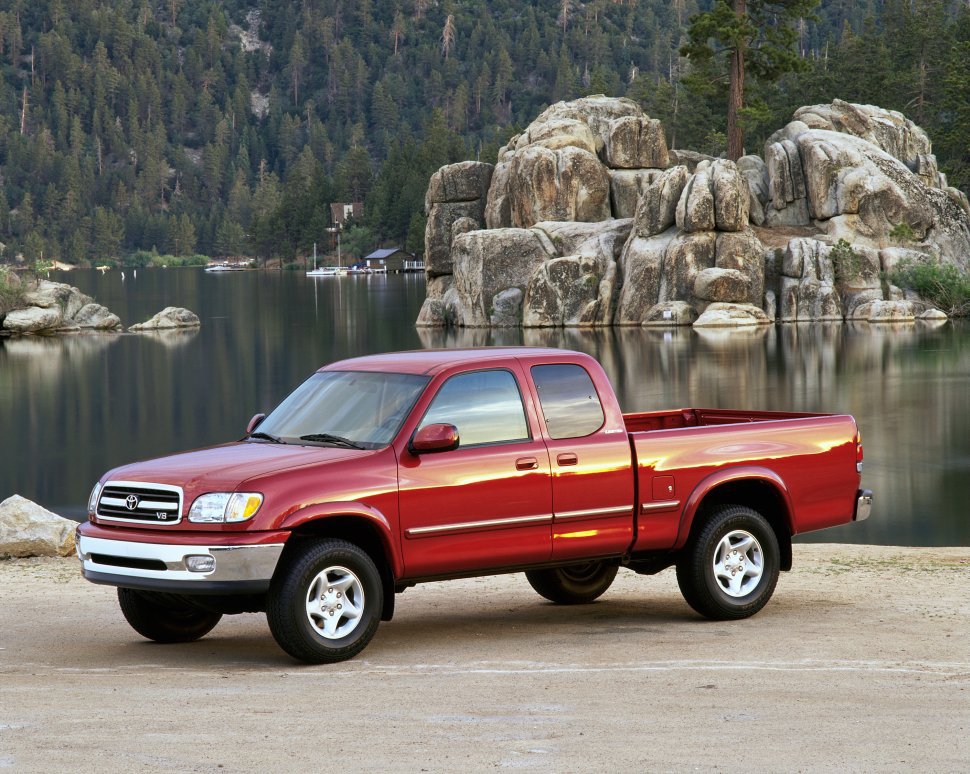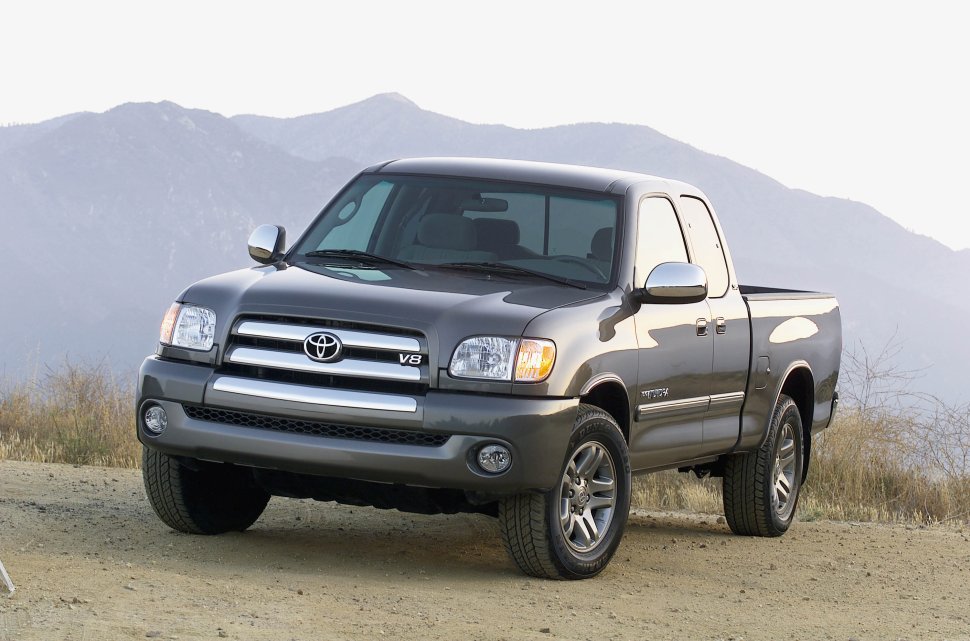
The Toyota Tundra I Access Cab (facelift 2002) 3.4i represents Toyota’s initial foray into the full-size pickup truck market in North America. Introduced in 1999 and receiving a significant facelift in 2002, the Tundra was designed to appeal to American truck buyers seeking a reliable, capable, and well-equipped alternative to domestic offerings. The Access Cab configuration, featuring a smaller second row of seats, broadened the Tundra’s appeal to families and those needing occasional passenger space. This generation Tundra aimed to balance rugged utility with Toyota’s reputation for quality and durability, establishing a foothold for the brand in a highly competitive segment.
Toyota Tundra I Access Cab (2002-2004)
The 2002 facelift brought cosmetic updates to the Tundra, including revised front and rear styling, and interior refinements. While not a complete redesign, these changes helped modernize the truck’s appearance and enhance its marketability. The 3.4i model, powered by the 5VZ-FE engine, was a mainstay of the Tundra lineup, offering a blend of adequate power and proven reliability. The Tundra I Access Cab competed directly with the Ford F-150, Chevrolet Silverado, and Dodge Ram, aiming to carve out a niche based on its perceived value and dependability.
Engine & Performance
The heart of the 2002-2004 Toyota Tundra 3.4i is the 5VZ-FE 3.4-liter V6 engine. This naturally aspirated powerplant produces 190 horsepower at 4800 rpm and 298 Nm (219.79 lb.-ft.) of torque at 3600 rpm. The engine features a cast iron block and aluminum cylinder heads, incorporating multi-port fuel injection and a double overhead camshaft (DOHC) valvetrain with four valves per cylinder. This configuration delivers a power-to-weight ratio of 9.9 kg/Hp and a torque-to-weight ratio of 6.3 kg/Nm. The engine is longitudinally mounted and drives the rear wheels through a four-speed automatic transmission with ECT (Electronic Control Transmission). Fuel economy is rated at 14.7 l/100 km (16 US mpg) in urban driving and 12.3 l/100 km (19.1 US mpg) on the highway. The 3.4-liter engine, while not the most powerful in its class, provided sufficient performance for typical truck duties and was known for its longevity and relatively low maintenance requirements.
Design & Features
The Toyota Tundra I Access Cab is a four-door, five-seat pickup truck with a body-on-frame construction. The Access Cab configuration features a smaller rear seat compared to the larger Double Cab model, offering a compromise between passenger space and bed length. The truck bed measures 2625 liters (92.7 cu. ft.) in volume, providing ample cargo capacity. The exterior design is characterized by a relatively conservative aesthetic, typical of trucks from this era. Key features include ventilated front disc brakes and drum brakes in the rear, an anti-lock braking system (ABS) for enhanced safety, and a steering rack and pinion system for responsive handling. Ride height, or ground clearance, is a substantial 269 mm (10.59 in), allowing for moderate off-road capability. The Tundra’s approach and departure angles are 27° and 23° respectively, further aiding its off-road performance. The interior, while functional, prioritized durability over luxury, with durable materials and a straightforward layout. The Tundra’s design focused on providing a practical and reliable work truck with a degree of passenger comfort.
Technical Specifications
| Brand | Toyota |
| Model | Tundra |
| Generation | Tundra I Access Cab (facelift 2002) |
| Type (Engine) | 3.4i (190 Hp) Automatic |
| Start of production | 2002 |
| End of production | 2004 |
| Powertrain Architecture | Internal Combustion engine |
| Body type | Pick-up |
| Seats | 5 |
| Doors | 4 |
| Fuel consumption (urban) | 14.7 l/100 km (16 US mpg) |
| Fuel consumption (extra urban) | 12.3 l/100 km (19.1 US mpg) |
| Fuel Type | Petrol (Gasoline) |
| Weight-to-power ratio | 9.9 kg/Hp |
| Weight-to-torque ratio | 6.3 kg/Nm |
| Power | 190 Hp @ 4800 rpm |
| Torque | 298 Nm @ 3600 rpm (219.79 lb.-ft. @ 3600 rpm) |
| Engine layout | Front, Longitudinal |
| Engine Model/Code | 5VZ-FE |
| Engine displacement | 3378 cm3 (206.14 cu. in.) |
| Number of cylinders | 6 |
| Engine configuration | V-engine |
| Cylinder Bore | 93.4 mm (3.68 in.) |
| Piston Stroke | 82 mm (3.23 in.) |
| Compression ratio | 9.6:1 |
| Number of valves per cylinder | 4 |
| Fuel injection system | Multi-port manifold injection |
| Engine aspiration | Naturally aspirated |
| Valvetrain | DOHC |
| Engine oil capacity | 5.2 l (5.49 US qt | 4.58 UK qt) |
| Coolant capacity | 9.9 l (10.46 US qt | 8.71 UK qt) |
| Kerb Weight | 1886 kg (4157.92 lbs.) |
| Max. weight | 2585 kg (5698.95 lbs.) |
| Max load | 699 kg (1541.03 lbs.) |
| Trunk (boot) space – maximum | 2625 l (92.7 cu. ft.) |
| Fuel tank capacity | 100 l (26.42 US gal | 22 UK gal) |
| Permitted trailer load with brakes (12%) | 2177 kg (4799.46 lbs.) |
| Length | 5545 mm (218.31 in.) |
| Width | 1910 mm (75.2 in.) |
| Height | 1796 mm (70.71 in.) |
| Wheelbase | 3259 mm (128.31 in.) |
| Front track | 1681 mm (66.18 in.) |
| Rear (Back) track | 1648 mm (64.88 in.) |
| Ride height (ground clearance) | 269 mm (10.59 in.) |
| Minimum turning circle (turning diameter) | 13.6 m (44.62 ft.) |
| Approach angle | 27° |
| Departure angle | 23° |
| Drivetrain Architecture | Rear wheel drive |
| Number of gears and type of gearbox | 4 gears, automatic transmission ECT |
| Front suspension | Double wishbone |
| Rear suspension | Leaf spring |
| Front brakes | Ventilated discs |
| Rear brakes | Drum |
| Assisting systems | ABS (Anti-lock braking system) |
| Steering type | Steering rack and pinion |
| Tires size | 245/70 R16; 265/70 R16; 265/65 R17 |
| Wheel rims size | 7.0J x 16; 7.5J x 17 |