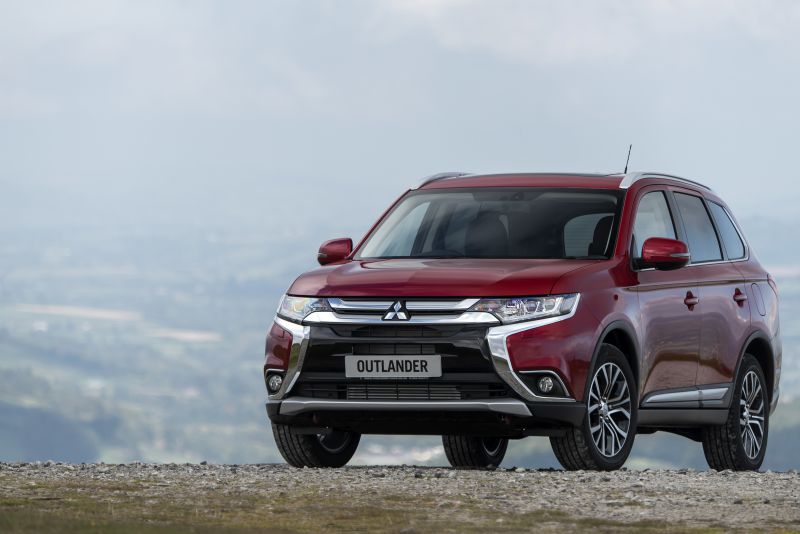
The Mitsubishi Outlander III, specifically the facelifted version introduced in 2015, represents a significant iteration of Mitsubishi’s popular crossover SUV. Positioned within the compact SUV segment, the Outlander III aimed to balance practicality, fuel efficiency, and a degree of off-road capability. While not a major seller in the United States compared to competitors like the Honda CR-V or Toyota RAV4, the Outlander held a stronger presence in European and Asian markets, particularly as a diesel-powered option. The 2015 facelift brought styling updates, improved interior materials, and refinements to the vehicle’s technology, enhancing its overall appeal.
Mitsubishi Outlander III (2015-2018) 2.2 DI-D 4WD
The Outlander III, launched initially in 2012, underwent a notable refresh in 2015. This facelift focused on enhancing the vehicle’s front-end styling, improving interior quality, and refining the available technology. The 2.2 DI-D variant, powered by a turbocharged diesel engine, was a key offering, particularly in Europe where diesel fuel was more prevalent and economically advantageous. This model combined a relatively efficient powertrain with Mitsubishi’s Super All-Wheel Control (S-AWC) system, providing enhanced traction and stability in various driving conditions. The Outlander III aimed to provide a versatile vehicle suitable for both daily commuting and weekend adventures.
Engine & Performance
The heart of the 2015 Mitsubishi Outlander III 2.2 DI-D is a 2.3-liter (2268 cm3) inline-four cylinder diesel engine, designated the 4N14. This engine produces 150 horsepower at 3500 rpm and 380 Nm (280.27 lb.-ft.) of torque between 1750 and 2500 rpm. The engine utilizes a turbocharger with an intercooler to boost performance and efficiency. Fuel is delivered via a diesel commonrail direct injection system. Power is delivered to all four wheels through a six-speed manual transmission. This configuration allows for a 0-60 mph (0-97 km/h) acceleration time of approximately 9.7 seconds and a top speed of 124.27 mph (200 km/h). Fuel economy is a strong point, with combined cycle figures reaching 44.4 US mpg (53.3 UK mpg or 5.3 l/100 km). The engine meets Euro 6 emission standards, incorporating a particulate filter to reduce harmful emissions.
Design & Features
The Mitsubishi Outlander III is a five-door SUV/Crossover body style, offering seating for five passengers. The 2015 facelift brought a revised front fascia with a more prominent grille and updated headlights, giving the vehicle a more modern appearance. The interior received improvements in material quality and trim. Key features include Mitsubishi’s S-AWC all-wheel-drive system, which utilizes sensors and electronic control to distribute torque effectively for optimal traction. Safety features, typical for its era, include ABS (Anti-lock Braking System) and a range of airbags. The Outlander III offers a practical cargo area, with a minimum capacity of 4.52 cu. ft. (128 liters) expanding to 56.79 cu. ft. (1608 liters) with the rear seats folded down. The vehicle’s dimensions are 184.84 inches (4695 mm) in length, 71.26 inches (1810 mm) in width, and 66.14 inches (1680 mm) in height, with a wheelbase of 105.12 inches (2670 mm) and a ground clearance of 7.48 inches (190 mm).
Technical Specifications
| Brand | Mitsubishi |
| Model | Outlander |
| Generation | Outlander III (facelift 2015) |
| Type (Engine) | 2.2 DI-D (150 Hp) 4WD |
| Start of production | 2015 |
| End of production | 2018 |
| Powertrain Architecture | Internal Combustion engine |
| Body type | SUV, Crossover |
| Seats | 5 |
| Doors | 5 |
| Fuel consumption (urban) | 6.2 l/100 km (37.9 US mpg) |
| Fuel consumption (extra urban) | 4.8 l/100 km (49 US mpg) |
| Fuel consumption (combined) | 5.3 l/100 km (44.4 US mpg) |
| CO2 emissions | 139 g/km |
| Fuel Type | Diesel |
| Acceleration 0 – 100 km/h | 10.2 sec |
| Acceleration 0 – 62 mph | 10.2 sec |
| Acceleration 0 – 60 mph | 9.7 sec |
| Maximum speed | 200 km/h (124.27 mph) |
| Emission standard | Euro 6 |
| Weight-to-power ratio | 10.7 kg/Hp |
| Weight-to-torque ratio | 4.2 kg/Nm |
| Power | 150 Hp @ 3500 rpm |
| Torque | 380 Nm @ 1750-2500 rpm (280.27 lb.-ft.) |
| Engine layout | Front, Transverse |
| Engine Model/Code | 4N14 |
| Engine displacement | 2268 cm3 (138.4 cu. in.) |
| Number of cylinders | 4 |
| Engine configuration | Inline |
| Number of valves per cylinder | 4 |
| Fuel injection system | Diesel Commonrail |
| Engine aspiration | Turbocharger, Intercooler |
| Valvetrain | DOHC |
| Engine oil capacity | 5.9 l (6.23 US qt | 5.19 UK qt) |
| Coolant capacity | 7.5 l (7.93 US qt | 6.6 UK qt) |
| Kerb Weight | 1600 kg (3527.4 lbs.) |
| Trunk (boot) space – minimum | 128 l (4.52 cu. ft.) |
| Trunk (boot) space – maximum | 1608 l (56.79 cu. ft.) |
| Fuel tank capacity | 60 l (15.85 US gal | 13.2 UK gal) |
| Length | 4695 mm (184.84 in.) |
| Width | 1810 mm (71.26 in.) |
| Height | 1680 mm (66.14 in.) |
| Wheelbase | 2670 mm (105.12 in.) |
| Ride height (ground clearance) | 190 mm (7.48 in.) |
| Minimum turning circle | 10.6 m (34.78 ft.) |
| Drive wheel | All wheel drive (4×4) |
| Number of gears | 6 |
| Gearbox type | Manual transmission |
| Front suspension | Independent type McPherson |
| Rear suspension | Independent multi-link suspension |
| Front brakes | Ventilated discs |
| Rear brakes | Disc |
| Assisting systems | ABS (Anti-lock braking system) |
| Steering type | Steering rack and pinion |