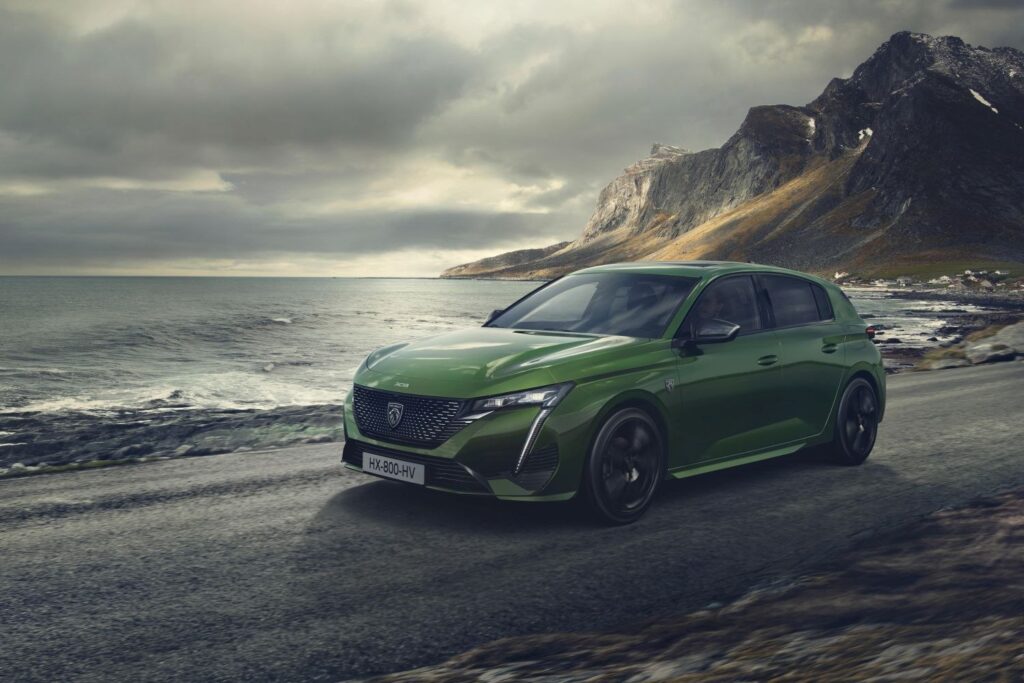
The Peugeot 308 III, launched in 2021 (Phase I), represents the third generation of Peugeot’s popular compact hatchback. Positioned within the highly competitive C-segment, the 308 aims to deliver a blend of style, technology, and efficiency. This iteration marked a significant departure from its predecessors, featuring a redesigned exterior, a completely new interior focused on i-Cockpit technology, and the introduction of electrified powertrain options. The model detailed here is the 1.2-liter (136 horsepower) Mild Hybrid e-DCS variant, a key offering in Peugeot’s strategy to broaden its appeal with fuel-efficient and lower-emission vehicles. While the 308 has historically been a strong seller in Europe, it has had limited direct sales in the United States, making it a notable example of a European-market vehicle with increasingly global technological influences.
Peugeot 308 III (Phase I): A Detailed Overview
The third-generation 308 builds upon the success of previous models, offering a more refined and technologically advanced package. The Phase I models, produced from September 2023 to March 2025, introduced a new design language for Peugeot, characterized by a more assertive front end with a frameless grille and claw-like LED daytime running lights. The interior underwent a complete overhaul, adopting Peugeot’s i-Cockpit design philosophy, featuring a compact steering wheel, a raised instrument cluster, and a central touchscreen infotainment system. The 1.2-liter Mild Hybrid e-DCS version specifically targets drivers seeking improved fuel economy and reduced emissions without the full commitment of a plug-in hybrid or fully electric vehicle.
Engine & Performance
The heart of the Peugeot 308 III 1.2 (136 Hp) Mild Hybrid e-DCS is a 1.2-liter, three-cylinder turbocharged gasoline engine (EB2LTD). This engine produces 136 horsepower at 5500 rpm and 230 Nm (169.64 lb-ft) of torque at 1750 rpm, offering a good balance of performance and efficiency. The “Mild Hybrid” designation indicates the presence of a 48-volt electrical system and a small electric motor, contributing an additional 21 horsepower and 51 Nm (37.62 lb-ft) of torque. This electric assistance primarily aids during acceleration and allows for smoother start-stop operation, improving fuel economy. The powertrain utilizes a six-speed automatic transmission (e-DCS) which is specifically tuned to work in conjunction with the mild hybrid system. Performance figures include a 0-100 km/h (0-62 mph) acceleration time of 9 seconds and a top speed electronically limited to 210 km/h (130.49 mph). The engine’s power-to-weight ratio is 10.1 kg/Hp, and the torque-to-weight ratio is 6 kg/Nm.
Design & Features
The Peugeot 308 III is a five-door hatchback, offering a practical and versatile body style. Its exterior design is characterized by sharp lines, a sloping roofline, and a modern aesthetic. The Phase I models feature distinctive LED headlights and taillights, contributing to a sophisticated appearance. Inside, the i-Cockpit design prioritizes driver engagement with its small, multi-functional steering wheel and elevated instrument panel. The central touchscreen infotainment system provides access to navigation, entertainment, and vehicle settings. Safety features are comprehensive, including ABS, electronic stability control, and a suite of driver-assistance systems. The 308 offers a comfortable and well-equipped interior, with a focus on quality materials and ergonomic design. Trunk space is a practical 412 liters (14.55 cu. ft.), expandable with the rear seats folded down. The vehicle’s dimensions are 4367 mm (171.93 in) in length, 1852 mm (72.91 in) in width, and 1441 mm (56.73 in) in height.
Technical Specifications
| Brand | Peugeot |
| Model | 308 |
| Generation | 308 III (Phase I, 2021) |
| Type (Engine) | 1.2 (136 Hp) Mild Hybrid e-DCS |
| Start of production | September, 2023 |
| End of production | March, 2025 |
| Powertrain Architecture | MHEV (Mild Hybrid Electric Vehicle) |
| Body type | Hatchback |
| Seats | 5 |
| Doors | 5 |
| Combined fuel consumption (WLTP) | 4.7-4.9 l/100 km (50 – 48 US mpg) |
| CO2 emissions (WLTP) | 106-110 g/km |
| Fuel Type | Petrol (Gasoline) |
| Acceleration 0 – 100 km/h | 9 sec |
| Acceleration 0 – 62 mph | 9 sec |
| Acceleration 0 – 60 mph | 8.6 sec |
| Maximum speed | 210 km/h (130.49 mph) |
| Emission standard | Euro 6d |
| Weight-to-power ratio | 10.1 kg/Hp |
| Weight-to-torque ratio | 6 kg/Nm |
| Gross battery capacity | 0.89 kWh |
| Battery voltage | 48 V |
| Battery technology | Lithium-ion (Li-Ion) |
| Electric motor power | 21 Hp @ 4264 rpm |
| Electric motor Torque | 51 Nm (37.62 lb.-ft.) |
| Power | 136 Hp @ 5500 rpm |
| Torque | 230 Nm @ 1750 rpm (169.64 lb.-ft. @ 1750 rpm) |
| Engine layout | Front, Transverse |
| Engine Model/Code | EB2LTD |
| Engine displacement | 1199 cm3 (73.17 cu. in.) |
| Number of cylinders | 3 |
| Engine configuration | Inline |
| Number of valves per cylinder | 4 |
| Fuel injection system | Direct injection |
| Engine oil capacity | 3.5 l (3.7 US qt | 3.08 UK qt) |
| Kerb Weight | 1375 kg (3031.36 lbs.) |
| Max. weight | 1960 kg (4321.06 lbs.) |
| Max load | 585 kg (1289.7 lbs.) |
| Trunk (boot) space – minimum | 412 l (14.55 cu. ft.) |
| Permitted trailer load with brakes (12%) | 1150 kg (2535.32 lbs.) |
| Length | 4367 mm (171.93 in.) |
| Width | 1852 mm (72.91 in.) |
| Height | 1441 mm (56.73 in.) |
| Wheelbase | 2675 mm (105.31 in.) |
| Number of gears and type of gearbox | 6 gears, automatic transmission e-DCS |
The Peugeot 308 III 1.2 Mild Hybrid e-DCS represents a significant step forward in compact car technology, offering a compelling combination of efficiency, style, and practicality. Its focus on electrification and driver-centric design positions it as a strong contender in the European C-segment, showcasing Peugeot’s commitment to innovation and sustainable mobility.