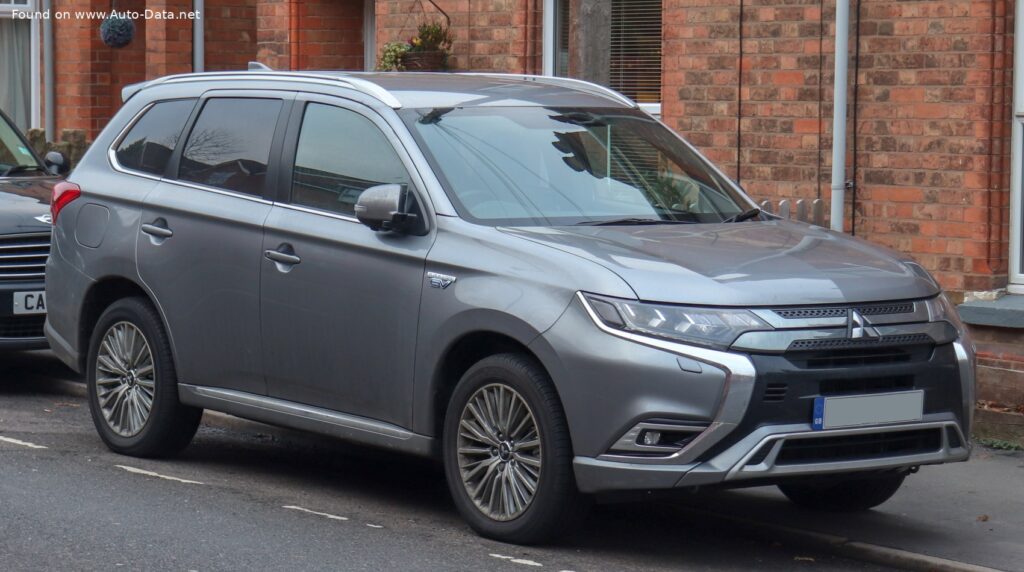
The Mitsubishi Outlander III (facelift 2018) 2.4 MIVEC (224 Hp) Plug-in Hybrid 4WD represents a significant evolution of Mitsubishi’s popular crossover SUV. Introduced in 2018 as a refresh of the third-generation Outlander, this variant focused heavily on incorporating plug-in hybrid technology to enhance fuel efficiency and reduce emissions. Primarily marketed in Europe and Asia, where demand for PHEVs was strong, the Outlander PHEV aimed to provide a practical and environmentally conscious option within the competitive Crossover SUV segment. This model was not widely sold in the United States, with Mitsubishi focusing on other models for the North American market.
Mitsubishi Outlander III (facelift 2018) Overview
The facelifted Outlander III, specifically the 2.4 MIVEC Plug-in Hybrid 4WD, distinguishes itself through its sophisticated powertrain and commitment to fuel economy. It caters to buyers seeking a versatile vehicle capable of both all-electric commuting and longer journeys with the reassurance of a gasoline engine. The vehicle’s design balances practicality with a modern aesthetic, offering seating for five passengers and a spacious cargo area. The 2018 refresh brought styling updates and improvements to the PHEV system, solidifying its position as a key model in Mitsubishi’s lineup during its production run from 2018 to 2021.
Engine & Performance
The heart of the Outlander PHEV is a 2.4-liter MIVEC inline-four gasoline engine, producing 135 horsepower at 4500 rpm and 155.63 lb-ft of torque at the same engine speed. This engine operates on a naturally aspirated cycle and is paired with two electric motors – one powering the front wheels (82 Hp, 101.05 lb-ft of torque) and another driving the rear wheels (95 Hp, 143.82 lb-ft of torque). The combined system output reaches 224 horsepower and 244.87 lb-ft of torque. This configuration allows for all-wheel drive capability and the flexibility to operate in various modes, including pure electric, series hybrid, and parallel hybrid. Acceleration from 0 to 60 mph is achieved in approximately 10 seconds, while the top speed is electronically limited to 105.63 mph. The vehicle’s powertrain architecture is a sophisticated PHEV system, utilizing a 13.8 kWh lithium-ion battery pack located under the floor to provide an all-electric range of up to 27.96 miles (WLTP) or 33.55 miles (NEDC).
Design & Features
The Mitsubishi Outlander III (facelift 2018) maintains the SUV/Crossover body style of its predecessor, offering a practical and spacious interior. The exterior design features updated front and rear styling cues, including a revised grille, headlights, and taillights. The vehicle’s dimensions are 184.84 inches in length, 70.87 inches in width, and 67.32 inches in height, with a wheelbase of 105.12 inches. Inside, the Outlander PHEV offers seating for five passengers and a versatile cargo area with a minimum capacity of 16.35 cubic feet, expandable to 56.57 cubic feet with the rear seats folded down. Key features include an electric parking brake, regenerative braking system, and various safety technologies such as ABS. The vehicle’s focus on efficiency is reflected in its aerodynamic design and lightweight materials. The interior appointments are geared towards comfort and practicality, with a focus on user-friendly controls and ample storage space.
Technical Specifications
| Brand | Mitsubishi |
| Model | Outlander |
| Generation | Outlander III (facelift 2018) |
| Type (Engine) | 2.4 MIVEC (224 Hp) Plug-in Hybrid 4WD |
| Start of production | 2018 |
| End of production | 2021 |
| Powertrain Architecture | PHEV (Plug-in Hybrid Electric Vehicle) |
| Body type | SUV, Crossover |
| Seats | 5 |
| Doors | 5 |
| Combined fuel consumption (WLTP) | 2 l/100 km (117.6 US mpg, 141.2 UK mpg, 50 km/l) |
| CO2 emissions (WLTP) | 46 g/km |
| Fuel consumption (NEDC) – combined | 1.8 l/100 km (130.7 US mpg, 156.9 UK mpg, 55.6 km/l) |
| CO2 emissions (NEDC) | 40 g/km |
| Fuel Type | Petrol / electricity |
| Acceleration 0 – 100 km/h | 10.5 sec |
| Acceleration 0 – 62 mph | 10.5 sec |
| Acceleration 0 – 60 mph | 10 sec |
| Maximum speed | 170 km/h (105.63 mph) |
| Emission standard | Euro 6d-Temp |
| Weight-to-power ratio | 8.4 kg/Hp, 119.1 Hp/tonne |
| Weight-to-torque ratio | 5.7 kg/Nm, 176.6 Nm/tonne |
| Gross battery capacity | 13.8 kWh |
| Battery voltage | 300 V |
| Battery technology | Lithium-ion (Li-Ion) |
| Battery location | Below the floor |
| All-electric range (WLTP) | 45 km (27.96 mi) |
| All-electric range (NEDC) | 54 km (33.55 mi) |
| Average Energy consumption (WLTP) | 16.9 kWh/100 km (27.2 kWh/100 mi, 124 MPGe, 5.9 km/kWh, 3.7 mi/kWh) |
| Average Energy consumption (NEDC) | 14.8 kWh/100 km (23.82 kWh/100 mi, 141 MPGe, 6.8 km/kWh, 4.2 mi/kWh) |
| Max speed (electric) | 135 km/h (83.89 mph) |
| Electric motor 1 Power | 82 Hp |
| Electric motor 1 Torque | 137 Nm (101.05 lb.-ft.) |
| Electric motor 2 Power | 95 Hp |
| Electric motor 2 Torque | 195 Nm (143.82 lb.-ft.) |
| System power | 224 Hp |
| System torque | 332 Nm (244.87 lb.-ft.) |
| Engine Power | 135 Hp @ 4500 rpm |
| Engine Torque | 211 Nm @ 4500 rpm (155.63 lb.-ft. @ 4500 rpm) |
| Engine displacement | 2360 cm3 (144.02 cu. in.) |
| Number of cylinders | 4 |
| Kerb Weight | 1880 kg (4144.69 lbs.) |
| Max. weight | 2390 kg (5269.05 lbs.) |
| Trunk (boot) space – minimum | 463 l (16.35 cu. ft.) |
| Trunk (boot) space – maximum | 1602 l (56.57 cu. ft.) |
| Fuel tank capacity | 45 l (11.89 US gal | 9.9 UK gal) |
| Length | 4695 mm (184.84 in.) |
| Width | 1800 mm (70.87 in.) |
| Height | 1710 mm (67.32 in.) |
| Wheelbase | 2670 mm (105.12 in.) |