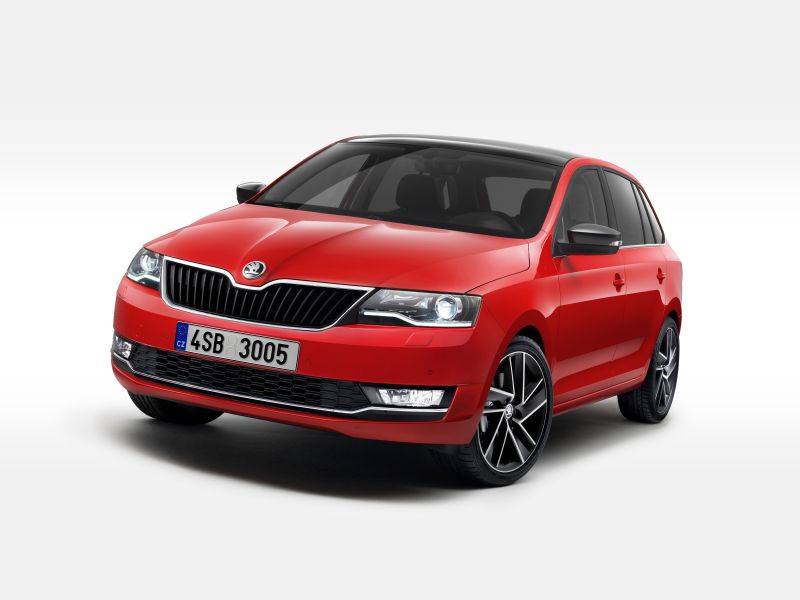
The Skoda Rapid Spaceback, particularly the facelifted version introduced in 2017, represents Skoda’s entry into the compact hatchback segment. While not officially sold in the United States, the Rapid Spaceback was a significant model for Skoda in the European market, offering a practical and affordable alternative to more established competitors. The 2017 facelift brought styling updates and revised engine options, including the 1.0 TSI engine paired with an automatic transmission, aiming to improve fuel efficiency and appeal to a broader customer base. This model focused on providing a spacious interior and a versatile cargo area within a relatively compact footprint.
Skoda Rapid Spaceback (Facelift 2017) 1.0 TSI: An Overview
The Rapid Spaceback is essentially the hatchback derivative of the Rapid sedan, designed to cater to buyers seeking a more versatile body style. The “Spaceback” designation highlights the car’s emphasis on interior space and practicality. The 2017 facelift was a crucial update, refreshing the design and introducing more modern technology. The 1.0 TSI (95 horsepower) automatic variant was positioned as an efficient and user-friendly option, appealing to urban drivers and those prioritizing fuel economy. It’s important to note that Skoda, as part of the Volkswagen Group, often shares platforms and technologies across its brands, and the Rapid Spaceback is no exception.
Engine & Performance
The heart of the 2017 Skoda Rapid Spaceback 1.0 TSI is a 999cc, three-cylinder turbocharged gasoline engine. This engine, part of Volkswagen Group’s EA211 engine family, produces 95 horsepower and 160 Nm (118 lb-ft) of torque between 1500 and 3500 rpm. The direct injection system and turbocharger contribute to a good balance of power and efficiency. Power is delivered to the front wheels via a seven-speed automatic transmission. Acceleration from 0 to 100 km/h (0-62 mph) takes 11.3 seconds, while 0 to 60 mph is achieved in approximately 10.7 seconds. The top speed is rated at 186 km/h (115.58 mph). The engine’s relatively small displacement and turbocharging contribute to a power-to-weight ratio of 12.6 kg/Hp and a torque-to-weight ratio of 7.5 kg/Nm. Fuel economy is a strong point, with combined fuel consumption rated at 4.6 l/100 km (51.1 US mpg), and CO2 emissions of 107 g/km, meeting Euro 6 emission standards.
Design & Features
The Skoda Rapid Spaceback is a five-door hatchback, offering seating for five passengers. The 2017 facelift brought subtle but noticeable changes to the exterior, including revised front and rear bumpers, a redesigned grille, and updated headlight and taillight designs. These changes aimed to give the car a more modern and refined appearance. Inside, the Spaceback prioritizes practicality and space. The rear seats can be folded down to increase cargo capacity, which ranges from 415 liters (14.66 cu ft) with the seats up to 1381 liters (48.77 cu ft) with the seats folded. Standard safety features typically included ABS (Anti-lock Braking System), and the car’s structure was designed to meet European safety standards. Other features included electric power steering, and a range of infotainment options depending on the trim level. The vehicle’s dimensions are 4304 mm (169.45 in) in length, 1706 mm (67.17 in) in width, and 1459 mm (57.44 in) in height. The wheelbase measures 2602 mm (102.44 in).
Technical Specifications
| Brand | Skoda |
| Model | Rapid Spaceback (facelift 2017) |
| Type (Engine) | 1.0 TSI (95 Hp) Automatic |
| Start of production | 2017 |
| End of production | 2019 |
| Powertrain Architecture | Internal Combustion engine |
| Body type | Hatchback |
| Seats | 5 |
| Doors | 5 |
| Fuel consumption (urban) | 5.5 l/100 km (42.8 US mpg) |
| Fuel consumption (extra urban) | 4.1 l/100 km (57.4 US mpg) |
| Fuel consumption (combined) | 4.6 l/100 km (51.1 US mpg) |
| CO2 emissions | 107 g/km |
| Fuel Type | Petrol (Gasoline) |
| Acceleration 0 – 100 km/h | 11.3 sec |
| Acceleration 0 – 62 mph | 11.3 sec |
| Acceleration 0 – 60 mph | 10.7 sec |
| Maximum speed | 186 km/h (115.58 mph) |
| Emission standard | Euro 6 |
| Weight-to-power ratio | 12.6 kg/Hp |
| Weight-to-torque ratio | 7.5 kg/Nm |
| Power | 95 Hp |
| Power per litre | 95.1 Hp/l |
| Torque | 160 Nm @ 1500-3500 rpm (118.01 lb.-ft. @ 1500-3500 rpm) |
| Engine layout | Front, Transverse |
| Engine Model/Code | EA211 / CHZB |
| Engine displacement | 999 cm3 (60.96 cu. in.) |
| Number of cylinders | 3 |
| Engine configuration | Inline |
| Cylinder Bore | 74.5 mm (2.93 in.) |
| Piston Stroke | 76.4 mm (3.01 in.) |
| Compression ratio | 10.3:1 |
| Fuel injection system | Direct injection |
| Engine aspiration | Turbocharger, Intercooler |
| Engine oil capacity | 4 l (4.23 US qt | 3.52 UK qt) |
| Coolant | 10 l (10.57 US qt | 8.8 UK qt) |
| Kerb Weight | 1199 kg (2643.34 lbs.) |
| Max. weight | 1659 kg (3657.47 lbs.) |
| Max load | 460 kg (1014.13 lbs.) |
| Trunk (boot) space – minimum | 415 l (14.66 cu. ft.) |
| Trunk (boot) space – maximum | 1381 l (48.77 cu. ft.) |
| Fuel tank capacity | 55 l (14.53 US gal | 12.1 UK gal) |
| Max. roof load | 75 kg (165.35 lbs.) |
| Permitted trailer load with brakes (12%) | 1000 kg (2204.62 lbs.) |
| Permitted trailer load without brakes | 590 kg (1300.73 lbs.) |
| Length | 4304 mm (169.45 in.) |
| Width | 1706 mm (67.17 in.) |
| Height | 1459 mm (57.44 in.) |
| Wheelbase | 2602 mm (102.44 in.) |
| Front track | 1463 mm (57.6 in.) |
| Rear (Back) track | 1500 mm (59.06 in.) |
| Minimum turning circle (turning diameter) | 10.9 m (35.76 ft.) |
| Drivetrain Architecture | Front wheel drive |
| Number of gears and type of gearbox | 7 gears, automatic transmission |
| Front brakes | Ventilated discs |
| Rear brakes | Disc |
| Tires size | 185/60 R15 |
| Wheel rims size | 6J x 15 |
The Skoda Rapid Spaceback (facelift 2017) 1.0 TSI Automatic, while not a performance car, offered a compelling package of practicality, fuel efficiency, and affordability within the European compact hatchback market. Its focus on maximizing interior space and providing a comfortable driving experience made it a popular choice for families and urban commuters.