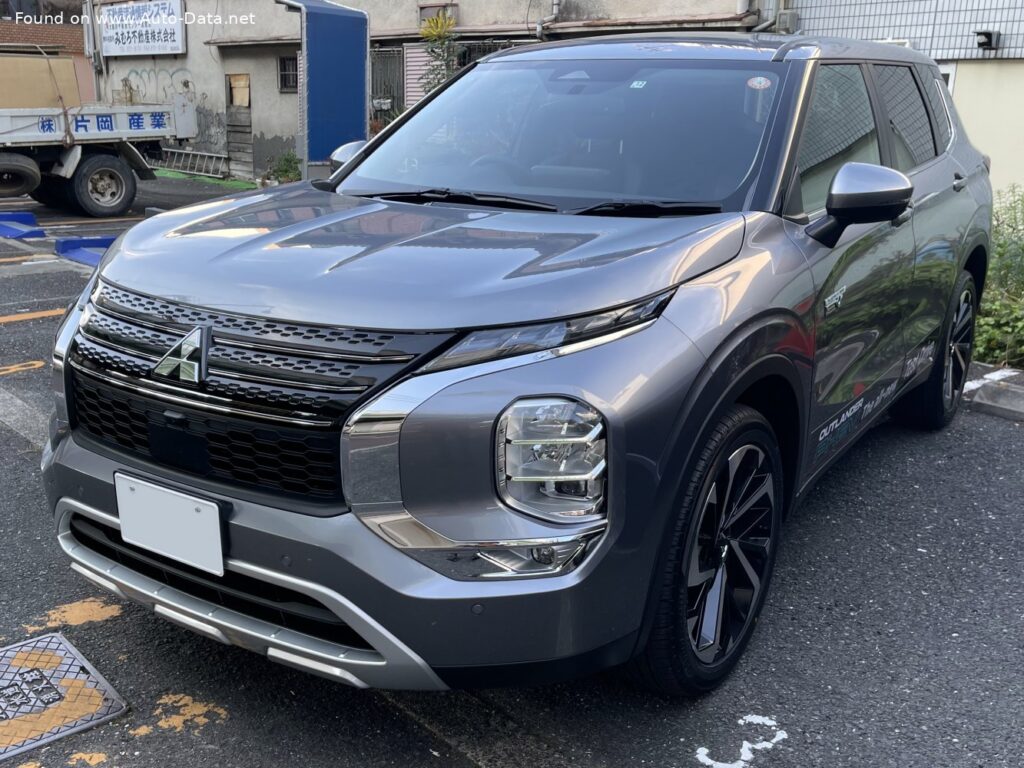
The Mitsubishi Outlander IV 2.4 MIVEC (252 Hp) Plug-in Hybrid 4WD, produced from October 2021 to December 2024, represents a significant evolution in Mitsubishi’s crossover SUV lineup. This fourth-generation Outlander, while not initially a high-volume seller in the United States, is a crucial model for Mitsubishi globally, particularly in European and Asian markets where plug-in hybrid technology enjoys greater adoption. It distinguishes itself through a sophisticated plug-in hybrid powertrain, offering a blend of gasoline engine efficiency and all-electric driving capability, packaged within a practical and spacious seven-passenger SUV.
Mitsubishi Outlander IV: A Detailed Overview
The Outlander IV builds upon the strengths of its predecessors, focusing on improved fuel economy, enhanced technology, and a more refined driving experience. It competes in the compact to mid-size crossover SUV segment, facing rivals such as the Toyota RAV4 Prime, Ford Escape Plug-In Hybrid, and Hyundai Tucson Plug-In Hybrid. The vehicle’s design incorporates Mitsubishi’s Dynamic Shield front design language, emphasizing a bold and protective aesthetic. The plug-in hybrid variant specifically targets environmentally conscious consumers seeking a versatile and efficient family vehicle.
Engine & Performance
The heart of the Outlander IV 2.4 MIVEC Plug-in Hybrid is a 2.4-liter inline-four cylinder gasoline engine (4B12 code) producing 133 horsepower at 5000 rpm and 195 Nm (143.82 lb.-ft.) of torque at 4300 rpm. This engine operates on a multi-port fuel injection system and features a double overhead camshaft (DOHC) valvetrain. However, the true complexity lies in its integration with the plug-in hybrid system. Two electric motors – one 116 Hp motor integrated with the front transmission and a 136 Hp motor driving the rear axle – work in conjunction with the gasoline engine to deliver a combined system output of 252 horsepower and 450 Nm (331.9 lb.-ft.) of torque. The powertrain architecture allows for both parallel and serial hybrid modes, optimizing efficiency based on driving conditions. The vehicle can operate in all-electric mode for up to 83-87 km (51.57 – 54.06 mi) thanks to a 20 kWh lithium-ion battery pack located under the floor. The weight-to-power ratio is 8 kg/Hp, and the weight-to-torque ratio is 4.5 kg/Nm, contributing to responsive acceleration. Power is delivered to all four wheels via a single-speed automatic transmission.
Design & Features
The Mitsubishi Outlander IV is a five-door SUV/Crossover body style, offering seating for five to seven passengers depending on the configuration. Its dimensions are 4710 mm (185.43 in.) in length, 1862 mm (73.31 in.) in width, and 1740 mm (68.5 in.) in height. The vehicle’s interior prioritizes practicality and comfort, with a focus on maximizing space for passengers and cargo. Trunk space ranges from a minimum of 485 liters (17.13 cu. ft.) to a maximum of 1478 liters (52.2 cu. ft.) with the rear seats folded down. Key features include a modern infotainment system, advanced driver-assistance systems (ADAS) such as ABS, and a comfortable ride quality. The exterior styling is characterized by Mitsubishi’s Dynamic Shield design, featuring a prominent front grille and sculpted body lines. Ride height (ground clearance) is 199 mm (7.83 in.), providing adequate capability for light off-road conditions. The vehicle’s kerb weight is 2020 kg (4453.34 lbs), with a maximum weight of 2650 kg (5842.25 lbs).
Technical Specifications
| Brand | Mitsubishi |
| Model | Outlander |
| Generation | Outlander IV |
| Type (Engine) | 2.4 MIVEC (252 Hp) Plug-in Hybrid 4WD |
| Start of production | October, 2021 |
| End of production | December, 2024 |
| Powertrain Architecture | PHEV (Plug-in Hybrid Electric Vehicle) |
| Body type | SUV, Crossover |
| Seats | 5-7 |
| Doors | 5 |
| Fuel consumption (combined) | 6-6.3 l/100 km (39.2 – 37.3 US mpg, 47.1 – 44.8 UK mpg, 16.7 – 15.9 km/l) |
| Fuel Type | Petrol / electricity |
| Weight-to-power ratio | 8 kg/Hp, 124.8 Hp/tonne |
| Weight-to-torque ratio | 4.5 kg/Nm, 222.8 Nm/tonne |
| Gross battery capacity | 20 kWh |
| Battery voltage | 350 V |
| Battery technology | Lithium-ion (Li-Ion) |
| Battery location | Below the floor |
| All-electric range | 83-87 km (51.57 – 54.06 mi) |
| Average Energy consumption | 22.7-23.9 kWh/100 km (36.53 – 38.46 kWh/100 mi, 92 – 88 MPGe, 4.4 – 4.2 km/kWh, 2.7 – 2.6 mi/kWh) |
| Electric motor 1 Power | 116 Hp |
| Electric motor 1 Torque | 255 Nm (188.08 lb.-ft.) |
| Electric motor 1 Model/Code | S91 |
| Electric motor 1 Location | Integrated into the transmission |
| Electric motor 1 Type | Synchronous |
| Electric motor 2 Power | 136 Hp |
| Electric motor 2 Torque | 195 Nm (143.82 lb.-ft.) |
| Electric motor 2 Model/Code | YA1 |
| Electric motor 2 Location | Rear axle, Transverse |
| Electric motor 2 Type | Synchronous |
| System power | 252 Hp |
| System torque | 450 Nm (331.9 lb.-ft.) |
| Engine Power | 133 Hp @ 5000 rpm |
| Engine Torque | 195 Nm @ 4300 rpm (143.82 lb.-ft. @ 4300 rpm) |
| Engine layout | Front, Transverse |
| Engine Model/Code | 4B12 |
| Engine displacement | 2360 cm3 (144.02 cu. in.) |
| Number of cylinders | 4 |
| Engine configuration | Inline |
| Cylinder Bore | 88 mm (3.46 in.) |
| Piston Stroke | 97 mm (3.82 in.) |
| Compression ratio | 11.8:1 |
| Number of valves per cylinder | 4 |
| Fuel injection system | Multi-port manifold injection |
| Engine aspiration | Naturally aspirated engine |
| Valvetrain | DOHC |
| Engine oil capacity | 4.6 l (4.86 US qt | 4.05 UK qt) |
| Coolant | 7.5 l (7.93 US qt | 6.6 UK qt) |
| Kerb Weight | 2020 kg (4453.34 lbs.) |
| Max. weight | 2650 kg (5842.25 lbs.) |
| Max load | 630 kg (1388.91 lbs.) |
| Trunk (boot) space – minimum | 485 l (17.13 cu. ft.) |
| Trunk (boot) space – maximum | 1478 l (52.2 cu. ft.) |
| Fuel tank capacity | 56 l (14.79 US gal | 12.32 UK gal) |
| Max. roof load | 80 kg (176.37 lbs.) |
| Permitted trailer load with brakes (12%) | 1600 kg (3527.4 lbs.) |
| Permitted trailer load without brakes | 750 kg (1653.47 lbs.) |
| Permitted towbar download | 160 kg (352.74 lbs.) |
| Length | 4710 mm (185.43 in.) |
| Width | 1862 mm (73.31 in.) |
| Width including mirrors | 2144 mm (84.41 in.) |
| Height | 1740 mm (68.5 in.) |
| Wheelbase | 2706 mm (106.54 in.) |
| Front track | 1593 mm (62.72 in.) |
| Rear (Back) track | 1602 mm (63.07 in.) |
| Front overhang | 979 mm (38.54 in.) |
| Rear overhang | 1025 mm (40.35 in.) |
| Ride height (ground clearance) | 199 mm (7.83 in.) |
| Minimum turning circle (turning diameter) | 11 m (36.09 ft.) |
| Drivetrain Architecture | An Internal combustion engine (ICE) drives the front wheels, one electric motor drives the front wheels, one electric motor drives the rear wheels. There is an ability for running in full electric or mixed mode. There are parallel and serial hybrid modes. |
| Drive wheel | All wheel drive (4×4) |
| Number of gears and type of gearbox | 1 gears, automatic transmission |