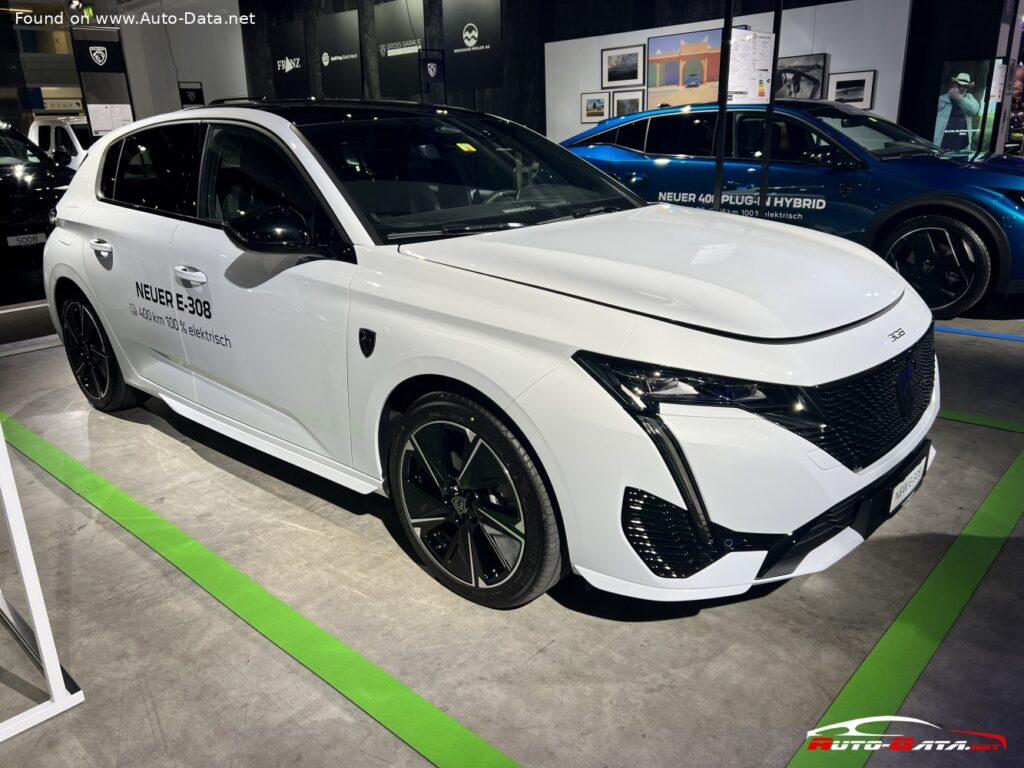
The Peugeot 308 III, launched in 2021 (Phase I), represents the third generation of Peugeot’s popular compact hatchback. Positioned within the highly competitive C-segment, the 308 aims to blend stylish design with practical functionality and, increasingly, efficient powertrain options. This iteration marked a significant step forward for Peugeot, incorporating a new design language and a greater emphasis on technology. The e-308 variant, specifically the 54 kWh model producing 156 horsepower, is a key component of Peugeot’s electrification strategy, offering a fully electric alternative to traditional internal combustion engines. Production of this specific phase ran from September 2023 to August 2025.
Peugeot 308 III e-308: An Overview
The e-308 is Peugeot’s entry into the burgeoning all-electric hatchback market. While the 308 has been a mainstay in European markets for decades, the e-308 represents a commitment to providing consumers with zero-emission vehicles. Unlike some manufacturers who initially focused on larger electric vehicles, Peugeot opted to electrify its popular C-segment offering, making electric mobility more accessible. The 54 kWh battery pack provides a competitive range and performance profile, targeting daily commutes and shorter journeys. It’s important to note that the 308, and particularly the e-308, is primarily marketed in Europe and other international markets; it was not officially sold in the United States.
Engine & Performance
The Peugeot 308 III e-308 54 kWh is powered by a single electric motor, designated ZK02, producing 156 horsepower (Hp) between 4070 and 7500 rpm, and 270 Nm (199.14 lb.-ft.) of torque. This motor is transversely mounted on the front axle, driving the front wheels. The powertrain utilizes a single-speed automatic transmission, typical of electric vehicles. Acceleration from 0 to 100 km/h (0-62 mph) takes 10.5 seconds, while 0 to 60 mph is achieved in approximately 10 seconds. The top speed is electronically limited to 170 km/h (105.63 mph). The weight-to-power ratio is 10.8 kg/Hp, and the weight-to-torque ratio is 6.2 kg/Nm, indicating a reasonably efficient power delivery. The system power and torque mirror the electric motor’s output, as there are no supplementary power sources.
Design & Features
The 308 III adopts Peugeot’s latest design language, characterized by a sharp, modern aesthetic. The body style is a traditional five-door hatchback, offering a practical and versatile layout. The e-308 retains the sleek lines of the standard 308, with subtle visual cues differentiating it as an electric model. Inside, the cabin features Peugeot’s i-Cockpit interior design, which includes a compact steering wheel and a raised instrument cluster. Key features focus on technology and safety, including a touchscreen infotainment system, advanced driver-assistance systems (ADAS) such as ABS, and a comfortable interior. The 54 kWh battery pack is located under the floor, minimizing impact on interior space. Trunk space is a respectable 412 liters (14.55 cu. ft.).
Technical Specifications
| General Information | |
| Brand | Peugeot |
| Model | 308 |
| Generation | 308 III (Phase I, 2021) |
| Type (Engine) | e-308 54 kWh (156 Hp) |
| Start of production | September, 2023 |
| End of production | August, 2025 |
| Powertrain Architecture | BEV (Electric Vehicle) |
| Body type | Hatchback |
| Seats | 5 |
| Doors | 5 |
| Performance Specs | |
| Fuel Type | Electricity |
| Acceleration 0 – 100 km/h | 10.5 sec |
| Acceleration 0 – 62 mph | 10.5 sec |
| Acceleration 0 – 60 mph | 10 sec |
| Maximum speed | 170 km/h (105.63 mph) |
| Weight-to-power ratio | 10.8 kg/Hp |
| Weight-to-torque ratio | 6.2 kg/Nm |
| Electric Car Specs | |
| Gross battery capacity | 54 kWh |
| Net (usable) battery capacity | 51 kWh |
| Battery voltage | 375 V |
| Battery technology | Lithium nickel manganese cobalt oxides (Li-NMC) |
| Battery weight | 340 kg (749.57 lbs.) |
| Battery location | Below the floor |
| All-electric range (WLTP) | 410-413 km (254.76 – 256.63 mi) |
| Average Energy consumption (WLTP) | 15-15.1 kWh/100 km |
| Dimensions & Weights | |
| Kerb Weight | 1684 kg (3712.58 lbs.) |
| Max. weight | 2110 kg (4651.75 lbs.) |
| Max load | 426 kg (939.17 lbs.) |
| Trunk (boot) space – minimum | 412 l (14.55 cu. ft.) |
| Length | 4367 mm (171.93 in.) |
| Width | 1852 mm (72.91 in.) |
| Width including mirrors | 2062 mm (81.18 in.) |
| Height | 1441 mm (56.73 in.) |
| Wheelbase | 2675 mm (105.31 in.) |
| Drivetrain & Suspension | |
| Drivetrain Architecture | One electric motor drives the front wheels. |
| Drive wheel | Front wheel drive |
| Number of gears and type of gearbox | 1 gears, automatic transmission |
| Front suspension | Independent type McPherson |
| Rear suspension | Torsion |
| Front brakes | Ventilated discs, 304 mm |
| Rear brakes | Disc, 290 mm |
| Tires size | 215/45 R18 |
| Wheel rims size | 18 |
The Peugeot 308 III e-308 54 kWh represents a significant step towards electrification for the Peugeot brand. By offering a practical and efficient all-electric hatchback, Peugeot aimed to appeal to a wider audience and contribute to a more sustainable automotive future, particularly within the European market. While not available in the US, the e-308 showcases Peugeot’s commitment to innovation and its ability to adapt to the evolving demands of the automotive industry.