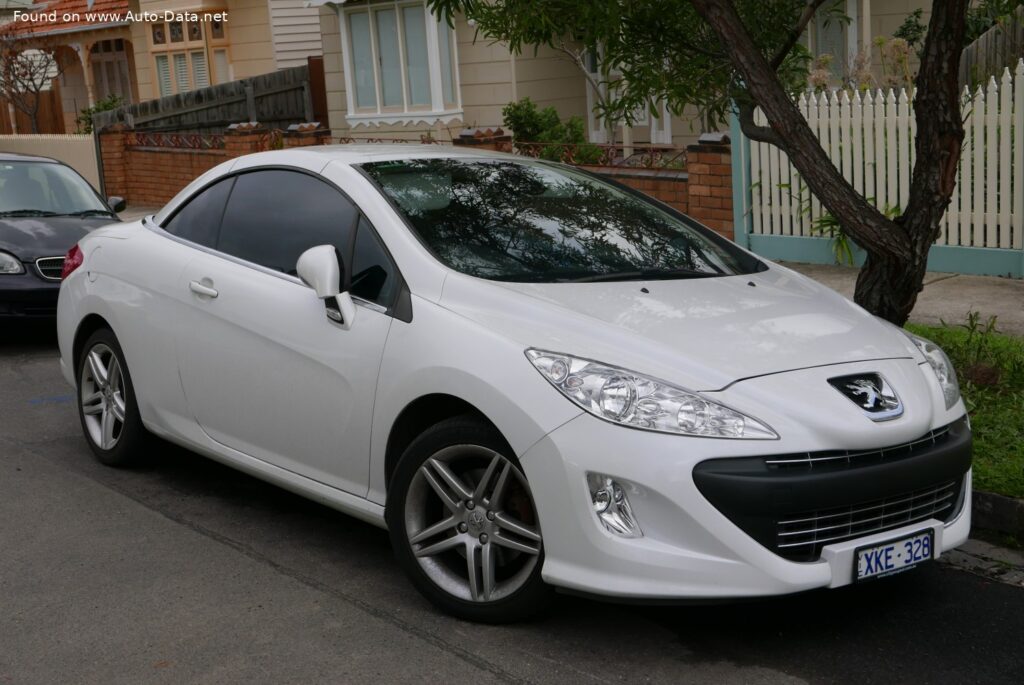
The Peugeot 308 SW I (Phase I), produced from 2010 to 2011, represents Peugeot’s entry into the competitive compact station wagon (estate) segment. As a practical and versatile vehicle, the 308 SW aimed to provide family-oriented transportation with a focus on space and usability. While not initially sold in the United States, the 308 range was a significant model for Peugeot in Europe, offering a compelling alternative to rivals like the Ford Focus Estate and Volkswagen Golf Variant. The 1.4 16V VTi variant, equipped with a 98 horsepower engine, was positioned as an economical option within the lineup.
Peugeot 308 SW I (Phase I): Overview
The first generation Peugeot 308 SW, introduced as the estate version of the 308 hatchback, expanded the model’s appeal by offering increased cargo capacity and practicality. The “SW” designation, standing for “Station Wagon,” signified Peugeot’s commitment to providing versatile vehicles for families and those requiring ample space. The Phase I models, produced between 2010 and 2011, featured a specific set of design and mechanical characteristics that defined this iteration of the 308 SW. This model was designed to appeal to European buyers seeking a blend of style, functionality, and fuel efficiency.
Engine & Performance
The 1.4 16V VTi engine powering the Peugeot 308 SW I (Phase I) is a naturally aspirated, inline-four cylinder gasoline engine. Displacing 1397 cm³ (85.25 cubic inches), it produces a maximum power output of 98 horsepower at 6000 rpm and 136 Nm (100.31 lb.-ft.) of torque at 4000 rpm. This engine, while not focused on outright performance, delivers adequate power for everyday driving. Acceleration from 0 to 100 km/h (0-62 mph) takes 13.4 seconds, while 0 to 60 mph is achieved in 12.7 seconds. The vehicle has a top speed of 182 km/h (113.09 mph). Fuel economy is rated at 6.3 liters per 100 kilometers combined (37.3 US mpg, 44.8 UK mpg), with CO2 emissions of 144 g/km, meeting Euro 5 emission standards. The engine utilizes a multi-port fuel injection system and a double overhead camshaft (DOHC) valvetrain.
Design & Features
The Peugeot 308 SW I (Phase I) is a five-door station wagon with seating for up to seven passengers, depending on the configuration. Its exterior design reflects Peugeot’s styling cues of the era, characterized by a sleek profile and a distinctive front grille. The SW body style significantly enhances practicality, offering a generous 573 liters (20.24 cubic feet) of trunk space with the rear seats up, expanding to a substantial 1736 liters (61.31 cubic feet) when the rear seats are folded down. The vehicle’s dimensions include a length of 4500 mm (177.17 inches), a width of 1815 mm (71.46 inches), and a height of 1564 mm (61.57 inches). Standard features included ABS (Anti-lock Braking System), electric power steering, and a five-speed manual transmission. The suspension utilizes an independent McPherson strut setup at the front and a coil spring torsion beam arrangement at the rear. Safety features were typical for the period, focusing on active safety systems like ABS to enhance control during braking.
Technical Specifications
| Brand | Peugeot |
| Model | 308 |
| Generation | 308 SW I (Phase I, 2008) |
| Type (Engine) | 1.4 16V VTi (98 Hp) |
| Start of production | 2010 |
| End of production | 2011 |
| Powertrain Architecture | Internal Combustion engine |
| Body type | Station wagon (estate) |
| Seats | 5-7 |
| Doors | 5 |
| Fuel consumption (urban) | 8.4 l/100 km (28 US mpg, 33.6 UK mpg, 11.9 km/l) |
| Fuel consumption (extra urban) | 5.1 l/100 km (46.1 US mpg, 55.4 UK mpg, 19.6 km/l) |
| Fuel consumption (combined) | 6.3 l/100 km (37.3 US mpg, 44.8 UK mpg, 15.9 km/l) |
| CO2 emissions | 144 g/km |
| Fuel Type | Petrol (Gasoline) |
| Acceleration 0 – 100 km/h | 13.4 sec |
| Acceleration 0 – 62 mph | 13.4 sec |
| Acceleration 0 – 60 mph | 12.7 sec |
| Maximum speed | 182 km/h (113.09 mph) |
| Emission standard | Euro 5 |
| Weight-to-power ratio | 13.8 kg/Hp, 72.4 Hp/tonne |
| Weight-to-torque ratio | 10 kg/Nm, 100.4 Nm/tonne |
| Power | 98 Hp @ 6000 rpm |
| Power per litre | 70.2 Hp/l |
| Torque | 136 Nm @ 4000 rpm (100.31 lb.-ft. @ 4000 rpm) |
| Engine layout | Front, Transverse |
| Engine Model/Code | 8FR EP3C |
| Engine displacement | 1397 cm3 (85.25 cu. in.) |
| Number of cylinders | 4 |
| Engine configuration | Inline |
| Cylinder Bore | 77 mm (3.03 in.) |
| Piston Stroke | 75 mm (2.95 in.) |
| Number of valves per cylinder | 4 |
| Fuel injection system | Multi-port manifold injection |
| Engine aspiration | Naturally aspirated engine |
| Valvetrain | DOHC |
| Engine oil capacity | 4.25 l (4.49 US qt | 3.74 UK qt) |
| Coolant | 6 l (6.34 US qt | 5.28 UK qt) |
| Kerb Weight | 1354 kg (2985.06 lbs.) |
| Max. weight | 1920 kg (4232.88 lbs.) |
| Max load | 566 kg (1247.82 lbs.) |
| Trunk (boot) space – minimum | 573 l (20.24 cu. ft.) |
| Trunk (boot) space – maximum | 1736 l (61.31 cu. ft.) |
| Fuel tank capacity | 60 l (15.85 US gal | 13.2 UK gal) |
| Max. roof load | 75 kg (165.35 lbs.) |
| Permitted trailer load with brakes (12%) | 1100 kg (2425.08 lbs.) |
| Permitted trailer load without brakes | 695 kg (1532.21 lbs.) |
| Permitted towbar download | 60 kg (132.28 lbs.) |
| Length | 4500 mm (177.17 in.) |
| Width | 1815 mm (71.46 in.) |
| Width including mirrors | 2038 mm (80.24 in.) |
| Height | 1564 mm (61.57 in.) |
| Wheelbase | 2708 mm (106.61 in.) |
| Front track | 1526-1536 mm (60.08 – 60.47 in.) |
| Rear (Back) track | 1521-1531 mm (59.88 – 60.28 in.) |
| Front overhang | 926 mm (36.46 in.) |
| Rear overhang | 866 mm (34.09 in.) |
| Minimum turning circle | 10.7 m (35.1 ft.) |
| Drivetrain Architecture | Front wheel drive |
| Number of gears and type of gearbox | 5 gears, manual transmission |
| Front suspension | Independent, type McPherson with coil spring and anti-roll bar |
| Rear suspension | Coil spring, Torsion |
| Front brakes | Ventilated discs |
| Rear brakes | Disc |
| Tires size | 195/65 R15; 205/55 R16 |
| Wheel rims size | 6.5J x 15; 7J x 16 |