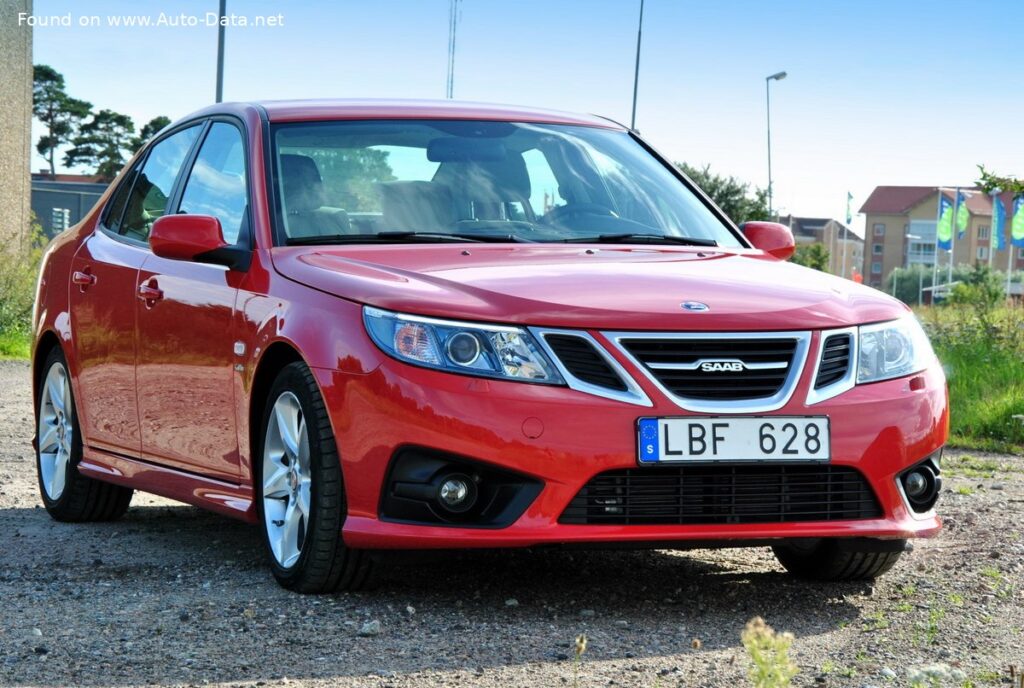
The Saab 9-3 Sedan II Griffin, specifically the 2.0t BioPower (220 Hp) XWD variant, represents a late-stage evolution of a model line that defined Saab’s commitment to Scandinavian design and innovative engineering. Produced briefly in 2011, it was the final iteration of the second-generation 9-3 before Saab’s unfortunate bankruptcy. While not widely sold in the United States due to Saab’s limited presence in the American market during this period, the 9-3 was a significant competitor in the European sports sedan segment, known for its blend of performance, safety, and distinctive styling. The “Griffin” facelift brought updated aesthetics and, in this case, a flexible-fuel powertrain capable of running on gasoline or ethanol, reflecting a growing environmental consciousness.
Saab 9-3 Sedan II Griffin: A Detailed Overview
The 9-3 Sedan II Griffin occupied a niche position as a compact executive car, competing with models like the Audi A4, BMW 3 Series, and Mercedes-Benz C-Class. However, Saab differentiated itself through its unique design language and a focus on driver-centric features. The 2.0t BioPower XWD model, in particular, aimed to deliver a compelling combination of power, efficiency, and all-weather capability thanks to its all-wheel-drive system.
Engine & Performance
At the heart of the 9-3 2.0t BioPower XWD lies a 1.998-liter (121.93 cubic inches) inline-four cylinder engine. This engine, designated A20NFT, produces 220 horsepower at 5300 rpm and 350 Nm (258.15 lb.-ft.) of torque between 2000 and 4000 rpm. The “BioPower” designation indicates the engine’s ability to run on gasoline or a blend of gasoline and ethanol (up to E85). This flexibility allowed owners to take advantage of potentially lower fuel costs and reduced emissions, depending on ethanol availability and pricing. The engine utilizes direct fuel injection and a twin-scroll turbocharger with an intercooler to maximize power and efficiency. Power is delivered to all four wheels via a six-speed manual transmission and Saab’s XWD all-wheel-drive system. This system intelligently distributes torque between the front and rear axles, enhancing traction and stability in various driving conditions. Performance figures include a 0-100 km/h (0-62 mph) acceleration time of 6.8 seconds and a 0-60 mph time of approximately 6.5 seconds, with a maximum speed of 240 km/h (149.13 mph).
Design & Features
The 9-3 Sedan II Griffin features a classic three-box sedan profile, characterized by clean lines and a relatively understated elegance. The Griffin facelift brought subtle but noticeable changes to the front fascia, including a revised grille and headlights, giving the car a more contemporary appearance. The interior prioritized functionality and driver comfort, with a focus on ergonomic design. Key features included comfortable seating for five passengers, a spacious trunk with a capacity of 461 liters (16.28 cubic feet), and a range of standard and optional equipment. Safety was a core tenet of Saab’s engineering philosophy, and the 9-3 was equipped with features such as ABS (Anti-lock Braking System) and a robust chassis designed to protect occupants in the event of a collision. The XWD system further enhanced safety by providing improved stability and control in challenging road conditions. The car’s dimensions include a length of 4668 mm (183.78 in), a width of 1762 mm (69.37 in), and a height of 1486 mm (58.5 in).
Technical Specifications
| Brand | Saab |
| Model | 9-3 |
| Generation | 9-3 Sedan II Griffin (facelift 2011) |
| Type (Engine) | 2.0t BioPower (220 Hp) XWD |
| Start of production | 2011 |
| End of production | December, 2011 |
| Powertrain Architecture | Internal Combustion engine |
| Body type | Sedan |
| Seats | 5 |
| Doors | 4 |
| Fuel consumption (urban) | 12 l/100 km (19.6 US mpg, 23.5 UK mpg, 8.3 km/l) |
| Fuel consumption (extra urban) | 6.2 l/100 km (37.9 US mpg, 45.6 UK mpg, 16.1 km/l) |
| Fuel consumption (combined) | 8.3 l/100 km (28.3 US mpg, 34 UK mpg, 12 km/l) |
| CO2 emissions | 194 g/km |
| Fuel Type | Petrol / Ethanol – E85 |
| Acceleration 0 – 100 km/h | 6.8 sec |
| Acceleration 0 – 62 mph | 6.8 sec |
| Acceleration 0 – 60 mph | 6.5 sec |
| Maximum speed | 240 km/h (149.13 mph) |
| Emission standard | Euro 5 |
| Weight-to-power ratio | 7.2 kg/Hp, 138.8 Hp/tonne |
| Weight-to-torque ratio | 4.5 kg/Nm, 220.8 Nm/tonne |
| Power | 220 Hp @ 5300 rpm |
| Power per litre | 110.1 Hp/l |
| Torque | 350 Nm @ 2000-4000 rpm (258.15 lb.-ft. @ 2000-4000 rpm) |
| Engine layout | Front, Transverse |
| Engine Model/Code | A20NFT |
| Engine displacement | 1998 cm3 (121.93 cu. in.) |
| Number of cylinders | 4 |
| Engine configuration | Inline |
| Cylinder Bore | 86 mm (3.39 in.) |
| Piston Stroke | 86 mm (3.39 in.) |
| Number of valves per cylinder | 4 |
| Fuel injection system | Direct injection |
| Engine aspiration | Twin-scroll turbo, Intercooler |
| Valvetrain | DOHC |
| Engine oil capacity | 6 l (6.34 US qt | 5.28 UK qt) |
| Coolant | 7.5 l (7.93 US qt | 6.6 UK qt) |
| Kerb Weight | 1585-1685 kg (3494.33 – 3714.79 lbs.) |
| Max. weight | 2140 kg (4717.89 lbs.) |
| Max load | 455-555 kg (1003.1 – 1223.57 lbs.) |
| Trunk (boot) space | 461 l (16.28 cu. ft.) |
| Fuel tank capacity | 61 l (16.11 US gal | 13.42 UK gal) |
| Max. roof load | 100 kg (220.46 lbs.) |
| Permitted trailer load with brakes (12%) | 1600 kg (3527.4 lbs.) |
| Permitted trailer load without brakes | 750 kg (1653.47 lbs.) |
| Length | 4668 mm (183.78 in.) |
| Width | 1762 mm (69.37 in.) |
| Width including mirrors | 2038 mm (80.24 in.) |
| Height | 1486 mm (58.5 in.) |
| Wheelbase | 2675 mm (105.31 in.) |
| Front track | 1524 mm (60 in.) |
| Rear track | 1506 mm (59.29 in.) |
| Front overhang | 1002 mm (39.45 in.) |
| Rear overhang | 991 mm (39.02 in.) |
| Drivetrain Architecture | All wheel drive (4×4). ICE drives front wheels, rear wheels driven by clutch. |
| Number of gears | 6 |
| Gearbox type | Manual transmission |
| Front suspension | Independent, McPherson with coil spring and anti-roll bar |
| Rear suspension | Independent multi-link spring suspension with stabilizer |
| Front brakes | Ventilated discs, 302 mm |
| Rear brakes | Ventilated discs, 292 mm |
| Steering type | Steering rack and pinion |
| Power steering | Electric |
| Tires size | 235/45 R17; 225/45 R18; 235/45 R18; 235/40 R19 |
| Wheel rims size | 7.5J x 17; 7.5J x 18; 8J x 19 |
The Saab 9-3 Sedan II Griffin 2.0t BioPower XWD, despite its short production run, represents a compelling example of Saab’s engineering prowess and commitment to creating unique and driver-focused vehicles. Its blend of performance, efficiency, and all-weather capability made it a desirable option for those seeking a distinctive alternative in the competitive executive sedan segment.