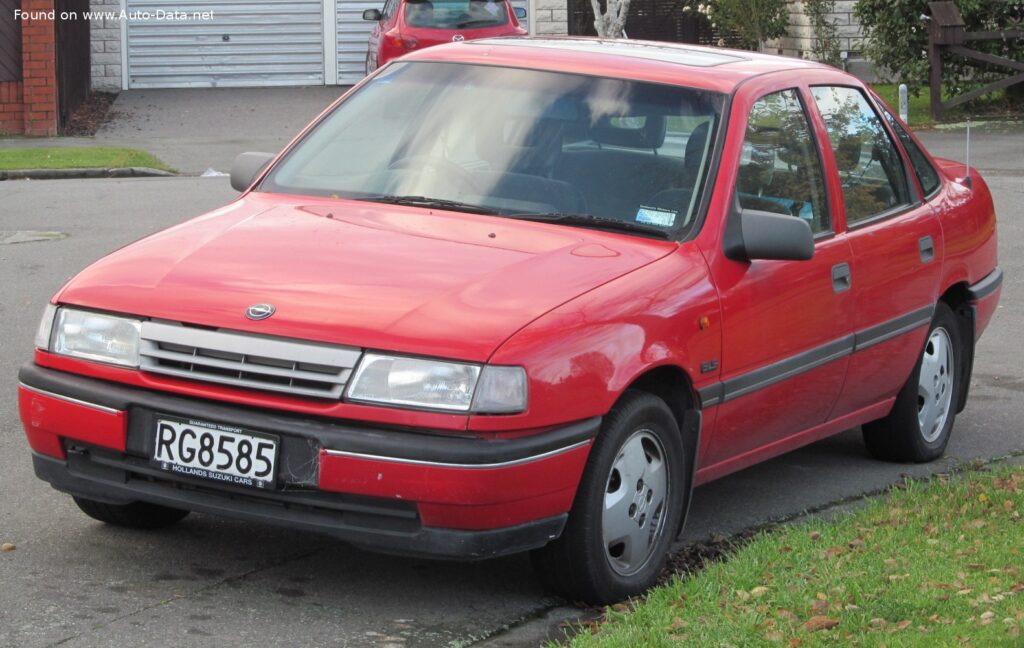
The Opel Vectra B CC 1.8i 16V, produced from October 1995 to November 1998, represents a significant evolution in Opel’s mid-size offerings. As a compact hatchback (CC denoting “Coupe Cabriolet” despite being a five-door hatchback), the Vectra B aimed to blend practicality with a more modern aesthetic than its predecessor. While not officially sold in the United States, the Vectra held a prominent position in the European market, competing with vehicles like the Ford Mondeo, Volkswagen Passat, and Peugeot 406. The “B” generation marked a substantial redesign, incorporating improved aerodynamics, safety features, and a range of more efficient engine options. This article details the specifications and characteristics of the 1.8i 16V variant, a popular choice within the Vectra B lineup.
Opel Vectra B CC 1.8i 16V: An Overview
The Vectra B CC 1.8i 16V was positioned as a mainstream, family-oriented vehicle, offering a balance between performance, fuel economy, and affordability. It was a key model in Opel’s strategy to modernize its image and appeal to a broader customer base. The 1.8-liter engine provided adequate power for everyday driving, while the hatchback body style offered increased versatility compared to traditional sedans. The Vectra B also benefited from advancements in automotive technology during the mid-1990s, including improved suspension systems and the increasing availability of safety features like Anti-lock Braking Systems (ABS).
Engine & Performance
At the heart of the Vectra B CC 1.8i 16V lies the X18XE inline four-cylinder engine, displacing 1799 cubic centimeters (109.78 cubic inches). This naturally aspirated engine produces 116 horsepower at 5400 rpm and 170 Newton-meters (125.39 lb.-ft.) of torque at 3600 rpm. The engine’s power-to-weight ratio is 90.7 horsepower per tonne, and the torque-to-weight ratio is 132.9 Nm per tonne. This powertrain configuration allows for a 0-100 km/h (0-62 mph) acceleration time of 11 seconds, and a 0-60 mph time of approximately 10.5 seconds. The vehicle achieves a maximum speed of 203 km/h (126.14 mph). Fuel consumption is rated at 11.6 liters per 100 kilometers (20.3 US mpg) in urban driving and 6.2 liters per 100 kilometers (37.9 US mpg) in extra-urban conditions. The engine utilizes a multi-port fuel injection system and a double overhead camshaft (DOHC) valvetrain, contributing to its relatively efficient operation. The engine requires 4.25 liters (4.49 US quarts) of engine oil and 7.1 liters (7.5 US quarts) of coolant.
Design & Features
The Opel Vectra B CC is a five-door hatchback, offering a practical and versatile body style. Its design represented a departure from the more angular aesthetics of previous Opel models, adopting a smoother, more aerodynamic profile. The interior provides seating for five passengers and offers a usable trunk space ranging from 480 liters (16.95 cubic feet) with the rear seats up to 790 liters (27.9 cubic feet) with the rear seats folded down. The vehicle’s dimensions are: length 4495 mm (176.97 in), width 1707 mm (67.2 in) including mirrors 1841 mm (72.48 in), and height 1425 mm (56.1 in). The wheelbase measures 2637 mm (103.82 in). Safety features for the time included ABS as standard equipment. The Vectra B also featured hydraulic power steering and a five-speed manual transmission. The vehicle’s curb weight is 1279 kg (2819.71 lbs), with a maximum permissible weight of 1790 kg (3946.27 lbs) and a maximum load capacity of 511 kg (1126.56 lbs). The vehicle rides on 15-inch wheel rims with tire size 195/65 R15.
Technical Specifications
| Brand | Opel |
| Model | Vectra |
| Generation | Vectra B CC |
| Type (Engine) | 1.8i 16V (116 Hp) |
| Start of production | October, 1995 |
| End of production | November, 1998 |
| Powertrain Architecture | Internal Combustion engine |
| Body type | Hatchback |
| Seats | 5 |
| Doors | 5 |
| Fuel consumption (urban) | 11.6 l/100 km (20.3 US mpg) |
| Fuel consumption (extra urban) | 6.2 l/100 km (37.9 US mpg) |
| Fuel Type | Petrol (Gasoline) |
| Acceleration 0 – 100 km/h | 11 sec |
| Acceleration 0 – 62 mph | 11 sec |
| Acceleration 0 – 60 mph | 10.5 sec |
| Maximum speed | 203 km/h (126.14 mph) |
| Weight-to-power ratio | 11 kg/Hp |
| Weight-to-torque ratio | 7.5 kg/Nm |
| Power | 116 Hp @ 5400 rpm |
| Torque | 170 Nm @ 3600 rpm (125.39 lb.-ft. @ 3600 rpm) |
| Engine layout | Front, Transverse |
| Engine Model/Code | X18XE |
| Engine displacement | 1799 cm3 (109.78 cu. in.) |
| Number of cylinders | 4 |
| Engine configuration | Inline |
| Cylinder Bore | 81.6 mm (3.21 in.) |
| Piston Stroke | 86 mm (3.39 in.) |
| Compression ratio | 10.8:1 |
| Number of valves per cylinder | 4 |
| Fuel injection system | Multi-port manifold injection |
| Engine aspiration | Naturally aspirated |
| Valvetrain | DOHC |
| Engine oil capacity | 4.25 l (4.49 US qt | 3.74 UK qt) |
| Coolant capacity | 7.1 l (7.5 US qt | 6.25 UK qt) |
| Kerb Weight | 1279 kg (2819.71 lbs.) |
| Max. weight | 1790 kg (3946.27 lbs.) |
| Max load | 511 kg (1126.56 lbs.) |
| Trunk (boot) space – minimum | 480 l (16.95 cu. ft.) |
| Trunk (boot) space – maximum | 790 l (27.9 cu. ft.) |
| Fuel tank capacity | 60 l (15.85 US gal | 13.2 UK gal) |
| Length | 4495 mm (176.97 in.) |
| Width | 1707 mm (67.2 in.) |
| Width including mirrors | 1841 mm (72.48 in.) |
| Height | 1425 mm (56.1 in.) |
| Wheelbase | 2637 mm (103.82 in.) |
| Front track | 1484 mm (58.43 in.) |
| Rear track | 1487 mm (58.54 in.) |
| Drivetrain | Front wheel drive |
| Number of gears | 5 |
| Gearbox type | Manual transmission |
| Front suspension | Coil spring |
| Rear suspension | Coil spring |
| Front brakes | Ventilated discs |
| Rear brakes | Disc |
| Assisting systems | ABS (Anti-lock braking system) |
| Steering type | Steering rack and pinion |
| Power steering | Hydraulic |
| Tires size | 195/65 R15 |
| Wheel rims size | 15 |
The Opel Vectra B CC 1.8i 16V, while not a performance icon, offered a solid and reliable transportation solution for European families in the late 1990s. Its blend of practicality, reasonable performance, and improving safety features cemented its position as a popular choice in a competitive market segment.