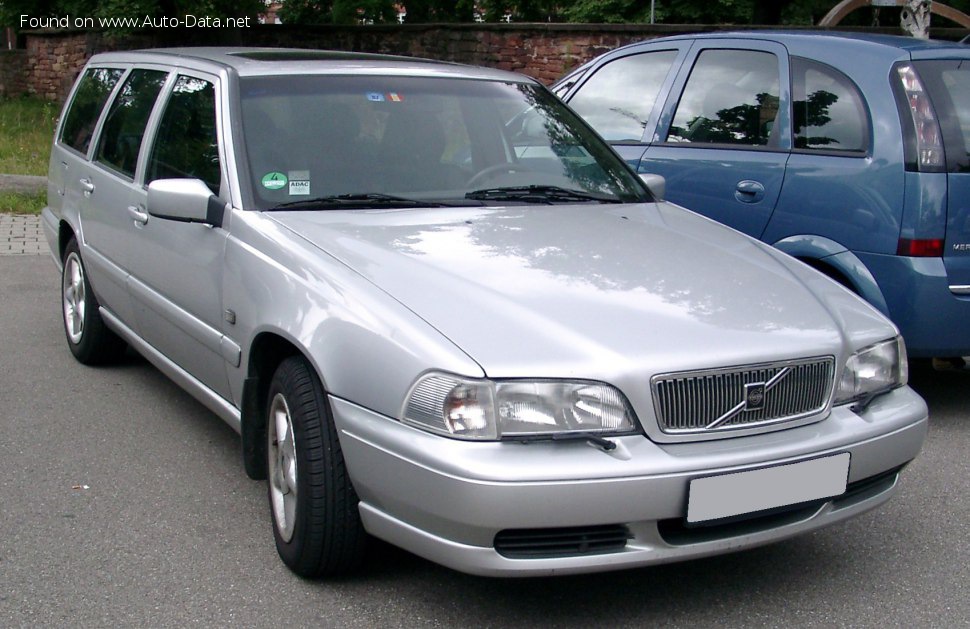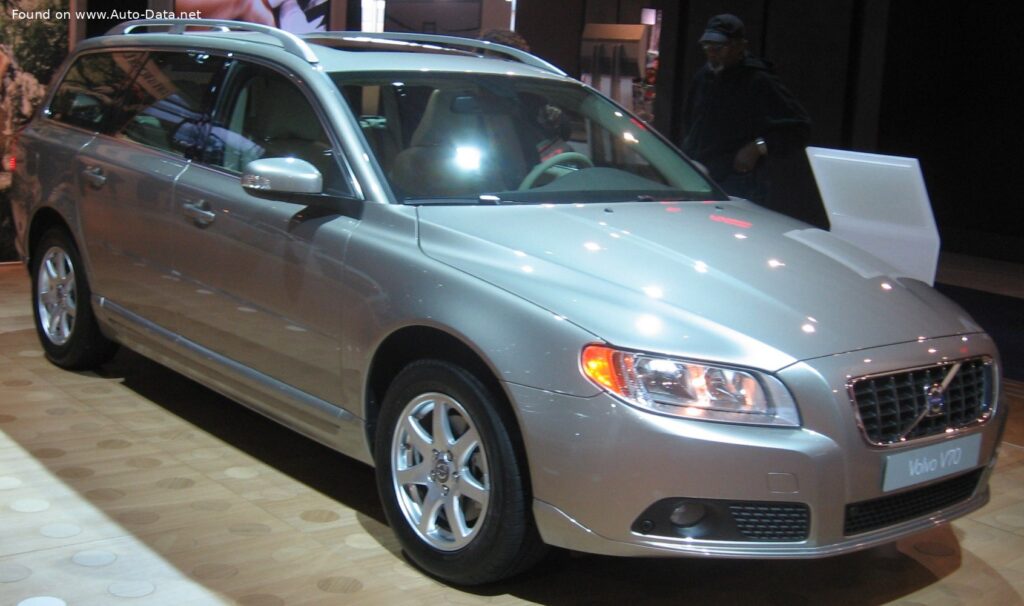
The Volvo V70 III 2.5 T (231 Hp) Automatic, produced between 2009 and 2010, represents the third generation of Volvo’s popular station wagon. Positioned within the mid-size executive car segment, the V70 aimed to combine practicality, safety, and Scandinavian design with a focus on comfortable long-distance travel. While not officially sold in the United States during this generation, the V70 was a significant model in Europe, competing with vehicles like the Audi A6 Avant, BMW 5 Series Touring, and Mercedes-Benz E-Class Estate. This iteration built upon the established V70 reputation, offering a refined driving experience and a spacious interior suitable for families and those requiring substantial cargo capacity.
Volvo V70 III 2.5 T: Overview and Market Position
The V70 III, launched in 2007, was based on the Volvo P24 platform, shared with the S80 sedan and XC70 crossover. The 2.5 T variant, equipped with a turbocharged five-cylinder engine and a six-speed automatic transmission, was a popular choice, offering a balance between performance and fuel efficiency. Volvo’s commitment to safety remained a core value, and the V70 III incorporated numerous advanced safety features for its time. The model’s design emphasized clean lines and a sophisticated aesthetic, reflecting Volvo’s Scandinavian heritage. The V70’s primary market was Europe, where station wagons maintained a strong following, but it was also sold in select markets like Australia and parts of Asia.
Engine & Performance
The heart of the V70 III 2.5 T is a 2.5-liter inline five-cylinder turbocharged gasoline engine, designated the B5254T10. This engine produces 231 horsepower at 4800 rpm and 340 Nm (250.77 lb.-ft.) of torque between 1700 and 4800 rpm. The turbocharger and intercooler work in tandem to deliver responsive acceleration and ample power across a broad rev range. Power per liter is rated at 91.6 hp/l. The engine is transversely mounted at the front of the vehicle and paired with a six-speed automatic transmission, providing smooth and efficient gear changes. Performance figures include a 0-100 km/h (0-62 mph) acceleration time of 7.9 seconds and a 0-60 mph time of approximately 7.5 seconds. The V70 III 2.5 T achieves a maximum speed of 210 km/h (130.49 mph). The weight-to-power ratio is 6.9 kg/Hp, and the weight-to-torque ratio is 4.7 kg/Nm.
Design & Features
The Volvo V70 III is a five-door, five-seat station wagon (estate) characterized by its elegant and understated design. Its long roofline and spacious interior provide exceptional cargo capacity, with a minimum trunk volume of 575 liters (20.31 cu. ft.). The vehicle’s dimensions are 4823 mm (189.88 in.) in length, 1861 mm (73.27 in.) in width, and 1547 mm (60.91 in.) in height. The wheelbase measures 2816 mm (110.87 in.). Key features include independent suspension – McPherson struts at the front and a multi-link setup at the rear – providing a comfortable ride and stable handling. Safety features, a Volvo hallmark, include ABS (Anti-lock Braking System) and a robust body structure designed to protect occupants in the event of a collision. The V70 III also offered features such as power steering (hydraulic), ventilated front disc brakes, and disc brakes on the rear axle. The drag coefficient is rated at 0.31, contributing to improved fuel efficiency and reduced wind noise.
Technical Specifications
| Brand | Volvo |
| Model | V70 |
| Generation | V70 III |
| Type (Engine) | 2.5 T (231 Hp) Automatic |
| Start of production | 2009 |
| End of production | 2010 |
| Powertrain Architecture | Internal Combustion engine |
| Body type | Station wagon (estate) |
| Seats | 5 |
| Doors | 5 |
| Fuel consumption (urban) | 14.2 l/100 km (16.6 US mpg, 19.9 UK mpg, 7 km/l) |
| Fuel consumption (extra urban) | 7.1 l/100 km (33.1 US mpg, 39.8 UK mpg, 14.1 km/l) |
| Fuel consumption (combined) | 9.7 l/100 km (24.2 US mpg, 29.1 UK mpg, 10.3 km/l) |
| CO2 emissions | 232 g/km |
| Fuel Type | Petrol (Gasoline) |
| Acceleration 0 – 100 km/h | 7.9 sec |
| Acceleration 0 – 62 mph | 7.9 sec |
| Acceleration 0 – 60 mph | 7.5 sec |
| Maximum speed | 210 km/h (130.49 mph) |
| Power | 231 Hp @ 4800 rpm |
| Torque | 340 Nm @ 1700-4800 rpm (250.77 lb.-ft. @ 1700-4800 rpm) |
| Maximum engine speed | 6500 rpm |
| Engine layout | Front, Transverse |
| Engine Model/Code | B5254T10 |
| Engine displacement | 2521 cm3 (153.84 cu. in.) |
| Number of cylinders | 5 |
| Engine configuration | Inline |
| Cylinder Bore | 83 mm (3.27 in.) |
| Piston Stroke | 93.2 mm (3.67 in.) |
| Compression ratio | 9:1 |
| Number of valves per cylinder | 4 |
| Fuel injection system | Multi-port manifold injection |
| Engine aspiration | Turbocharger, Intercooler |
| Valvetrain | DOHC |
| Engine oil capacity | 5.5 l (5.81 US qt | 4.84 UK qt) |
| Coolant | 9 l (9.51 US qt | 7.92 UK qt) |
| Kerb Weight | 1592 kg (3509.76 lbs.) |
| Max. weight | 2280 kg (5026.54 lbs.) |
| Max load | 688 kg (1516.78 lbs.) |
| Trunk (boot) space – minimum | 575 l (20.31 cu. ft.) |
| Fuel tank capacity | 70 l (18.49 US gal | 15.4 UK gal) |
| Max. roof load | 100 kg (220.46 lbs.) |
| Permitted trailer load with brakes (12%) | 1800 kg (3968.32 lbs.) |
| Permitted trailer load without brakes | 750 kg (1653.47 lbs.) |
| Length | 4823 mm (189.88 in.) |
| Width | 1861 mm (73.27 in.) |
| Width with mirrors folded | 1907 mm (75.08 in.) |
| Width including mirrors | 2106 mm (82.91 in.) |
| Height | 1547 mm (60.91 in.) |
| Wheelbase | 2816 mm (110.87 in.) |
| Front track | 1588 mm (62.52 in.) |
| Rear (Back) track | 1586 mm (62.44 in.) |
| Ride height (ground clearance) | 151 mm (5.94 in.) |
| Drag coefficient (Cd) | 0.31 |
| Minimum turning circle (turning diameter) | 11.7 m (38.39 ft.) |
| Drive wheel | Front wheel drive |
| Number of gears and type of gearbox | 6 gears, automatic transmission |
| Front suspension | Independent, type McPherson with coil spring and anti-roll bar |
| Rear suspension | Independent multi-link spring suspension with stabilizer |
| Front brakes | Ventilated discs |
| Rear brakes | Disc |
| Tires size | 225/55 R16 |
| Wheel rims size | 7J x 16 |
The Volvo V70 III 2.5 T Automatic offered a compelling package for buyers seeking a practical, safe, and comfortable station wagon. Its blend of performance, efficiency, and Scandinavian design ensured its continued popularity in the European market during its production run.